Rss

Watching Pro Basketball In Unreal Time: NBA Finals, Game 2!

[Two-minute read]

Just home from a gathering of the friends, and now I get to fire up the National Basketball Association Finals. It’s the Knicks, it’s the Spurs, it’s  game 2. Game 1 was my second time watching during this playoff run – wait, is that right? – well, in any case, I am trying to limit the amount of time I devote to the watching of televised sport. I do pretty well for a pathological devotee of hockey, baseball, football and basketball on the ‘boob tube’. (Does anybody still call it that? Haven’t heard that expression this century, I do believe.) Not much hockey or baseball anymore, except when the Blue Jays, or I guess any Canadian-based NHL club (thanks, and sorry, Oilers!), make their Big Dance. Football is mainly just the Super Bowl now. Freedom!

My SportsNet feed keeps trying to take me ahead to Spurs-up-7, but I’m gonna watch the whole thing. Okay, I fast-forwarded through the anthem. (Rather attractive young lady, but I’ve heard enough “Banners”; I can hear my sports-centric big sister grumbling about the big pride-of-America hoopla.) And hey, the guy San Antonio had to introduce the Knicks seemed like he was heavily sedated, but for the Spurs, suddenly he was on caffeine, amphetamines and who knows what.

Man, the hype. The game never gets old, but man, the crazed intensity – so much of it performative and rehearsed and amplified, having to outdo the manic fans of days of yore (like, say, way back in March for the Madness) – gotta say, it just, y’know, seems like a lot.

So yeah, I’m watching the NBA. On a sort of television: my laptop screen. (But EVERYTHING IS TELEVISION. If we thought Neil Postman’s Amusing Ourselves to Death was out of date, consider how our screen addictions have only deepened and multiplied.) And you get to read, Not Quite Live But Surely Of Surpassing and Profound Interest, my random thoughts. Blessings! And peace be upon you and your mind. Further instalments to come. TONIGHT.

[This has been lightly edited since last night; a couple of brief elaborations. Parts Two and Three can be found in the “It’s All About Sports!” section of this site, here and here.]

Ursula K. Le Guin (on the alleged decline of reading)

[6-minute read]

One of her mightiest novels, but she wrote *everything*.

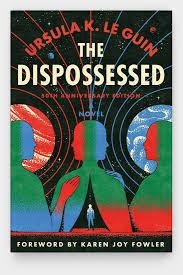
Ursula Le Guin is a hero of mine and, though often labeled as a ‘genre writer’, she is a giant of 20th century American literature. Her series of so-called “young adult” fantasy novels, beginning with A Wizard of Earthsea, were the first Le Guin books that I read. I recently finished The Dispossessed, a remarkable invocation of an extra-planetary society built on the principles of Anarchism, for a book club. (I’d read it before; I loved it again.) I’m midway through a fascinating, diverse non-fiction collection of hers, called Dancing at the Edge of the World. I was lucky enough to see her in conversation before an audience that packed an otherwise underused Anglican cathedral at the Ottawa Writers Festival in 2009. I cannot un-hear, from that electric evening, what her fiction so regularly upheld: her rejection of the trope, so common in speculative fiction (and Westerns, and comic books), of what she called “redemptive violence”. For her, this was an especially ugly non sequitur, a strikingly vulgar contradiction in terms. She radiated intelligence. Wisdom. There was someone to listen to.

Not long before this downright reverent reception at Christchurch Cathedral, in February 2008, Harper’s magazine had published her essay “Staying Awake: Notes on the alleged decline of reading”. I keep a photocopy of it. It anchors a school notebook where I keep irregular tabs on my own reading. “Staying Awake” begins: “Some people lament the disappearance of the spotted owl from our forests; others sport bumper stickers boasting that they eat fried spotted owls. It appears that books, too, are a threatened species…” and she goes on to cite both alarmed and shoulder-shrugging so what? reactions to the “alleged decline”. In the essay, she challenges mass-media’s sometimes gleeful response to surveys indicating that we read less, especially in book form. She takes the publishing industry to task with “amused contempt”; she is deliciously snarky as she bites the corporate hands that (carelessly) feed her craft. She analyzes historical and contemporary trends in literacy and what it means, and has meant, to our culture.

Most importantly, though, she centres her argument on what the act of reading actually is, and what it does with our minds. And what is a book, exactly? But wait. Before quoting the Le Guin perspective that brings us together here in electronic communion, please allow a short side trip. (If you jump ahead to read Ursula, who’s going to know? And how could I complain?)

So here’s a personal, but also amazingly planetary, narrative tangent. It’s all about BOOKS.

An abundance of good luck – and a massive adolescent absence of caution – has meant that I have hovered at the margins of the worldwide Bahá’í community for a long while now. This has meant several sweet things. I have a taste and an ongoing hunger for Persian food; the 19th-century foundation of the Faith in what is now Iran means that I’ve come to understand and love many Persian things and people! I have also known two hopeful and fruitful marriages to believers, the second of which is alive and well, and the first of which is now remembered with fondness and gratitude. I guess I could mention, too, that my worldview has been constantly expanded, enriched, interrogated and confirmed; the globe’s move toward unity and peace and justice is inevitable.

That’s the kind of mindset you can sustain if you hang around with the Bahá’í teachings  and those that seek to apply them. So, lucky me!

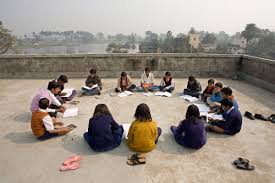
Literacy, learning, society-building in action. Where in the world?

Now, speaking of “the alleged decline of reading” mentioned by the great Ursula K., the Bahá’í community reads like crazy! The ancient references to the “people of the Book”, applied notably (and approvingly) by the Qur’an to Jews and Christians, also pertains to the followers of Muhammad themselves. In the Faith of Bahá’u’lláh, reverence for these and other holy scriptures is deepened by adding a whole modern canon of the Word. “In the beginning was the Word,” says the New Testament (John 1:1), to which I dare to add this: the Word has remained alive, and been renewed, and shall ever continue as the foundation of human progress and comprehension. That’s my take on the Bahá’í take on the power of the Word.

The Bahá’ís, too, are “people of the Book” in their high regard for the sacred teachings and writings of the major world Faiths, as well as the traditional wisdom of Indigenous peoples. It is not some passive, token respect for holy writings. They actually read them. For example, faithful believers are asked to read from the Faith’s writings twice a day; not for long, necessarily, but as part of their spiritual hygiene. What’s more, the worldwide community has adopted, as one of its core activities – all of which are open to the wider public – a series of “study circles” that enhance one’s understanding and application of the Bahá’í principles. (Check ‘em out: truth, justice, love – the old faithfuls – as well as the essential oneness of humanity, the equality of women and men, the fundamental harmony of science and religion, and the eradication of all forms of prejudice and oppression. Yup. Astounding stuff.)

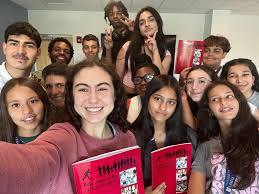
These young’uns are from Boston, could’ve been my town or yours.

The initial sequence of courses has titles like “Reflections on the Life of the Spirit”, “Arising to Serve”, and “Releasing the Powers of Junior Youth”. For the Baha’is and their friends, though, in-group shorthand just calls them Book 1, Book 2, and Book 5. (People of the Books!) And you’ll find such study circles, if you look a bit, just about everywhere in the world. They work. Learning happens, habits build, trust is established. And more: the act of reading, and of education generally, is celebrated and valorized in the most grassroots way. I’ve seen photos from all over the world — what happens when a study circle is complete? In a most charming and counter-cultural tradition, the group will have a photo taken, smiling friends holding up their red or yellow or green manuals. They might be saying, with their grins, We love our books! It’s been great to study and learn together! We even memorize certain passages! We are learning to not only read the Word but to read the reality of our place and time, and we find great hope in our shared community-building. How’s that for enthusiasm for the importance of the written word?

Thanks for staying with me! And now, back to Ms. Le Guin, for one of the clearest and most emphatic arguments for the power of the word (not to mention The Word) that I have read.

“At about the two-thirds mark in her essay, Le Guin acknowledges the variety of ‘entertainment media’ available to the modern data-consumer; after all, “the Internet offers everything to everybody: but…there is curiously little aesthetic satisfaction to be got from [it].” And then she gets to the heart of the matter; here is why reading matters SO MUCH to so many of us:

Reading. Trees.
(Public Domain)

“…[R]eaders aren’t viewers; they recognize their pleasure as different from that of being entertained. Once you’ve pressed the on button, the TV goes on, and on, and on, and all you have to do is sit and stare. But reading is active, an act of attention, of absorbed alertness—not all that different from hunting, in fact, or from gathering. In its silence, a book is a challenge: it can’t lull you with surging music or deafen you with screeching laugh tracks or fire gunshots in your living room; you have to listen to it in your head. A book won’t move your eyes for you the way images on a screen do. It won’t move your mind unless you give it your mind, or your heart unless you put your heart in it. It won’t do the work for you. To read a story well is to follow it, to act it, to feel it, to become it—everything short of writing it, in fact. Reading is not ‘interactive’ with a set of rules or options, as games are; reading is actual collaboration with the writer’s mind. No wonder not everybody is up to it.

“The book itself is a curious artifact, not showy in its technology but complex and extremely efficient: a really neat little device, compact, often very pleasant to look at and handle, that can last decades, even centuries. It doesn’t have to be plugged in, activated, or performed by a machine; all it needs is light, a human eye, and a human mind. It is not one of a kind, and it is not ephemeral. It lasts. It is reliable. If a book told you something when you were fifteen, it will tell it to you again when you’re fifty, though you may understand it so differently that it seems you’re reading a whole new book.

“This is crucial, the fact that a book is a thing, physically there, durable, indefinitely reusable, an object of value.

“…[Meanwhile] [e]lectrons are as evanescent as thoughts. History begins with the written word. Much of civilization now relies on the durability of the bound book—its capacity for keeping memory in solid, physical form. The continuous existence of books is a great part of our continuity as an intelligent species. We know it: we see their willed destruction as an ultimate barbarism. The burning of the Library of Alexandria has been mourned for two thousand years, as people may well remember the desecration and destruction of the great Library in Baghdad [during the 2003 Iraq war]…”

[Italicized emphasis in the quote above is mine, not Le Guin’s. Read the whole essay here.]

Tilting at Track ‘n’ Field

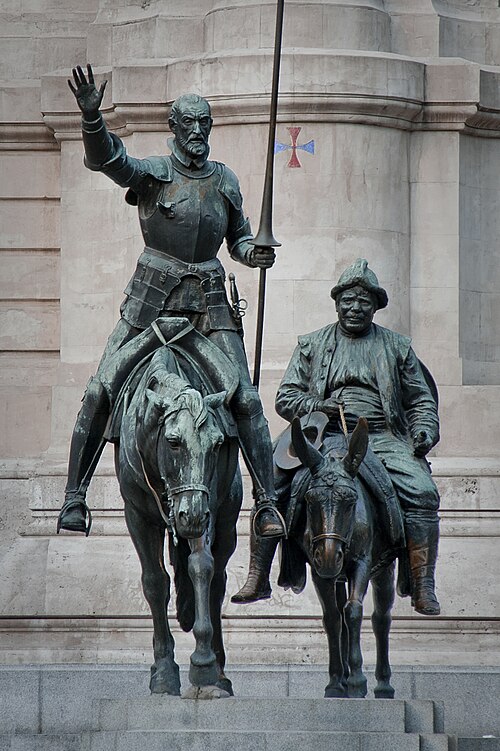
The Don and his loyal sidekick, Sancho Panza. (Where is my Sancho?) They seek great deeds, and charge against windmills… (from Wikipedia)

[4-minute read]
[This was originally posted on May 27/26 under the “It’s All About Sports!” rubric.]

I really must read Don Quixote. Many say it’s the first great novel in Western Literature, written in Spain while Shakespeare ruled English theatre. Early 17th-century work of genius, fully titled The Ingenious Gentleman Don Quixote of La Mancha, by Miguel de Cervantes. Maybe you’ve heard of it. I’m amazed I’ve never gotten ‘round to it. And no, this isn’t English class, and yes, we WILL be talking about sports. Metaphor alert! Hang on tight now!

(Look, never mind my career as a high school English teacher and alleged lit-wit. Ignore the pretensions, the haunting of Writers Festivals (pre-eminently my Ottawa local) and poetry-adjacent mooning (and jooning) and my long affection for being among readers even less accomplished than me. (Hello, Room 2011! Hello, ENG 3A1!) Pretend, you and I, that we barely notice all the faux-brave resolutions and horse-wishes about finding myself, thorough-going small-town balls-for-brains that I was and remain, in the art of writing, and maybe even finding the artist in me. Yeah, Don Quixote is a substantial hole in my reading resume, and likely yours, too. Call yourself a READER? Et cetera.)

But even that cliché shame doesn’t quite cover it, since I know myself to be more than a little “quixotic, i.e., /kwɪkˈsɒtɪk/, defined by Merriam-Webster as the foolishly impractical pursuit of ideals, typically marked by rash and lofty romanticism” (Wikipedia). Furthermore the expression “tilting at windmills describes an act of attacking imaginary enemies (or an act of extreme idealism), [which] derives from an iconic scene in the book.” (This was also Wikipedia.) Don Quixote was so buzzed out on his reading of romances that he charged into noble battle against, yes, windmills, which he mistook for the kind of fearsome monsters that noble knights slew and saved the day in books. Rash romanticism? Extreme idealism? Me? Heck, I spent the bulk of my professional life as a high school teacher in a couple of southern Ontario towns. I loved baseball and hockey, football and basketball, and have long coached the latter as if world peace and climate justice depended on it, as I like to say. Is that the biography of a crazy idealist undertaking missions ridiculous?

‘Fraid so. I have charged, on an overloaded donkey, sporting a rusty sword and a lance not much longer than my left arm, numerous windmills of my fevered athletic imagination. (Ask Cap’n Gord about my vision of new lights, a large grandstand and the hundreds-nay-thousands watching the Mount Hope A’s play Senior Men’s fastball. I played shortstop, batted leadoff, wasn’t bad, but in my mind was headed for the Olympics in a sport the IOC barely considered.) (Ask Coach Donny, who shared – though less scarred by ‘rash and lofty romanticism’ – my vision of challenging the great high school hoops teams of Toronto from the banks of the Grand River in a small hockey-mad town. I played the role of a less accomplished Chip Hilton turning into a Coach John Wooden Of The Western Niagara Peninsula. But we never quite made it to small-school provincials.)

The most recent evidence of this quixotic strain, this passion for the unlikely, comes at a French Catholic high school where I find myself coaching, deep into retirement from teaching, a junior varsity basketball team. I’m in a good-sized city this time, working alongside a fine young coach, but again as if world peace…etc. (And as if my remaining hair was on fire.) I still love it. Kids get fine things from it. I feel useful and engaged. And for a couple of years now, realizing how much high school ballers would benefit from such cross-training, a Phys. Ed. teacher and I have tried to develop a track ‘n’ field program, une équipe d’Athlètisme.  

I must be nuts. Another windmill? A big-city championship in school basketball, in a time when AAU clubs and alleged “prep schools” are ascendant, isn’t improbable enough?

I convinced, Mighty Persuader that I am, two of my kids (and not ONE varsity ballplayer) to make their fairly half-arse efforts at being tracksters. They weren’t really feeling it. But still I fell, rookie coach and raging romantic fool that I am, in athletic love with a group of new kids who initially came out for my back-hall Speed’n’Power training in March. Not gonna lie, as the kiddies say: it was such a pleasure to get to know and coach a number of girls, mostly in grades 9 and 10, who are regularly more pleasant and grateful and funny than their male peers. Some of the school’s best athletes made occasional appearances, wanting to get a few days off school for this year’s more ambitious slate of meets. Times went down and measurements rose.

Still, unlike Don Q, the “man of La Mancha”, reality does eventually register with me. Few kids were able to sustain much commitment to this new adventure of building a track and field team. “Coach, I train on my own for my soccer (or football, or hockey, or basketball, or improv) team…” As coaches, we tip-toed in setting expectations; predictably, most showed up for the bare minimum of events and, after a month, for way less than that. Sheesh, we had two kids take a pair of days off school for the City of Ottawa championship meet without having been to ANY of the previous ten practices. Good athletes, nice kids. Not my idea of team- and culture-building. Reality bites. Dreams grow mouldy.

The tabs of my laptop are littered with videos on the arm mechanics of hurdlers and the footwork of triple-jumpers; meanwhile, our school has a cruddy gravel track, no starting blocks, the most embarrassingly cobbled-together imitation hurdles, and one weedy jumping pit. But never fear! I see provincial championships and NCAA scholarships and genuinely strong and fit basketball boys in our future. Well, I did sustain that dream for a month or so. Athlètisme might even have a lower social media Q-score than hoops in my city, but there’s this: the best track and field athletes in Ottawa were all at the City championship meet. The best of them are members of the Ottawa Lions TFC, and are FAR out in front of the field. I’ve picked out a handful of names to watch for in future Olympics. And hey, we did have two athletes, admittedly inexperienced but in non-marquis events, win Novice (girls javelin) and Junior (boys 300m hurdles) titles. Eight more kids qualified top-five to go to Regionals tomorrow and Friday. (So did I!)

But as the chief coach, acknowledging my excellent general knowledge about track and field (Olympic Games quadrennial appointment television!) and my rudimentary technical skills in teaching events I never participated in, I can’t help reflecting that this “team” practised substantially less often and far less hard than my middle of the road JV basketball team. Still, I habitually think, Okay, it’s a start. We’re building something that could be meaningful, that kids would care about for more than just a barely-earned day (or six!) off school. From tiny acorns mighty oaks do grow. If you build it, they will come. And so on.

Right this minute, I’m not convinced. The kids sure aren’t buying it! I don’t like admitting defeat, but the alternative feels suspiciously like slaying monsters that don’t exist.

Windmills, man oh man. Windmills.

He Said/She Said: Bill Bryson (and Sarah Selecky) (on WONDER)

[3-minute read]

There’s a writing coach around whose e-bay window I occasionally lurk. She’s always pretty and smiling, or pensively curled up with notebook and pen. She entices me to write more, and more satisfyingly and more deeply, and to link up with other scribblers. Her messages sometimes inspire in a general way, they encourage without fail, though they may be too jasmine-scented, too chamomile and meditative and soft for me. (I sometimes write with Jeff Beck or The Propellerheads blazing in the background.) Perhaps I just resist for the sake of loonie-pinching resistance, carrying on in my own solitary way. Still, she has me wondering, and doing math about it…

Sarah’s recent e-blandishment was to join a virtual writing community that has a new emphasis each month. May’s is Wonder. She writes, “In their great new book, How to Design a Meaningful Life, Dave Evans and Bill Burnett share their wonder equation. Here it is:

curiosity + mystery = wonder.

When you know the equation, you see that wonder is always available. It’s a choice. You can find it in ordinary things, once you start looking. An apple, when you really think about it, is completely unfathomable…”

This image comes from Amazon, but please buy from an independent bookseller!

I wonder why and what?! and how?! and who was she in high school? and when will it be?… and I’m off to the races. We all are, when our curiosity isn’t strangled by routine or petty distractions — not to mention that my reflexive question is this: do these slim answer machines that we’re leashed to actually stunt or misdirect our engagement with life’s questions? My big sister loves her iPhone, and quick-drew it on me last weekend more than once to respond to my idlest who won/when’s the next game? queries with an encyclopedic recitation. Fair’s fair: I did ask, but there was precious little mystery attached to my bland microdose of curiosity. My question about smartphones stands, though I do admit that smartphones and the algorithms that fuel their constant use really can (he argues hypothetically, but without much conviction) prompt profound and useful investigations of mysteries more lofty than can you believe what this cat/these guys just did? 

But I wonder, I do, how much and how often this kind of outsourced thinking encourages genuine curiosity about truly mysterious things. They are more likely, in my experience, to excite thoughtless engagement with banal and repetitive images, without a single idea in sight. I wonder.

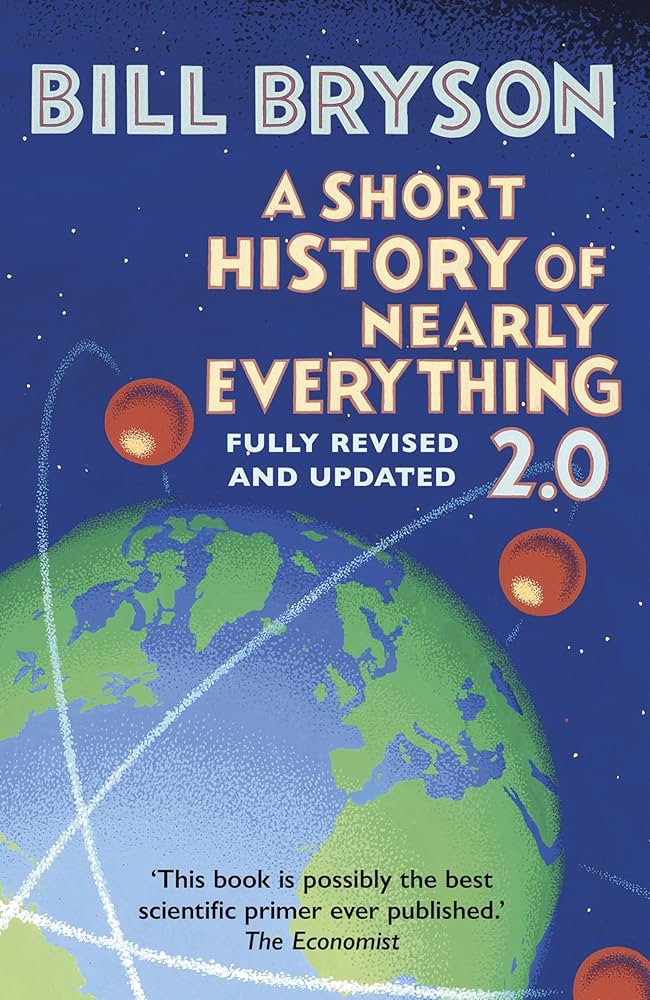
Now, according to my notes, the force-of-authorial-nature Bill Bryson was on my Sunday Magazine CBC wireless radio as 2025 wound down. (Vacuum tubes, static fuzz-hiss, carefully calibrating the dial so I could listen while shovelling coal into the furnace.) (Okay, no, the CBC still lives in modernity; I mostly listen to its shows as podcasts on my iPhone. Driving. Walking. Or in this case, I believe the Mother Corp soothed and informed me while I loaded the dishwasher.) Bryson is mainly known for writing rich and funny travel books – Notes From a Small Island (England) and A Sunburnt Country (Australia), for only two best-selling examples – but I especially liked his 2003 departure, A Short History of Nearly Everything. It was an avowed non-scientist’s gigantically ambitious attempt to write the story of scientific discovery from the ancients to the 21st century. For the first two years of my family’s five-year unplan in northeastern China, nightly readings of Sciencey Bill Bryson composed my young son’s science curriculum. (When Dad’s an English teacher, you come to expect science as an exercise in storytelling, and what an amazing work of narrative non-fiction it was!)

And is, still and again and even more so! Bryson was interviewing with Magazine host Piya Chattopadhyay about his 2025 complete revision and

Bryson in 2020 (from The Guardian, a fine news site).

update: A Short History of Nearly Everything 2.0. (This, despite his 2020 “retirement” from writing at age 68, as delightfully chronicled in The Guardian.) It was a tasty, engaging conversation, chock full of fun and fascination and – yes, I did remember where I was headed with this! — wonder. Piya wanted to know, after all these books and the over 20 years that had elapsed between original publication and this renewed re-telling of the greatest (and latest) adventures in scientific discovery: what feeds Bill Bryson’s curiosity? What makes the wonder mill keep on grinding?

I loved his answer. He’s a humorist by nature, but a relentlessly thoughtful and wonderfully wise one. He said,

“Here we are….We have this very short window of existence. Before we existed, there was this great eternity that we didn’t take part in, and when we die eternity will go on….But in between, there is this moment where we have the exhilarating privilege to exist. And I think it’s such a shame that we take it all for granted.”

So here’s the math: add Bill Bryson’s furious, curious desire to understand to the vast slowly revealed mysteries of the universe? The sum total is WONDER. Reverence. Amazement. And he moved me to want MORE.

Jim Rohn (on discipline and regret)

[3-minute read]

I had never heard of Mr. Rohn until years after his passing. It appears he was one of that prototypical tribe of American salesmen – “born poor, a millionaire by 30, broke by 33, etc.…” – who come to prominence in their quest to make influence, personal development and individual psychology into an alternative faith tradition. I don’t mean to trash the field entirely. After all, I am a Psych grad and a frequent consumer of PD content; Tony Robbins and I have gone a few rounds, and I learned some useful things. Jim Rohn wrote many books, with titles like The Power of Ambition, Take Charge of Your Life, and The Day That Turns Your Life Around. He inspired the Chicken Soup guys (Hansen and Canfield) as well as Master Robbins. So, that’s coaching. That’s influence, and I can think of a pile of so-called “influencers” who are far less valuable than what Mr. Rohn’s body of personal development work appears to offer.

So. Here’s the Rohn quote that brings me here.

“Everyone must choose one of two pains: the pain of discipline or the pain of regret.”

It’s pithy and blunt, and it got me one day back in 2025. I don’t remember, but it probably came from a basketball coach’s email subscription. Now, let’s talk about an out-of-context quote! It’s the kind of thing, my research tells me (though I might have guessed it), that you can order from Amazon in kitschy suitable for framing on fridge magnets form, but I haven’t been able to find what book it appeared in. On Reddit forums and Facebook pages, it often comes accompanied by the reminder that “discipline weighs ounces, but regrets weigh a ton”. I don’t know how much of his life pitch I would buy, but since I stumbled on THIS one, long after Jim Rohn had passed beyond this vale of human development, I haven’t been able to kick it out of my way. That’ll be useful for my players, I told myself. (Of course I did!) I do love coaching, from basketball to poetry, but recently I have challenged myself anew to accept coaching — and to reconsider my own levels of discipline and regret.

Coach Creede, meanwhile, has accepted the challenges that come from working with an egotistical writer, teacher and coach who has been accused of that worst of sporting crimes: being uncoachable. (That would be me.) Like Apollo (Rocky’s boxing frenemy), this Creede is beginning to punch through my phalanx of weaponized bad habits, mindset disorders, alleged neurodiversity and gigantic appetites for distraction. She asks Those Questions, simultaneously wonderfully encouraging and also barbed. Before long, I found myself making promises that I often don’t keep when I only make them to myself.

The pain of discipline? It’s real. It’s hard to put a lock on the doors of whimsy and impulse. This teacher and mighty slow learner is only too aware: push yourself away from the table, sir, or you’ll still be carrying extra kilos around without a wheelbarrow; if you don’t manufacture time for your writing, ol’ buddy, it’s unlikely to just fall into your crumb-laden lap!

HOWEVER. You’ve all heard this bold statement: I live my life without regrets! So say many contemporary influencers, entertainers and sports stars. It seems foolish to me. Juvenile. While I’m all for throwing off the slimy burdens of useless guilt and chronic self-loathing, it seems to me that people who claim to live without regrets just aren’t reflecting sufficiently on their lives. (Unless they’re psychopaths.) We are meant to take stock of our lives, and decide what is worthy of us and what we should leave behind. Certainly, for me, it’s the reality of various forms of regret that encourages me to stiffen feeble habits, that reinforces my general desire for a more disciplined sort of life.

Is that too old-fashioned for you? Don’t be afraid to comment below, or to share these thoughts with folks who might value them.

Thanks for reading, friends.

Going All *Gregorian* (though not necessarily in a timely fashion)

[And lo, he wrote a poem about OldNew Years and promises of scribbling. And a Happy 2026, headlines notwithstanding, to you!]
[2-minute read]

Going All Gregorian

And I said, Lo, this is an ancient and decrepit choreography for the

Changing of the Temporal Guard,

With attenuated powers of renewal and jangly echoes fading along

consumptive corridors of materialist advancement and

post-hangover promises.

Ridiculous spot for a “New Year”.

And yet it has been a new and Sunday sort of Day

And I’ve been thinking that even a busted, rusted tabula rasa

still offers that shopworn but still clean-enough board of

resolution.

(And resolution came into my language* to express a bringing-into-focus

of things seen darkly, as with camera or dialled-in microscope

of the kind I never used very well in the biology labs of yore)

(* in which your humble scribe lays claim to English)

So I’ll dig a little every day, using Seamus Heaney’s brand of shovel,

not worrying (much) about the impossibility of spading up

soil as rich as that Irish hero spelunked and spelled out.

I am deskside, armed with twentieth century penmanship and apparently

writing a POEM fergawdsake!

Although, reading Heaney aside, that was never the plan for this First Day

But I will X-marks-the-spot each day in January until the calendar scoffs.

And listen: this hardly hurt at all.

Retrofitting a Fancy

“I was an educator of some sort,” began my scribbling about a recent dream.

(This was also true to life. What “sort”, then? This sort: high school; English Creature; one for whom Dead Poet’s Society probably meant too much; taught like world peace depended upon my chalk-stained energy; raced to the gym many an after-school day; teacher-coach; regularly heart-broken but deeply committed, happy and perhaps absurdly proud to be so. “Uncle Jay,” a niece who had been with me in Room 2011 once wrote, “is, um, colourful.” Unlike my sons, she didn’t have to deal with me on the basketball court. And the ghost is still in the machine. I continue to haunt the corridors and the hardwood of Endless High School. “I guess that this must be the place…” (Talking Heads) One of my places, that’s sure.)

I was an educator of some sort, wandering through tight spaces in a huge, high vault of a warehouse. I couldn’t get out, or get where I needed to go, and was also frustrated that I couldn’t escape the dream itself. Moments of am I dreaming here? alternated with me writing on various found surfaces and random papers, here and there, so I wouldn’t forget what I was seeing. And then I’d forget where I left my urgent records. But I was amazed by all I saw in that enormous, high-walled building: old dictionaries, reams of stationery and computer equipment, redundant textbooks, tables, racks and shelves of building materials, fossil remains of art. There were a few rancid corners, but mostly it was filled with odd and dusty and stolidly interesting things. It went on and on. Does anybody realize that all this is still here? I had to get the word out, that all the old-school material — steel and wood and paper and thought — in this building, not to mention the real estate it sat on, had to be worth a LOT. It should at least be recycled and/or sold off! I made notes, lost them, wrote others.

All this STUFF! All this SPACE! Somebody should KNOW about all this! I gotta get this written down (AGAIN!) before I lose or forget it (again!)!

I went for a walk that morning, shared a few choice words with the sun and sky, cocked my head at a certain point and knew, without thinking hard or directly, what that dream was trying to tell me. (Most of the time, I find my dreams are just stacks of frustration dripping with a slurry of random events-from-the-day. I don’t expect revelation, or even meaning. But I’ll take it when I can get it.)

Ha! It was a Writing Dream!

Let’s say the storage area was my life and mind, my understanding, maybe even my imagination. Let’s say that, despite my distrust of my capacity for mysticism, I’m not above looking for signs and portents!

***

All this is a long way of saying that I’m having another kick at the Can. The Writing Can, the I-can Can. A.T. helped me resuscitate this old repository of my stuff. I’m spraying Lock De-Icer on my fingers, and sprinkling hopefulness on my spirit. You’re reading a wee result. Thanks for reading.


[I have also dumped, *just* over there in the “It’s All About Sports!” section, a lengthy essay on basketball coaching. It’s a ‘State of the Disunion’ address, slightly different versions of which I’ve been trying to share with coaches in my region, the wider basketball community, and anybody who can tolerate (or venerate) the idea that sport and education can “share the same space for a minute or two”, as the mighty David Byrne used to sing.]

Canada Day: It’s Complicated

[5-minute read]

Eh? What’s that? Time to put on red ‘n’ white clothes and fly the maple leaf flag on our barren flagpole?

Maybe so! Lady Laughter and I did finally slide our narrower (and much nimbler)  son out of our bedroom window in early May to take down the tattered flag that barely survived the winter. It was a drapeau of Earth, one of those photos-from-space of our little blue planet, and it had come to be a horrible reminder of the war-torn regions and generally fraying tapestry of the human world’s tentative movements toward oneness. While I do think that we obsess, in an unseemly and hugely discouraging way, about our destructive tendencies – sudden, violent, other-making, spectacular – and that a little more dwelling on the pleasant things of life – construction, kindness, vision, unity – would do us enormous bunches of good, that disintegrating rag of blue and green was a WAY too obvious metaphor. And to take the symbolism farther: we didn’t have a new Earth banner to put up, either.

And we totalled our car, got the gardens underway, dealt with contractors, listened to podcasts, and many other lively pursuits. My bride, it should be said, is a working person, while my retirement has me even less tethered to timelines that don’t involve high school hoops. June came. Events occurred. And then we went east. (Quebec, New Brunswick, Prince Edward Island, Nova Scotia, Maine, Quebec. It was lovely, thanks!)

We got back to Ottawa, car-worn and happy, on June 30. I woke up to Canada Day, none too early, and remembered that we did have a Canuck flag tucked away in a drawer. We haven’t flown it for a while, certainly not since a convoy of “freedom”-seeking protesters tied our city in knots for a while back there. For most of my life, Olympics aside, my fellow Canadians and I have not been big on flag-waving. Even our recent afternoon drive from Bar Harbor, Maine to the Quebec border, which is predominantly middle o’ nowhere forest, was notable for how much more likely American homes, businesses and every second telephone pole in the woods were to fly the stars and bars. Such conspicuous and rampant patriotism doesn’t suit us; at least, it doesn’t suit me.

However, a time came when disgruntled, irritated, peevish and me-first (me-only) Canadians took to flying our flag from trucks (alongside various iterations of “F— Trudeau!” and “government SUCKS, ‘cuz, like, vaccines and taxes and shit!” and you’re not the boss of ME! signs) and cars, making the humble red-and-white Maple Leaf suddenly a signal of rejection, it seemed to me, of the traditional Canadian virtues. Peace. Fairness. Good government. Order. The common good. Loyalty. A sense of proportion. Politeness. And, since the ‘70s or so, ethnic diversity has also become our very good friend, at least the idea of it. We used to call it multiculturalism, and some folks still do; unity in diversity is even better.

It bugged me that I felt unable to fly the red ‘n’ white because of what I uncharitably thought of as its (mis)appropriation as the flag of selfish yahoos. Mind you, even before the notorious “trucker convoy” protests, I had reservations. I wasn’t eager to be more jingoistic, in the American “my country right or wrong” vein. I was increasingly aware of associations that flag-flying might have for, say, Indigenous peoples or Black Canadians. Many citizens seek greater truth-telling. Many call for reconciliation between the undoubted pride and good fortune that most of us feel to be Canadian, and the unquestionably unjust choices that our country and its Eurocentric majority peoples have too often made. Beyond that, I have long been working to nourish the mindset, and the accompanying lifestyle and actions, of a global citizen. You know, trying to see all humanity as one family, that not-so-old idea.      

So, it’s been a few years since the Maple Leaf flew from our second floor pole, but Happy Canada Day anyway! Eh? And yes, despite his even more rampant youthful discomfort with The Whole Canada Thing, my lanky son was out on the roof again earlier today to do his father’s diffident bidding. There’s a red maple leaf, about 4′ x 6′ (and no, I don’t know what that is in metres!) waving outside my window once again. There’s a part of me that feels I should be lettering a bedroom-window disclaimer of all the things that we *don’t* mean in letting our not-so-freaky flag fly. I may yet.

In the meantime, we don’t use the Leaf to signify any of these things. 1. An undying loyalty to the red-and-white of the Liberal Party of Canada. (I vote, but partisan politics is all the more obviously the divisive force that I have long believed it is. In this and other degrading ways, we’re getting more like the Americans.1) 2. A belligerent antagonism toward the Liberal Party of Canada. (Ditto.) 3. A resentment of paying taxes. (I am often impressed, despite bloat and inefficiency, by the services our governments provide, education and health care and snow removal and so much more, for just about everybody.) 4. Some petulant desire to have our country be the more male-dominated and white-skinned place that it used to be. (I intend no self-hatred when I say that unipolar ethnicity and mouldy conceptions of masculinity can be boring, to say nothing of the hateful and retrogressive extremisms they can produce.) 5. A bitter rejection of broader loyalties, and signs of a planetary order. (What, you’d prefer planetary disorder?! The Guardian of the Bahá’í international community called all to a greater consciousness of the oneness of humanity, but also affirmed the value of “a sane and intelligent patriotism”, in which affection for one’s country was no impediment to loving the world.) So no, none of that.   

  1 And just to be clear: there are all kinds of ways in which Americans are marvellous. (Never forget.)

It’s my country’s national day, and there’s still lots to be grateful for. Canada still stands for worthwhile things, and it is composed of magnificent and favoured geography and a tonne of mainly beneficent folk. It’s my country, and I’ll party if I want to. Still, I probably won’t join the masses on Parliament Hill for the concerts, the boozy downtown celebrations, or gaze in childlike wonder at the fireworks displays, as magnificent as they will no doubt be. Some of that’s just being an older dude, and some of it is not really being much good at celebration in general. Maybe I’ll read an Alice Munro short story, or crack open J.R. Saul’s A Fair Country: Telling Truths About Canada (2008), a way of thinking about my place in the world, one that I’d like to understand better. Let’s make reading great again!

But then again, our garden needs some attention, and cutting grass is a way of “standing on guard”, I suppose. I foresee a long walk along local streets, after all our tramping about down East. There will be more than the usual frequency of friendly nods and waves. And I’ll maybe buy myself an ice cream sundae, because Canada Day comes but once a year…  

Bertrand Russell (on not being so damned SURE all the time…)

[4-minute read]

“…The best lack all conviction while the worst / Are full of passionate intensity…”

W.B. Yeats, Irish poet, “The Second Coming” (1919)

(Surprise BONUS! You came for some Bertrand Russell, but this is a ROGO post! (Read One Get One, free!) William Butler Yeats was an Irish contemporary of Russell, the British thinker, and this fragment from an epic poem is a fine companion to what I have to say about what Mr. Russell had to say about doubt. All set?)

There were no philosophy courses in my undergraduate career. I barely squeezed in an English Lit survey course, and only after graduation did I add more English and even a history course. Meanwhile, if I had known myself better, I would have majored in English with Psych, History and Philosophy on the side – which is a long-winded and self-referential way of saying that I’ve never read Bertrand Russell at length.

Yes, it’s an example of what dear old Mr. Hill once wrote on one of my high school assignments – “this is the evil of Bartlett’s” – when he recognized my random and promiscuous leafing through Bartlett’s Familiar Quotations instead of reading anything in full and in depth. The great English philosopher, activist and ultimately one of our greatest advocates of global peace? He remains known to me mainly through a quotation here or there, most recently in a study guide to The Promise of World Peace, an epic 1985 open letter from the Bahá’í community’s leaders to “the peoples of the world”. Bertrand Russell was one of the most profound and respected voices of the 20th-century movement for international peace, long before it became a popular cause in the late 1960s and ’70s. Here, though, I am referring to his thinking about the value of doubt, of a scientific and skeptical cast of mind.

(So yes: Once again, I am Actually Am doing this! I am chiding myself (and you!) for settling for little scraps of wisdom from Bertrand Russell (and many others!), even as I add another entry to my He Said / She Said quotation mill. I do try to source the quotations, and track down whether S/He did in fact say it. I do put it in context, if in no other way than to offer insights into how this particular mind – that is, mine – dances around and tries to understand the words of others. Back to What HE Said…)

Below is a chunk of Bertrand Russell’s thought from 1922. He was 50, famous and at his peak though he would remain a vital intellectual force well into the 1960s. Alongside his public advocacy for peace, he was a noted apologist for the philosophy of skepticism (he wrote a book-length collection of essays on the subject, and would have been, ahem, rather “sceptical” about the way that Canadians tend to spell it now). For Russell, it was not some bitter unwillingness to believe anything, but rather an attempt to use our minds to seek truth via reason, through some approximation of the systematic investigations performed by scientists. He would have agreed with Yeats’s criticism, above, of the skewed and toxic certainty of people who adopt their beliefs unthinkingly, via emotional selfishness and tribalism. (See: “My country, right or wrong!”) Russell would not have accepted so easily that doubtfulness, the willingness to consider all sides of an issue, and indeed scientific thinking in general, are examples of the poet’s reference to good folk who “lack all conviction”. Russell took stands, acted on his convictions, often paid the price of widespread criticism, and wasn’t afraid to challenge publicly an idea that he had earlier championed.

But he was firmly convinced of the value of doubt. This is all the more medicinal in our times of deep fakes, distrust of authority, idiocy widely adopted and higher education routinely scorned. He wanted us to consider the relativity of truth, and its changing nature, but without giving up on the search for what is real and true:

None of our beliefs are quite true; all have at least a penumbra of vagueness and error. The methods of increasing the degree of truth in our beliefs are well known; they consist in hearing all sides, trying to ascertain all the relevant facts, controlling our own bias by discussion with people who have the opposite bias, and cultivating a readiness to discard any hypothesis which has proved inadequate. These methods are practised in science, and have built up the body of scientific knowledge. Every man of science whose outlook is truly scientific is ready to admit that what passes for scientific knowledge at the moment is sure to require correction with the progress of discovery; nevertheless, it is near enough to the truth to serve for most practical purposes, though not for all. In science, where alone something approximating to genuine knowledge is to be found, men’s attitude is tentative and full of doubt.

Bertrand Russell, in the Conway Memorial Lecture, March 24, 1922 “Free Thought and Official Propaganda”

I disagree with his conviction that science is the only route to true knowledge. He was a fearless critic of unthinking, barnacle-encrusted religious dogma, and good for him, though he may have thrown out the baby of genuine wisdom with the cold and sludgy bathwater of bigotry and superstition. But what good medicine against prejudice and foolishness if we could adopt that opening mantra None of our beliefs are quite true…


Alexei Navalny (on NOT GIVING UP)

[2-minute read]

Alexei Navalny died in February. I’m sure somebody knows why and how, but the great WE doesn’t. It is not impossible that nothing acutely nefarious happened in his Russian prison four months back. Maybe his body had just had enough after the earlier poisoning and years spent on the run or in jail. But there is no doubt that, aged 47, he had sacrificed not only his freedom but his life to oppose injustice and to offer hope to the despairing. His death should be remembered. I learned more about him after he left us, and his words and example still work on me.

This is dramatically capsulized in his “final words” to Russian compatriots in the event of his death; they close the Oscar-winning 2022 documentary film Navalny, which chronicles what the dissident lawyer had come to understand following his nearly miraculous recovery from an obviously sinister poisoning in 2020. He is about to return to near-certain imprisonment or even death in his mother country. His interviewer asks him what, in the event of his demise, he would want to say to his fellow Russians. His answer is powerfully simple.

“NOT GIVE UP.” He speaks quietly to the camera, but something in his eyes had me writing it in capital letters. That is his message.

Of course, the film-maker wants more, and Alexei Navalny provides it. He includes a well-known saying, often unattributed or wrongly so¹, but it feels true coming from him. In so doing, he leaves for his countrymen, and for anyone and all peoples facing apparently overwhelming oppression – and hey, even for a Canadian Bahá’í-guy basketball coach with a comfy life and a scribbling itch – these quietly defiant words:

“I have something very obvious to tell you. You’re not allowed to give up. If they decide to kill me, it means that we are incredibly strong. We need to utilize this power, to not give up, to remember we are a huge power that is being oppressed by these bad dudes.

“We don’t realize how strong we actually are.

“The only thing necessary for the triumph of evil is for good people to do nothing. SO DON’T DO NOTHING.”

Don’t do nothing, noble reader. And try to do it in ALL-CAPS.

¹ When attributed, it most often goes to the Irish intellectual Edmund Burke, who said something in the same vein but not in these words. Reuters Fact Check has philosopher John Stuart Mill writing a speech saying, “Bad men need nothing more to compass their ends, than that good men should look on and do nothing.” (Wasn’t that an enjoyable detour?)