
[5-minute read]
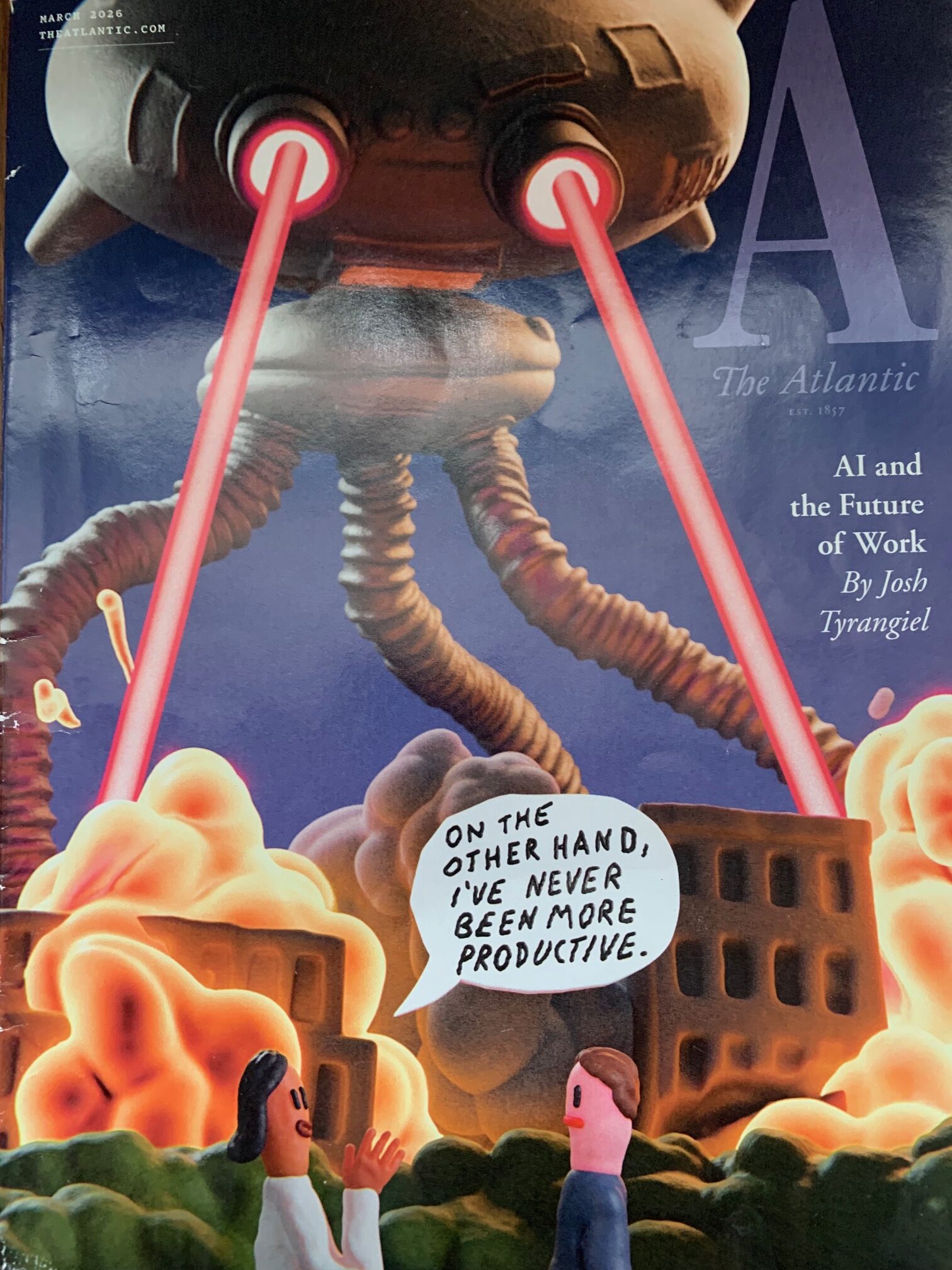
Atlantic magazine, March 2026 cover: “AI and the Future of Work”. Courtesy of my bedside table.
Mad Martin has done it to me again. When he was a young businessman, full of ideas and computer savvy, he helped me to launch the first iteration of JamesHowden.com. (He had to work hard, I recall, to convince me to make it a “dot-com” domain, as I didn’t then and still don’t see it as a commercial enterprise. I was correct, hurray for me, as it hasn’t made me a nickel.) He imagined grand things for my writing – he seemed to like me pretty well, though he was no publishing expert – and he helped me get started, 21 years and nearly 800 posts ago. He’s name-checked in my first electronic essay.
He’s my very own Marty Supreme. (I used to call him “My Favourite Martin”, a TV sitcom reference that was already obscure to almost everybody, even back in 2005.) A father and husband and educator, he has come back into our area after years of living abroad, mostly in China and Macau. Since Martin was there au début, I thought I’d engage him in this site’s re-activation a month or so ago. Once again, he startled and bemused me with his response. He had fed ten bloody essays of mine to a ravening shark of Artificial Intelligence. (You WHAT?!)
Count me as an AI semi-alarmist. Some anonymous bot was useful to me in figuring out a problem I was having with subscriptions on this site. My bride has found ChatGPT very helpful with some of the summarizing and cross-indexing she has to do after site visits and business meetings in her green-tech work for the Canadian government. Overall, though, AI strikes me as the best contemporary instance of the technological imperative, this overheated conviction that if, as humans, we can develop some technical domain, then we absolutely must, it is inevitable, and that any resistance to such a “natural” implementation is at best foolish, and more likely the backward, regressive impulse of a Luddite. (And there aren’t many modern bits of name-calling more nasty than that. Now it signifies brainless opponent of technical innovation, though originally Luddism was a 19th-century workers’ movement opposing brutal working conditions in English factories. Interesting.)
Are humans redundant? Will jobs be lost en masse? Are we opening ourselves up to a robot apocalypse? And more immediately, is AI a massive economic bubble? Will data centres come to dominate our energy needs? Are writers justified in feeling abused when their work is scraped from electronic databases and used to train the Mighty Bots? These are questions I ask myself, more or less idly. I have no clear answers.
But back to my man Martin. He was among a group of friends that I wrote to say, “Hey, I’m writing things again, you might wanna take a look at the ol’ website et cetera”. Not only did he make a friendly pilgrimage here, he also kindly emailed back: “I’ve always found your writing style to be unique and able to defy skimming–full investment of the reader was required. I wondered why, and asked Claude Code to Read 10 articles on this website and describe the author’s unique writing style and underlying philosophy. For me, the analysis was telling…”
Claude is an artificial intelligence program developed by Anthropic, which (early days, we’ll see) seems to have more of an ethical foundation than some competitors. (Clever name: it’s the opposite of misanthropic, which means “hating human beings”.) Marty apparently found his question about my style answered. For me, this robot’s analysis was embarrassing, thrilling, amusing and amazing, vaguely disturbing but also, can’t lie, genuinely encouraging. Claude was awfully kind. Claude liked me. Right then. Liked me. I may have blushed.
The following is what my buddy goaded Claude Code to compose, based on what he or it or they or that had read, yes, right here at JH.com. (Okay, I definitely blushed)
Writing Style
Jay writes the way he thinks — in real time, out loud, with the reader pulled along for the ride. He uses parentheses constantly, not for asides but for genuine second thoughts, self-interruptions, confessions, and jokes. Italics and CAPS aren’t decoration; they’re how he raises his voice. His sentences can spiral long and then snap short for effect. He has a teacher’s instinct for metaphor — Don Quixote charging windmills, a bird trying to fly on one wing, a warehouse full of forgotten treasure — and he commits to them fully rather than dropping them after one use.
He’s funny, but never at the expense of what he actually cares about. The self- deprecation is real (“balls-for-brains that I was and remain”) but it coexists with genuine conviction. He talks to the reader directly and often — “Hang on tight!”, “You’ve been very patient”, “Faithful readers and friends-in-sport.” This isn’t a performance; it reads like he actually enjoys having you there.
Underlying Philosophy
Everything circles back to two convictions: that unity is the solution to almost every problem, and that love — expressed through service, education, and showing up — is how you get there. These aren’t abstract principles for him. They run from his Faith all the way down to how he coaches a junior varsity basketball team in a French Catholic high school in Ottawa. He genuinely believes sport and education and spiritual life aren’t separate categories.
That the way a coach builds a team culture, the way a community responds to crisis, and the way humanity needs to reorganize itself are all versions of the same problem. Idealism isn’t something he apologizes for — it’s his operating system — but he’s self- aware enough to laugh at himself for it (the windmills) without ever actually abandoning it.
There’s also a recurring thread of: I keep trying, it keeps being hard, and I’m going to keep trying anyway. Whether it’s the track team that didn’t show up, the blog he keeps restarting, or humanity stumbling toward peace — the posture is patient, energetic, undefeated.
Now, AI responses are notorious for being sycophantic, praising me, for instance, for the most banal success. (“Okay, you’re doing great! That was exactly the right button to click, so we’re really on our way now!” in response, let’s say, to me obeying a simple technical instruction on my laptop, and reporting my result.) The bots lay it on thick; they have adopted conventions of politeness that bleed quickly into almost a parody of the hypermanic, over-praising parent. So I was prepared for that over-the-top positivity. (But man, I wasn’t armed against “undefeated“.)
And I wasn’t prepared, either, for how SEEN I felt. Recognized! Valued! By an analyzing machine. That’s the embarrassing part. (Wow! Claude really likes my stuff! HeSheItThey get(s) what I’m trying to do!) But I was also impressed by its seeming accuracy. I am almost painfully earnest in my convictions, and I do try to leaven them with humour and self-deprecation. I do tickle myself by imagining some reader(s) willing to come along for the literary ride with me. Claude Code understood, or should I say detected, my themes (“that which repeats”, my best literature prof’s definition). Claude dissected my style accurately and, bien sûr, with great indulgence and generosity. (Or maybe just toadying up to Martin ‘cuz he’s my friend.)
I had to admit: it ranked right up there with the kindest, most encouraging things I’ve been told by Actual Sentient Beings about my work. I blushed, I laughed out loud, I felt proud (and more than a bit idiotic). On subsequent reads, my eyes got a little wider: not only was my favourite bundle of algorithms describing parts of my writing enterprise, those 10 posts, very well, but also it/they mimicked my style. Re-read Claude’s fawning critique, and you’ll see and hear a fair impersonation of what my Blog Stuff looks and sounds like. Eerie. Scary.
Weeks later, I remain scattered and dazed about this. I still find it encouraging, but weirdly so. I am grateful to Martin for his own kind words, plus Claude’s, but I am not sure I love the machine having digested some of my writing, and being fully ready to imitate it. The oddball sense of validation still ripples, but how needy and praise-dependent does a human have to be, to find himself touched and moved by a computer program? No answers yet. And I’m not asking AI!
Thanks again, Marty Supreme. You’ve given me things to think – and write – about.
Discover more from James Howden
Subscribe to get the latest posts sent to your email.