Rss

Trust Me, They’re Tired: Venezuela’s Pain, and the Emptiness of Cliché

[3-minute read]

Martin Amis wrote a fine book called The War Against Cliché. He’s mainly known as a novelist, though for too long he was just “Kingsley Amis’s bad-boy son”. That cliché, at least, had been retired decades before Sir Martin’s long and accomplished life ended in 2024. But why would a collection of his essays have been titled as an all-out attack against familiar language? I couldn’t carry his pen-case, but I’m with Amis: “To idealise: all writing is a campaign against cliché…”

Listen: we have the expression “it’s a cliché for a reason” for a reason. Sometimes an old saying is a useful reminder or a profound comfort; my mother never wearied of gently saying, in the face of misfortune or gloom, it’s always darkest before the dawn (Thomas Fuller, 1650) and all things work together for good (Paul’s epistle to the Romans 8:28, about a millennium and a half earlier). And yes, whoever first said, about some sport or another, that “it’s a game of inches” knew what he was talking about. It expressed an evergreen truth about the games we watch and play. Still, the best jock commentators try to avoid saying it, or give a rueful shrug of apology when they do. Because it’s OLD. It’s TIRED.

But there’s more to Amis’s war, to every good writer’s battle against cliché, than simple fatigue or a wish to seem stylish. And it applies, to a less obvious but maybe even more essential degree, to all of us. It’s this: How can we know if we’re actually thinking if we merely recycle a set of phrases that we have heard from others? The creative writer (painter, film-maker, dancer) restlessly desires to make – even though there’s nothing new under the sun (Ecclesiastes 1:9, several centuries before St. Paul) – something novel, illuminating or (at the very least) interesting. Some describe poetry as the constant renovation, the organic renewal of language. Is that process merely about the quest for a fashionable phrase, some nifty bit of in-group vocabulary?

No.

There’s a crucial and mightier argument. If we’re not actually thinking, actively seeking understanding for ourselves, then we are subject to, in no particular order, empty-headed and derivative pop culture (bingo!), a heartless and bland societal conversation (John Ralston Saul’s “unconscious civilization”), endlessly persuasive Mad Men media urging us to Buy What They’re Selling! (now!), not to mention tyrant business monopolies and their pet politicians greasing the skids for autocracy. (I apologize. “Greasing the skids” is a cliché, though perhaps you’re young enough that it feels refreshing to you as an alternative to “paving the way”.) Thinking as I was about Martin Amis et sa guerre, I ran across a 15-year-old column from The Guardian lamenting, even back then, how decisively Mr. Amis had lost his War. (It’s rather British, but a lively rant against cliché.)

All of which leads me to this morning’s encounter with an online news digest from National Public Radio, an American treasure that is under attack. (Not by me, understand.) My bride and I have been touring Ontario, but our ten days of relatively news-free travel are over. I was having an oh shit re-entry into dismay, mostly at the fate of poor suffering Venezuela. For that country to endure monstrous natural disasters, on top of the human-made kind, feels like cruel and unusual punishment. (A cliché, yes. I’ll stand by this one.) From NPR: 

“The search for survivors continues nearly five days after two powerful earthquakes hit Venezuela. The official death toll is nearing 1,500, and thousands of people are still unaccounted for. Families and volunteers are tirelessly digging through collapsed buildings throughout the northern coast and in neighborhoods of Caracas, the country’s capital, in hopes of finding people alive.” (NPR’s second bit of “news we’re following”; Iran and the United States ceasing to cease fire, surprise, was number one on June 29, 2026.)

It’s awful. And just to be foolishly clear, it’s not the journalistic blandness in general that has my Cliché Alert sounding on a sunny Monday morning. Yes, “search for survivors”, “death toll” and “unaccounted for” are over-taxed phrases, but this is not poetry. Readers want to get their information efficiently, and NPR points them towards more detailed accounts if they want them. No notes, no complaint. It’s just that I have grown chronically fatigued with the adverb “tirelessly”. Obituaries of any respectable professional or half-diligent labourer are almost never without it, but it’s not just the overuse and the lack of genuine thought. It’s the lie.

Don’t start my obituary yet, but I’ll ask in advance: Please don’t use “tirelessly” to describe my life’s work as a dad, or as a midnight grader of English assignments, or as a basketball coach addicted to “the grind”. I wish we could retire the word tirelessly, and for good. (“Indefatigable” is less shopworn, but has too many syllables and is equally untrue.) I was exhausted by all of that. I still am. Life at its best, for most of us, is still tiring.

But widen the scope. As they find themselves in an epic tale of tragedy and pain and heroism, too, I am unsettled by the mere thought of that South American aftermath. Consider that legion of unhappy souls, labouring desperately to find loved ones, neighbours and strangers in a deeply shaken Venezuela!

They’re tired as hell. And they’ll keep going. It’s human nature.

Salman Rushdie (on whether we circle the drain)

In Canada, we have (steadily more meagre and occasionally even contemptuous) government-funded radio. Alarmists – unlike the always-judicious, ever-moderate me – might call the Canadian Broadcasting Corporation an endangered species. Last Chance to Hear! Broadcasters, Artists and Thinkers in Their Natural Habitat! It’s a pretty pale safari, but I’m on it. The CBC’s a national treasure.

Yesterday I listened to Q, Radio One’s flagship weekday arts ‘n’ culture show. It’s hosted by a grandson of Rwanda, a Canadian-as-socially-conscious-rap MC known as Shad. (By night, he’s a bouncy, smiling hip-hop groove-ster with a real band. By day, he talks to Salman Rushdie and Margaret Atwood and Darryl McDaniels, the DMC in rap/rockstar band Run DMC. In between, he’s Shadrach Kabango.) Actually, I was re-listening to an extended podcast recording of a conversation I’d heard part of earlier in the week. (I think I was sweeping. Or washing dishes?)

They were talking dystopias, especially regarding Rushdie’s new novel Two Years, Eight Months, and Twenty-Eight Nights. It’s full of malevolent genies, time travel, a corruption-exposing baby and a whole lot of thinly-disguised Now. It’s also apparently very funny, as Rushdie is no permanent pessimist and wanted to explore the “strangenesses” of our time with some inventive and comic strangeness of his own. He wasn’t trying to outgrim Margaret Atwood, in other words. (Though it must be said that her MaddAddam trilogy is nastily, wryly funny if you can suspend despairing recognition, at least for a moment.)

*Certainly* no pessimist! (This is not his daughter.) Padma Lakshmi was Mr. Rushdie's 4th wife.

*Certainly* no pessimist! (This is not his daughter.) Padma Lakshmi was Mr. Rushdie’s 4th wife.

This was only the first (and then second) time I’d heard Rushdie interviewed, surprisingly, and I found him an engaging and generous interviewee.

Continue Reading >>

J.R. Saul (on Adam Smith, Rolling in his Grave)

I’m no historian, and my knowledge of economics is even thinner, but I never liked Adam Smith. This was due mainly to my ignorance, as well as the company he keeps. Right-wingers and trickle-down theorists invoke him as if he was a bearded Old Testament patriarch, and as a younger man I assumed that their often-heartless, always plutocrat*-friendly policies made St. Adam someone to reflexively dislike and ignore. I still haven’t actually read much of Smith himself, but Saul’s The Unconscious Civilization points out, several times, the ways in which Adam Smith’s thinking has been cited selectively and often incorrectly by modern “voodoo economists”. Here’s one excerpt:

noun (derogatory) 1. a person whose power derives from their wealth. (syn. : rich person, magnate, millionaire, billionaire, multimillionaire)

“This idea that sympathy for others is the essential characteristic of the human condition was…central to Adam Smith’s Theory of Moral Sentiments, a treatise that is rarely mentioned by the false disciples of his economic theories. They limit themselves to a narrow reading of The Wealth of Nations and then apply it to the general…society….How poor Adam Smith got stuck with disciples like the market economists and the neo-conservatives is hard to imagine. He is in profound disagreement with their view of society.”

John Ralston Saul (1947- ) in the closing chapter of The Unconscious Civilization, a 1995 book that echoes his delivery that same year of Canada’s remarkable annual Massey Lecture series. The talks and the subsequent book are a good capsule of Saul’s views on individualism, corporatism, and the building of a humane and progressive society. I’ll soon be posting my final look at this excellent and admirably brief publication, the end of a series of posts that began here.  

Better Read Than Never: Saul’s Unconscious Civilization 3

My first look at this book (and its author, John Ralston Saul) was here, and the first chapter was summarized here.

Saul called Chapter 2 of The Unconscious Civilization – the second of the speeches he originally gave as the 1995 Massey Lectures in Canada – “From Propaganda to Language”. To bring (Western, or maybe even global) civilization to a more conscious state, to encourage genuine democracy and real citizenship in pursuit of the general good, he advocates fundamental changes in the way that we communicate, and in the role of

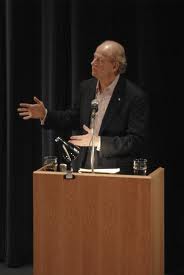
JRS at the lectern.

education in producing such true and meaningful expression. These are big ideas. Saul is often criticized for his sweeping generalizations. Even his fans might find occasional pronouncements positively tsunami-like in their breadth, force and where-did-that-come-from suddenness. This is also his greatest strength: he describes philosophical and historical forests to a public too often entranced by the trees.

And speaking of sweeping general statements, then, here are my no-more-than-500 words in summary of “From Propaganda to Language” by John Ralston Saul:

Continue Reading >>

John Ralston Saul (on corporatism and individualism)

In The Unconscious Civilization (1995), Saul traces the rise of individualism in the West, but complains that the term has been “hijacked” in modern times:

“Nowhere…was the individual seen as a single ambulatory centre of selfishness. That idea of individualism, dominant today, represents a narrow and superficial deformation of the Western idea….[We are] a society addicted to ideologies – a civilization tightly held at this moment in the embrace of a dominant ideology: corporatism…[It] causes us to deny and undermine the legitimacy of the individual as a citizen,…which leads to our adoration of self-interest and our denial of the public good….The overall effects on the individual are passivity and conformity in those areas which matter and non-conformism in those which don’t.”

John Ralston Saul is a Canadian thinker, writer and activist for the public good. I was lucky enough to watch from close range, in the mid-2000s, as he continued to develop the ideas he put forth in The Unconscious Civilization (1995) and to poke and provoke conversation about ideas that matter, from the neighbourhood to the globe. He’s an intellectual fireball. In the midst of watching too much basketball and reading too many student papers, I’m stealing the chance to re-read Saul.