Rss

Ursula K. Le Guin (on the alleged decline of reading)

[6-minute read]

One of her mightiest novels, but she wrote *everything*.

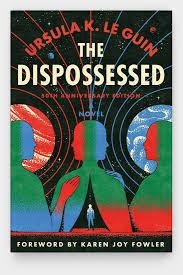
Ursula Le Guin is a hero of mine and, though often labeled as a ‘genre writer’, she is a giant of 20th century American literature. Her series of so-called “young adult” fantasy novels, beginning with A Wizard of Earthsea, were the first Le Guin books that I read. I recently finished The Dispossessed, a remarkable invocation of an extra-planetary society built on the principles of Anarchism, for a book club. (I’d read it before; I loved it again.) I’m midway through a fascinating, diverse non-fiction collection of hers, called Dancing at the Edge of the World. I was lucky enough to see her in conversation before an audience that packed an otherwise underused Anglican cathedral at the Ottawa Writers Festival in 2009. I cannot un-hear, from that electric evening, what her fiction so regularly upheld: her rejection of the trope, so common in speculative fiction (and Westerns, and comic books), of what she called “redemptive violence”. For her, this was an especially ugly non sequitur, a strikingly vulgar contradiction in terms. She radiated intelligence. Wisdom. There was someone to listen to.

Not long before this downright reverent reception at Christchurch Cathedral, in February 2008, Harper’s magazine had published her essay “Staying Awake: Notes on the alleged decline of reading”. I keep a photocopy of it. It anchors a school notebook where I keep irregular tabs on my own reading. “Staying Awake” begins: “Some people lament the disappearance of the spotted owl from our forests; others sport bumper stickers boasting that they eat fried spotted owls. It appears that books, too, are a threatened species…” and she goes on to cite both alarmed and shoulder-shrugging so what? reactions to the “alleged decline”. In the essay, she challenges mass-media’s sometimes gleeful response to surveys indicating that we read less, especially in book form. She takes the publishing industry to task with “amused contempt”; she is deliciously snarky as she bites the corporate hands that (carelessly) feed her craft. She analyzes historical and contemporary trends in literacy and what it means, and has meant, to our culture.

Most importantly, though, she centres her argument on what the act of reading actually is, and what it does with our minds. And what is a book, exactly? But wait. Before quoting the Le Guin perspective that brings us together here in electronic communion, please allow a short side trip. (If you jump ahead to read Ursula, who’s going to know? And how could I complain?)

So here’s a personal, but also amazingly planetary, narrative tangent. It’s all about BOOKS.

An abundance of good luck – and a massive adolescent absence of caution – has meant that I have hovered at the margins of the worldwide Bahá’í community for a long while now. This has meant several sweet things. I have a taste and an ongoing hunger for Persian food; the 19th-century foundation of the Faith in what is now Iran means that I’ve come to understand and love many Persian things and people! I have also known two hopeful and fruitful marriages to believers, the second of which is alive and well, and the first of which is now remembered with fondness and gratitude. I guess I could mention, too, that my worldview has been constantly expanded, enriched, interrogated and confirmed; the globe’s move toward unity and peace and justice is inevitable.

That’s the kind of mindset you can sustain if you hang around with the Bahá’í teachings  and those that seek to apply them. So, lucky me!
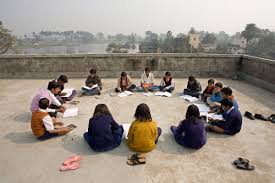
Literacy, learning, society-building in action. Where in the world?

Now, speaking of “the alleged decline of reading” mentioned by the great Ursula K., the Bahá’í community reads like crazy! The ancient references to the “people of the Book”, applied notably (and approvingly) by the Qur’an to Jews and Christians, also pertains to the followers of Muhammad themselves. In the Faith of Bahá’u’lláh, reverence for these and other holy scriptures is deepened by adding a whole modern canon of the Word. “In the beginning was the Word,” says the New Testament (John 1:1), to which I dare to add this: the Word has remained alive, and been renewed, and shall ever continue as the foundation of human progress and comprehension. That’s my take on the Bahá’í take on the power of the Word.

The Bahá’ís, too, are “people of the Book” in their high regard for the sacred teachings and writings of the major world Faiths, as well as the traditional wisdom of Indigenous peoples. It is not some passive, token respect for holy writings. They actually read them. For example, faithful believers are asked to read from the Faith’s writings twice a day; not for long, necessarily, but as part of their spiritual hygiene. What’s more, the worldwide community has adopted, as one of its core activities – all of which are open to the wider public – a series of “study circles” that enhance one’s understanding and application of the Bahá’í principles. (Check ‘em out: truth, justice, love – the old faithfuls – as well as the essential oneness of humanity, the equality of women and men, the fundamental harmony of science and religion, and the eradication of all forms of prejudice and oppression. Yup. Astounding stuff.)
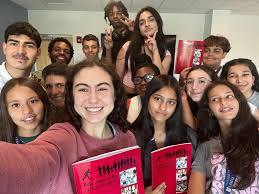
These young’uns are from Boston, could’ve been my town or yours.

The initial sequence of courses has titles like “Reflections on the Life of the Spirit”, “Arising to Serve”, and “Releasing the Powers of Junior Youth”. For the Baha’is and their friends, though, in-group shorthand just calls them Book 1, Book 2, and Book 5. (People of the Books!) And you’ll find such study circles, if you look a bit, just about everywhere in the world. They work. Learning happens, habits build, trust is established. And more: the act of reading, and of education generally, is celebrated and valorized in the most grassroots way. I’ve seen photos from all over the world — what happens when a study circle is complete? In a most charming and counter-cultural tradition, the group will have a photo taken, smiling friends holding up their red or yellow or green manuals. They might be saying, with their grins, We love our books! It’s been great to study and learn together! We even memorize certain passages! We are learning to not only read the Word but to read the reality of our place and time, and we find great hope in our shared community-building. How’s that for enthusiasm for the importance of the written word?

Thanks for staying with me! And now, back to Ms. Le Guin, for one of the clearest and most emphatic arguments for the power of the word (not to mention The Word) that I have read.

“At about the two-thirds mark in her essay, Le Guin acknowledges the variety of ‘entertainment media’ available to the modern data-consumer; after all, “the Internet offers everything to everybody: but…there is curiously little aesthetic satisfaction to be got from [it].” And then she gets to the heart of the matter; here is why reading matters SO MUCH to so many of us:
Reading. Trees.
(Public Domain)

“…[R]eaders aren’t viewers; they recognize their pleasure as different from that of being entertained. Once you’ve pressed the on button, the TV goes on, and on, and on, and all you have to do is sit and stare. But reading is active, an act of attention, of absorbed alertness—not all that different from hunting, in fact, or from gathering. In its silence, a book is a challenge: it can’t lull you with surging music or deafen you with screeching laugh tracks or fire gunshots in your living room; you have to listen to it in your head. A book won’t move your eyes for you the way images on a screen do. It won’t move your mind unless you give it your mind, or your heart unless you put your heart in it. It won’t do the work for you. To read a story well is to follow it, to act it, to feel it, to become it—everything short of writing it, in fact. Reading is not ‘interactive’ with a set of rules or options, as games are; reading is actual collaboration with the writer’s mind. No wonder not everybody is up to it.

“The book itself is a curious artifact, not showy in its technology but complex and extremely efficient: a really neat little device, compact, often very pleasant to look at and handle, that can last decades, even centuries. It doesn’t have to be plugged in, activated, or performed by a machine; all it needs is light, a human eye, and a human mind. It is not one of a kind, and it is not ephemeral. It lasts. It is reliable. If a book told you something when you were fifteen, it will tell it to you again when you’re fifty, though you may understand it so differently that it seems you’re reading a whole new book.

“This is crucial, the fact that a book is a thing, physically there, durable, indefinitely reusable, an object of value.

“…[Meanwhile] [e]lectrons are as evanescent as thoughts. History begins with the written word. Much of civilization now relies on the durability of the bound book—its capacity for keeping memory in solid, physical form. The continuous existence of books is a great part of our continuity as an intelligent species. We know it: we see their willed destruction as an ultimate barbarism. The burning of the Library of Alexandria has been mourned for two thousand years, as people may well remember the desecration and destruction of the great Library in Baghdad [during the 2003 Iraq war]…”

[Italicized emphasis in the quote above is mine, not Le Guin’s. Read the whole essay here.]

Chad Harbach (on art and beauty and sport)

I just finished The Art of Fielding, a 2011 novel by Chad Harbach that centres on baseball but ranges widely (sometimes wildly) from Herman Melville to environmental activism to collegiate sexual mores to the nature of the life well-lived. I liked best its many meditations on the meaning of sport, and the pursuit of greatness in it. Here is one passage:

“The making of a ballplayer: the production of brute efficiency out of natural genius.

“For Schwartz, this formed the paradox at the heart of baseball, or football, or any other sport. You loved it because you considered it an art: an apparently pointless affair, undertaken by people with a special aptitude, which sidestepped attempts to paraphrase its value yet somehow seemed to communicate something true or even crucial about The Human Condition…, that we’re alive and have access to beauty, can even erratically create it, but will someday be dead and will not.

“Baseball was an art, but to excel at it you had to become a machine. It didn’t matter how beautifully you performed sometimes, what you did on your best day,how many spectacular plays you made. You weren’t a painter or a writer — you didn’t work in private and discard your mistakes, and it wasn’t just your masterpieces that counted. What mattered, as for any machine, was repeatability…”

Chad Harbach is a new writer to me. He is the co-founder a literary and cultural magazine called n+1, also new to me. He writes about baseball like Henry the Shortstop, his protagonist, fields ground balls: with grace, the occasional wow, and deep understanding.

He came into my line of sight rather pathetically: a student in my writing class in a Chinese university, hectored by me to find something fun/interesting/pleasurable to read in English rather than the stiff, classical and too damnedly difficult texts they typically have chosen for them, showed up with The Art of Fielding. She’d paid 77 yuan for the paperback, about 13 bucks, which was in a Chinese bookstore solely because it was a New York Times notable book. Her choice was a sad, bitter and completely unintentional joke on me and my sometimes absurd hopes for students, and nobody got the joke but me: not only is it a fine and rather literary novel, it’s about baseball. Ms. An hadn’t the faintest clue what the book was about, and hadn’t even bothered trying to begin it. I released her from this painful (or patently fake) fantasy of fiction reading, then borrowed the book, and have so far been unsuccessful in convincing her to allow me to pay her for it. (It’s great. It’s so laughably/pitiably far beyond the grasp of nearly any Chinese student, though not apparently a financial stretch for this one.)


It’s Lonely at the Top…

…of this page, where a pale head on fuschia shoulders floats in a cold cerulean sea… (It’s just up there, top right corner — the disembodied Spirit of Semi-Constant Scribble. A couple of my nieces have found this site too funny to read, because of that ghostly noggin hovering there. But I swear the shirt was red when the photo was taken.) Even Writing Heads Get the Blues. But in contrast to the rude (and rhyming) epithet so common these days, I have only one thing to say to all of you out there in CyberLand: you can just WRITE me! A couple of you have noted the lack of ready-made comment space on JH.com, but you shouldn’t let that discourage you. At the bottom of that eerily glowing yellow box at left is a Write Me! (don’t bite me) button that gets you to my email address, and the rest is as easy as falling off your front porch.

For one thing, I’m a bit of a grammar-and-spelling freak and am occasionally horrified to see that something sub- or semi-literate has been set free to further corrupt the corridors of cyberspace, placing yet more of the misery of psoriasis on the unsightly shoulders of the information highway, sullying the glistening filaments of the world-wide Web. (Or you may object to overheated metaphors.) I’d be grateful for your help in eliminating errors of grammar or fact, but would welcome even more your reflections, commentary, or a simple “hello from Guadeloupe (Vancouver, Detroit, southern Caledonia…)”. ‘Sall good, as those spunky youngsters (spongy yunksters?) love to say.

 No hiding, now. My little stat machine tells me that there are a few of you out there now, and while I’ve been known to talk to myself, it’d be nice to know that there’s somebody out there who can read. And who does.

Just Say NO to Reading

Readers are Leaders was one of the main mantras of my teaching career, and no doubt it also soothed me regarding the undeniable Rightness of my constant hunger for text. But one of my annoying little assignments along The Artist’s Way this week has been reading deprivation. In a life like mine, that’s not such a small thing, actually, and though it has been easy to slip into that mindless groping for typeface, I’ve been surprised by how much I like it. It’s a relief. It makes me realize (again) that reading is not some lazy-boy dodge for me but a ravenous, indiscriminate and chronically unsatisfiable quest. I highly recommend it to the reading-addicted.

“Readers are leaders!” I harangued my classes, but “put the book down and go DO something!” has been a regular jab at my hyper-literate sons and even, now, their book-snaky Dad. “They say that life is the thing, but I prefer reading!” That has long been one of my favourite quotes (I forget who wrote it), but it’s not quite so funny anymore. It’s been good to find new ways to live in the evening, and it wasn’t all Adventures in More Timely Housework (though I even enjoyed some of those). I finally repaired those loveseat cushions. You might say it was only packing tape, but it was Industrial Design to me!