Rss

“Claude Likes Me! He Really Likes Me!!”

[5-minute read]

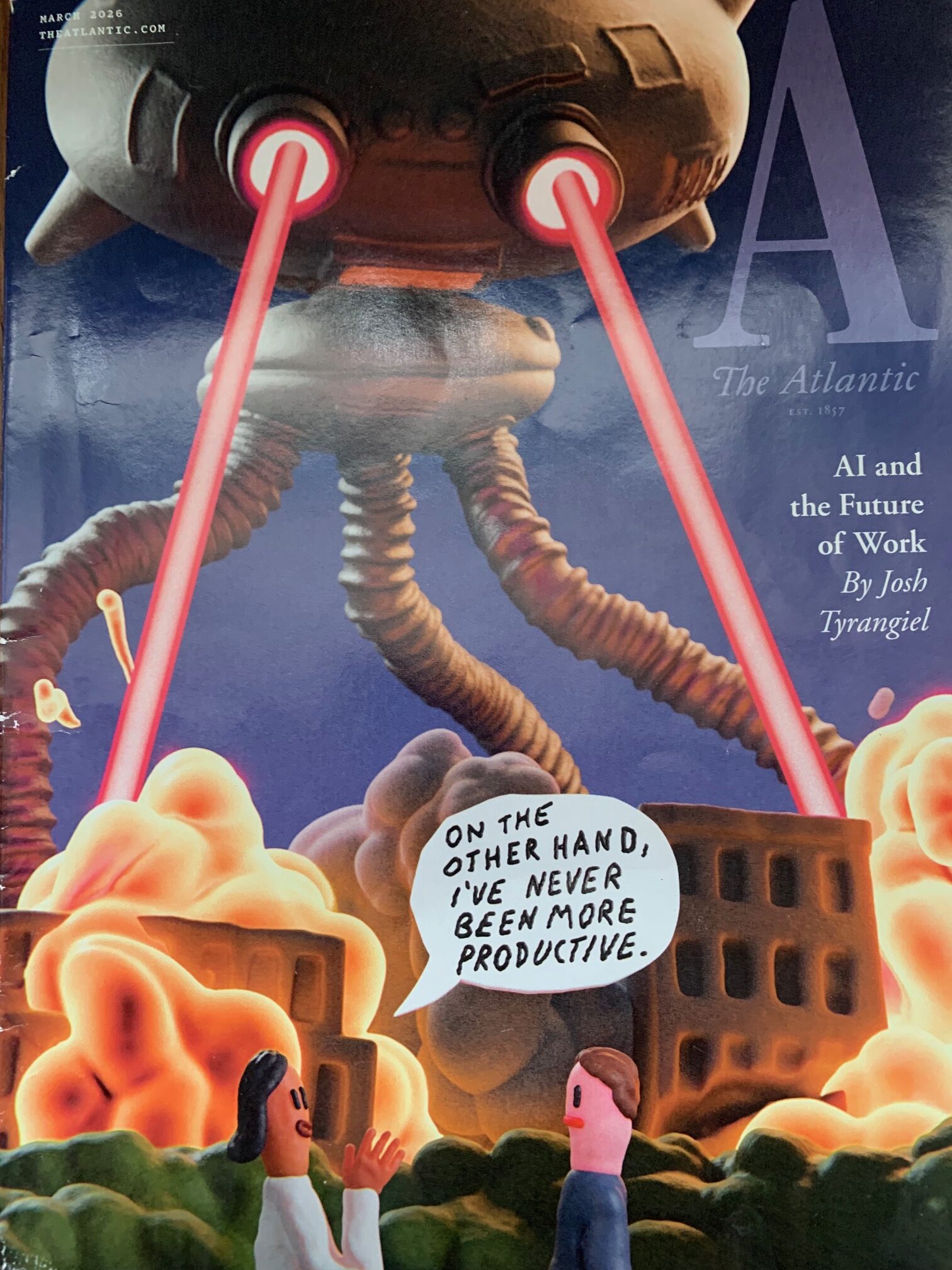
Atlantic magazine, March 2026 cover: “AI and the Future of Work”. Courtesy of my bedside table.

Mad Martin has done it to me again. When he was a young businessman, full of ideas and computer savvy, he helped me to launch the first iteration of JamesHowden.com. (He had to work hard, I recall, to convince me to make it a “dot-com” domain, as I didn’t then and still don’t see it as a commercial enterprise. I was correct, hurray for me, as it hasn’t made me a nickel.) He imagined grand things for my writing – he seemed to like me pretty well, though he was no publishing expert – and he helped me get started, 21 years and nearly 800 posts ago. He’s name-checked in my first electronic essay.

He’s my very own Marty Supreme. (I used to call him “My Favourite Martin”, a TV sitcom reference that was already obscure to almost everybody, even back in 2005.) A father and husband and educator, he has come back into our area after years of living abroad, mostly in China and Macau. Since Martin was there au début, I thought I’d engage him in this site’s re-activation a month or so ago. Once again, he startled and bemused me with his response. He had fed ten bloody essays of mine to a ravening shark of Artificial Intelligence. (You WHAT?!)

Count me as an AI semi-alarmist. Some anonymous bot was useful to me in figuring out a problem I was having with subscriptions on this site. My bride has found ChatGPT very helpful with some of the summarizing and cross-indexing she has to do after site visits and business meetings in her green-tech work for the Canadian government. Overall, though, AI strikes me as the best contemporary instance of the technological imperative, this overheated conviction that if, as humans, we can develop some technical domain, then we absolutely must, it is inevitable, and that any resistance to such a “natural” implementation is at best foolish, and more likely the backward, regressive impulse of a Luddite. (And there aren’t many modern bits of name-calling more nasty than that. Now it signifies brainless opponent of technical innovation, though originally Luddism was a 19th-century workers’ movement opposing brutal working conditions in English factories. Interesting.)

Are humans redundant? Will jobs be lost en masse? Are we opening ourselves up to a robot apocalypse? And more immediately, is AI a massive economic bubble? Will data centres come to dominate our energy needs? Are writers justified in feeling abused when their work is scraped from electronic databases and used to train the Mighty Bots? These are questions I ask myself, more or less idly. I have no clear answers.

But back to my man Martin. He was among a group of friends that I wrote to say, “Hey, I’m writing things again, you might wanna take a look at the ol’ website et cetera”. Not only did he make a friendly pilgrimage here, he also kindly emailed back: “I’ve always found your writing style to be unique and able to defy skimming–full investment of the reader was required. I wondered why, and asked Claude Code to Read 10 articles on this website and describe the author’s unique writing style and underlying philosophy. For me, the analysis was telling…”

Claude is an artificial intelligence program developed by Anthropic, which (early days, we’ll see) seems to have more of an ethical foundation than some competitors. (Clever name: it’s the opposite of misanthropic, which means “hating human beings”.) Marty apparently found his question about my style answered. For me, this robot’s  analysis was embarrassing, thrilling, amusing and amazing, vaguely disturbing but also, can’t lie, genuinely encouraging. Claude was awfully kind. Claude liked me. Right then. Liked me. I may have blushed.

The following is what my buddy goaded Claude Code to compose, based on what he or it or they or that had read, yes, right here at JH.com. (Okay, I definitely blushed)

Writing Style

Jay writes the way he thinks — in real time, out loud, with the reader pulled along for the ride. He uses parentheses constantly, not for asides but for genuine second thoughts, self-interruptions, confessions, and jokes. Italics and CAPS aren’t decoration; they’re how he raises his voice. His sentences can spiral long and then snap short for effect. He has a teacher’s instinct for metaphor — Don Quixote charging windmills, a bird trying to fly on one wing, a warehouse full of forgotten treasure — and he commits to them fully rather than dropping them after one use.

He’s funny, but never at the expense of what he actually cares about. The self- deprecation is real (“balls-for-brains that I was and remain”) but it coexists with genuine conviction. He talks to the reader directly and often — “Hang on tight!”, “You’ve been very patient”, “Faithful readers and friends-in-sport.” This isn’t a performance; it reads like he actually enjoys having you there.

Underlying Philosophy

Everything circles back to two convictions: that unity is the solution to almost every problem, and that love — expressed through service, education, and showing up — is how you get there. These aren’t abstract principles for him. They run from his Faith all the way down to how he coaches a junior varsity basketball team in a French Catholic high school in Ottawa. He genuinely believes sport and education and spiritual life aren’t separate categories.

That the way a coach builds a team culture, the way a community responds to crisis, and the way humanity needs to reorganize itself are all versions of the same problem. Idealism isn’t something he apologizes for — it’s his operating system — but he’s self- aware enough to laugh at himself for it (the windmills) without ever actually abandoning it.

There’s also a recurring thread of: I keep trying, it keeps being hard, and I’m going to keep trying anyway. Whether it’s the track team that didn’t show up, the blog he keeps restarting, or humanity stumbling toward peace — the posture is patient, energetic, undefeated.

Now, AI responses are notorious for being sycophantic, praising me, for instance, for the most banal success. (“Okay, you’re doing great! That was exactly the right button to click, so we’re really on our way now!” in response, let’s say, to me obeying a simple technical instruction on my laptop, and reporting my result.) The bots lay it on thick; they have adopted conventions of politeness that bleed quickly into almost a parody of the hypermanic, over-praising parent. So I was prepared for that over-the-top positivity. (But man, I wasn’t armed against “undefeated“.)

And I wasn’t prepared, either, for how SEEN I felt. Recognized! Valued! By an analyzing machine. That’s the embarrassing part. (Wow! Claude really likes my stuff! HeSheItThey get(s) what I’m trying to do!) But I was also impressed by its seeming accuracy. I am almost painfully earnest in my convictions, and I do try to leaven them with humour and self-deprecation. I do tickle myself by imagining some reader(s) willing to come along for the literary ride with me. Claude Code understood, or should I say detected, my themes (“that which repeats”, my best literature prof’s definition). Claude dissected my style accurately and, bien sûr, with great indulgence and generosity. (Or maybe just toadying up to Martin ‘cuz he’s my friend.)

I had to admit: it ranked right up there with the kindest, most encouraging things I’ve been told by Actual Sentient Beings about my work. I blushed, I laughed out loud, I felt proud (and more than a bit idiotic). On subsequent reads, my eyes got a little wider: not only was my favourite bundle of algorithms describing parts of my writing enterprise, those 10 posts, very well, but also it/they mimicked my style. Re-read Claude’s fawning critique, and you’ll see and hear a fair impersonation of what my Blog Stuff looks and sounds like. Eerie. Scary.

Weeks later, I remain scattered and dazed about this. I still find it encouraging, but weirdly so. I am grateful to Martin for his own kind words, plus Claude’s, but I am not sure I love the machine having digested some of my writing, and being fully ready to imitate it. The oddball sense of validation still ripples, but how needy and praise-dependent does a human have to be, to find himself touched and moved by a computer program? No answers yet. And I’m not asking AI!

Thanks again, Marty Supreme. You’ve given me things to think – and write – about.

The American Idea

The Atlantic is a magazine with which I have a turbulent relationship, or at least an up-and-down one. I have subscribed periodically, excited by its cover stories: long, smart, profound discussions of issues that shake and shape the world. And then I get bogged down, behind, and occasionally bored by its tendency to obsess about the American political system. It’s a great magazine, but I sometimes get lost in its density and its preoccupations. And the articles are too long for reading on the commode.

I’m about to enter another period in which, subscription abandoned, I will be free to wander retroactively through issues that still have weight and relevance for me, months or even years after urgency has passed. But I probably won’t. It’s one of those promises I guiltily make in the full knowledge that I won’t follow through. There’s so much to read, and grim obligation is such a poor prod to do so.

The Atlantic’s 150th anniversary issue came out in November. (I’m already reading it!) Referring back to a promise its founders made in 1857, this issue returns to what might be called the magazine’s central focus with a cover story on “The American Idea”. The editors invited dozens of American thinkers and commentators and builders to submit a short essay on the general theme, and they are brief and bracing pieces. There are the expected paeans to American freedom, energy, innovation, and destiny. (Early report: nobody writes more blandly on these things than the politicians, although Arnold Schwarzenegger does the unheard of, actually admitting a mistaken and overly partisan approach. God help me, but the guy is interesting!) But the voices don’t sing from the same all-approving hymnbook, and it’s a great reminder that, whatever you might think of the United States and its dominant position in world affairs, its leaders of thought are bright, contrary, and pretty darned brave. Here’s a taste of a few of them.

The writer Azar Nafisi (Reading Lolita in Tehran) uses that ever-influential American text, Huckleberry Finn, to argue that the strength of the American idea is that Americans regularly depart – “light  out for the territory,” as Huck insists he must – from the most rigidly conformist expressions of it. While there’s a lot of fear-induced group-think going on in American life, there are also many who will challenge orthodoxy and “hope to be a little less ‘sivilized’”.

As an example of this, the columnist George Will begins by questioning the very concept of the American idea, arguing that the country gets in trouble whenever it thinks of itself as having one central concept, and therefore one predominant purpose. Because, he says, the lightly sleeping “missionary impulse” that is never far from American consciousness can take over; the current mania for bringing American-style democracy to the benighted world comes to mind. So listen to this: Will calls the greatest challenge to America “the false idea that American patriotism is inextricably bound up with the notion that being a normal nation is somehow beneath America’s dignity”. (Read that sentence again!)

Another broadside against the perverse elements of the belief in American “exceptionalism” comes from the wildly prolific novelist and commentator Joyce Carol Oates. “How heartily sick the world has grown,” she begins her mini-essay, “of the American idea!” It has become “a cruel joke, a blustery and bellicose body-builder luridly bulked up on steroids…” (Wonder what she thinks of The Arnold?) She questions the overweening pride implicit in the whole notion of an American idea: “Our unexamined belief in American exceptionalism…makes our imperialism altruistic, our plundering of the world’s resources a healthy exercise of capitalism…[and makes it seem that our] political goals are always idealistic, while the goals of other nations are transparently opportunistic”. And she heaps scorn on the resolute and wilful ignorance of the motto, “my country, right or wrong”. Oh, and full disclosure: I may have been also swayed by her persuasive statement of the “higher degree of civilization embodied by Canada”. Wouldn’t you be?

There are many notable submissions. Bernard Lewis, a scholar and British World War II vet, observes that Americans are “unteachable”, insisting on doing things their own stubborn and sometimes ignorant way, but that they are also quick to recognize and remedy their errors. The wonderful David Foster Wallace makes a plea for modern society’s least-invoked virtue – sacrifice – arguing in effect that Americans by quiet consensus feel that 40,000 annual traffic deaths is an acceptable price to pay for the freedom of driving; therefore, why should a markedly lower toll of “terror” deaths lead to such mad curtailment of liberties as we continue to see? (Much of his mini-essay is in the form of questions, yet its own stand is clear.) Historian and poet Robert Conquest speaks of the “lethal certainties” – the worst of Marxism, or Naziism, or jihadism – that have faced Americans, and their own need to retain “a sense of proportion” and avoid the pitfalls of being cocksure. Columnist Arianna Huffington harks back to the Declaration of Independence and its famous credo of “life, liberty and pursuit of happiness”, suggesting that the Founders didn’t have in mind “the blessed-out buzz induced by drugs or shopping sprees”, but rather “the happiness that comes from feeling good by doing good.” Talk of sacrifice AND service?? What decade are we in? Nice to hear. So much else, too, that is good and thought-provoking. Or irritating.

Two back-to-back submissions startle by their utterly opposite views of U.S. problems. Sam Harris, fervent anti-religionist and author of The End of Faith and Letter to a Christian Nation, bemoans Christian extremism and its “pious phantasmagoria” of distracting concerns: school prayer, gay marriage, etc. He longs for the boost to reason that America could give to the world if it wasn’t so hobbled by an ignorant Christian majority. Meanwhile, the essay immediately following, by the Christian pastor Tim LaHaye (he of the Left Behind series of novels about Rapture and “end times”, where the faithful do mighty tricks and the faithless burn), laments the godlessness of American life and the secret machinations of the “scientific humanists” who have undermined the “country more blessed by God than any other nation in history”. Shudder. Sam Harris blusters and exaggerates, but I must say that the writing of LaHaye – no doubt more circumspect and gentle than usual given the audience he’s writing to here – makes me wish for a sickening instant that I wasn’t a person of faith. (Perverting Groucho Marx for my own purposes, I’m inclined to ask, “Why would I want to belong to a club that would have him as a member?”)

But I am. (And I don’t ask.) While the American Bahá’í community has been regularly warned about the materialistic excesses, the substandard morals and the racist poisons infecting their country, the United States is also regarded as having achieved an exemplary level of civic cohesion. The States, in other words, through trial and many errors, have actually been  something of a beacon to the world by remaining united. It is ironic that the government of these United States has, in recent years especially, been so dismissive and even distrustful of the United Nations and its work to extend such civic harmony to the world level.

I recommend the November issue of The Atlantic, still likely available on newsstands, for anyone wishing to better understand this powerful and complex nation. Particularly if you tend toward reflexive anti-Americanism, you will find much to convince you that Americans do not speak with one under-educated voice. To brand those damned Americans for whatever hubris, intrusion or exceptionalism most irritate you is akin to absurd comments like typical male or just like a woman or [insert ethnic or religious minority here] are all alike. It just ain’t so. There’s a lot of brilliant, contrary and incisive commentary here. The essays, though a few are longer, are mainly about 300 words long. (A quarter the size of the woolly beast you just fleeced.) Together, they make for an interesting tapestry of American thought, a sort of U.S. Studies 101 if you’re inclined to education.

Crazy Frenchman on the Road: Catching Up With BHL

In my frequently relenting quest to get caught up on the pile of Atlantic magazines  that looms accusingly over my desk, I went back to May 2005 because it began a series by the French writer and philosopher Bernard-Henri Lévy. The cover story last May was “In the Footsteps of Tocqueville”, a wonderfully affecting and effective look at America a century and a half after Alexis de Tocqueville, another son of France, wrote the famous Democracy in America. (I wrote about this here.) This, of course, was long before the United States had caught the imagination (and inspired the resentment) of much of the rest of the world.  Well, good news, friends! I’m now up to June 2005, whose cover carries the provocative title “How We Would Fight China” and which includes articles like “Managing China’s Rise” (Holy hubris, Batman!) and “The Next Cold War” (more erudite apocalyptica from the gloom-meister, Robert Kaplan).

But the best and most telling writing in the issue belongs to BHL (Lévy’s superstar nom de célébrité in Europe; it sounds quite zippy when the letters are pronounced as in French) and his “Road Trip, Part II”. His favourite American city? Seattle mon amour. “If I had to choose an American city to live in – if I had to pick a place, and only one, where I had the feeling in America of discovering my lost bearings – it would be here, in Seattle.” The Space Needle, the docks, the Sound, the intellectual ferment – he loves it all.

From Seattle, BHL goes on to the queerly conservative, even geriatric ambience of “Gayland”, the heart of the homosexual district of San Francisco. He also has an unusual and characteristically thoughtful take on “one of the most significant and innovative American political movements in recent times”, MoveOn.org. (If this is unfamiliar to you, think Clinton, Lewinsky, and the hungry Republican effort to impeach the Prez.) While in California, of course, Lévy is obligated to meditate (in the spirit of Tocqueville’s investigation of American prisons) on the myth and the meaning of Alcatraz, the long-closed island penitentiary from which none, famously, could escape. His conclusion on the latter obsession: maybe America’s prisons aren’t even really about the usual debate between “rehabilitation or rectification” but more about banishment, exclusion from the “sacred circle” of power. In California, he also ponders the “anti-city” of Los Angeles and the “bombastic kitsch” of San Simeon, the Hearst mansion that inspired Orson Welles’s depiction of “Xanadu” in the immortal film Citizen Kane. It also inspired in BHL the “irrepressible and contradictory wishes to laugh, to vomit, and yet at times to applaud”. (This last may be a microcosm of Lévy’s response to his entire American odyssey, but it’s too soon to say.) He investigates America’s suddenly legendary obesity, and draws some interesting and contrary conclusions regarding Europe’s exaggeration of it but also of its necessity. He wanders along the California/Mexico border, tries to explain the uneasy paradox between the States’ desire to exclude migrants and the undoubted economic need for them, and concludes that “I don’t like any of these explanations….[But] in America, newcomers take nothing for granted. For them, America is a place that must be earned.”

What I offer here, as you can probably tell, are the tiniest snippets from an involved, digressive but coherent 11-page article, pages of text with only tiny flourishes of illustration. (Don’t mean to discourage anyone, but the Atlantic is a magazine for people who read, which is not as redundant a statement as I wish it was.) One of these days, Bernard-Henri Lévy’s series will become a book, and you’ll no doubt thank me for this prescient and forward-looking advance review, even as you now snicker at how far behind I am in my reading.