Rss

Ursula K. Le Guin (on the alleged decline of reading)

[6-minute read]

One of her mightiest novels, but she wrote *everything*.

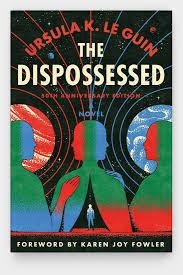
Ursula Le Guin is a hero of mine and, though often labeled as a ‘genre writer’, she is a giant of 20th century American literature. Her series of so-called “young adult” fantasy novels, beginning with A Wizard of Earthsea, were the first Le Guin books that I read. I recently finished The Dispossessed, a remarkable invocation of an extra-planetary society built on the principles of Anarchism, for a book club. (I’d read it before; I loved it again.) I’m midway through a fascinating, diverse non-fiction collection of hers, called Dancing at the Edge of the World. I was lucky enough to see her in conversation before an audience that packed an otherwise underused Anglican cathedral at the Ottawa Writers Festival in 2009. I cannot un-hear, from that electric evening, what her fiction so regularly upheld: her rejection of the trope, so common in speculative fiction (and Westerns, and comic books), of what she called “redemptive violence”. For her, this was an especially ugly non sequitur, a strikingly vulgar contradiction in terms. She radiated intelligence. Wisdom. There was someone to listen to.

Not long before this downright reverent reception at Christchurch Cathedral, in February 2008, Harper’s magazine had published her essay “Staying Awake: Notes on the alleged decline of reading”. I keep a photocopy of it. It anchors a school notebook where I keep irregular tabs on my own reading. “Staying Awake” begins: “Some people lament the disappearance of the spotted owl from our forests; others sport bumper stickers boasting that they eat fried spotted owls. It appears that books, too, are a threatened species…” and she goes on to cite both alarmed and shoulder-shrugging so what? reactions to the “alleged decline”. In the essay, she challenges mass-media’s sometimes gleeful response to surveys indicating that we read less, especially in book form. She takes the publishing industry to task with “amused contempt”; she is deliciously snarky as she bites the corporate hands that (carelessly) feed her craft. She analyzes historical and contemporary trends in literacy and what it means, and has meant, to our culture.

Most importantly, though, she centres her argument on what the act of reading actually is, and what it does with our minds. And what is a book, exactly? But wait. Before quoting the Le Guin perspective that brings us together here in electronic communion, please allow a short side trip. (If you jump ahead to read Ursula, who’s going to know? And how could I complain?)

So here’s a personal, but also amazingly planetary, narrative tangent. It’s all about BOOKS.

An abundance of good luck – and a massive adolescent absence of caution – has meant that I have hovered at the margins of the worldwide Bahá’í community for a long while now. This has meant several sweet things. I have a taste and an ongoing hunger for Persian food; the 19th-century foundation of the Faith in what is now Iran means that I’ve come to understand and love many Persian things and people! I have also known two hopeful and fruitful marriages to believers, the second of which is alive and well, and the first of which is now remembered with fondness and gratitude. I guess I could mention, too, that my worldview has been constantly expanded, enriched, interrogated and confirmed; the globe’s move toward unity and peace and justice is inevitable.

That’s the kind of mindset you can sustain if you hang around with the Bahá’í teachings  and those that seek to apply them. So, lucky me!
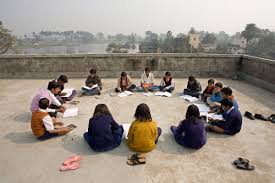
Literacy, learning, society-building in action. Where in the world?

Now, speaking of “the alleged decline of reading” mentioned by the great Ursula K., the Bahá’í community reads like crazy! The ancient references to the “people of the Book”, applied notably (and approvingly) by the Qur’an to Jews and Christians, also pertains to the followers of Muhammad themselves. In the Faith of Bahá’u’lláh, reverence for these and other holy scriptures is deepened by adding a whole modern canon of the Word. “In the beginning was the Word,” says the New Testament (John 1:1), to which I dare to add this: the Word has remained alive, and been renewed, and shall ever continue as the foundation of human progress and comprehension. That’s my take on the Bahá’í take on the power of the Word.

The Bahá’ís, too, are “people of the Book” in their high regard for the sacred teachings and writings of the major world Faiths, as well as the traditional wisdom of Indigenous peoples. It is not some passive, token respect for holy writings. They actually read them. For example, faithful believers are asked to read from the Faith’s writings twice a day; not for long, necessarily, but as part of their spiritual hygiene. What’s more, the worldwide community has adopted, as one of its core activities – all of which are open to the wider public – a series of “study circles” that enhance one’s understanding and application of the Bahá’í principles. (Check ‘em out: truth, justice, love – the old faithfuls – as well as the essential oneness of humanity, the equality of women and men, the fundamental harmony of science and religion, and the eradication of all forms of prejudice and oppression. Yup. Astounding stuff.)
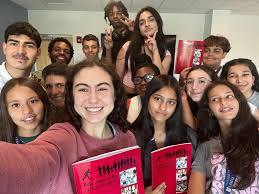
These young’uns are from Boston, could’ve been my town or yours.

The initial sequence of courses has titles like “Reflections on the Life of the Spirit”, “Arising to Serve”, and “Releasing the Powers of Junior Youth”. For the Baha’is and their friends, though, in-group shorthand just calls them Book 1, Book 2, and Book 5. (People of the Books!) And you’ll find such study circles, if you look a bit, just about everywhere in the world. They work. Learning happens, habits build, trust is established. And more: the act of reading, and of education generally, is celebrated and valorized in the most grassroots way. I’ve seen photos from all over the world — what happens when a study circle is complete? In a most charming and counter-cultural tradition, the group will have a photo taken, smiling friends holding up their red or yellow or green manuals. They might be saying, with their grins, We love our books! It’s been great to study and learn together! We even memorize certain passages! We are learning to not only read the Word but to read the reality of our place and time, and we find great hope in our shared community-building. How’s that for enthusiasm for the importance of the written word?

Thanks for staying with me! And now, back to Ms. Le Guin, for one of the clearest and most emphatic arguments for the power of the word (not to mention The Word) that I have read.

“At about the two-thirds mark in her essay, Le Guin acknowledges the variety of ‘entertainment media’ available to the modern data-consumer; after all, “the Internet offers everything to everybody: but…there is curiously little aesthetic satisfaction to be got from [it].” And then she gets to the heart of the matter; here is why reading matters SO MUCH to so many of us:
Reading. Trees.
(Public Domain)

“…[R]eaders aren’t viewers; they recognize their pleasure as different from that of being entertained. Once you’ve pressed the on button, the TV goes on, and on, and on, and all you have to do is sit and stare. But reading is active, an act of attention, of absorbed alertness—not all that different from hunting, in fact, or from gathering. In its silence, a book is a challenge: it can’t lull you with surging music or deafen you with screeching laugh tracks or fire gunshots in your living room; you have to listen to it in your head. A book won’t move your eyes for you the way images on a screen do. It won’t move your mind unless you give it your mind, or your heart unless you put your heart in it. It won’t do the work for you. To read a story well is to follow it, to act it, to feel it, to become it—everything short of writing it, in fact. Reading is not ‘interactive’ with a set of rules or options, as games are; reading is actual collaboration with the writer’s mind. No wonder not everybody is up to it.

“The book itself is a curious artifact, not showy in its technology but complex and extremely efficient: a really neat little device, compact, often very pleasant to look at and handle, that can last decades, even centuries. It doesn’t have to be plugged in, activated, or performed by a machine; all it needs is light, a human eye, and a human mind. It is not one of a kind, and it is not ephemeral. It lasts. It is reliable. If a book told you something when you were fifteen, it will tell it to you again when you’re fifty, though you may understand it so differently that it seems you’re reading a whole new book.

“This is crucial, the fact that a book is a thing, physically there, durable, indefinitely reusable, an object of value.

“…[Meanwhile] [e]lectrons are as evanescent as thoughts. History begins with the written word. Much of civilization now relies on the durability of the bound book—its capacity for keeping memory in solid, physical form. The continuous existence of books is a great part of our continuity as an intelligent species. We know it: we see their willed destruction as an ultimate barbarism. The burning of the Library of Alexandria has been mourned for two thousand years, as people may well remember the desecration and destruction of the great Library in Baghdad [during the 2003 Iraq war]…”

[Italicized emphasis in the quote above is mine, not Le Guin’s. Read the whole essay here.]

Sunday School Picnic (non-Super Bowl edition)

Let’s talk about toxic religion!

 ***

Ask the people in Peshawar. (Though they might have a different answer than you’d think.) Ask in Paris. Ask anybody qui est Charlie. We could ask those affected by the Boko Haram militias spreading like a cancer from northeastern Nigeria, I suppose, if they were still alive, or if we cared about folks so unlike us and so far away. Even in boring old Canada, 2014 brought us faithful killings and rumours of more. What to do when religion goes murderous? (Spare a thought for doctors killed by Christian fundamentalists at abortion clinics, or women abused on Super Bowl Sunday. Beware the deadly fruit of any sort of fanaticism, any belief gone sour, whether it invokes God or racial superiority or football fever.)

You may have heard of “lone wolf” acts of terror in Canada, men allegedly inspired in the name of their Islamic leanings to kill peace-time soldiers who weren’t looking. (Ah, courage.) In the news recently were reports that Muslim Imams here in Ottawa were concerned at the spike of interest in Islam in the wake of the shootings at the national War Memorial and in Parliament itself. Muslim community leaders wondered aloud about some process of slowing down the new-found ardour they were seeing, and they questioned its source. How depressing! People are so desperate for a thing they can stand up for, I thought, they’ll fall for anything! Any port of committed action, however nutty, in an existential storm.

Commentators invoke loneliness and anomie, and lament that the mentally fragile, vulnerable to the attractions of religious madness, don’t get the help they need. What we rarely hear in the public debate is mention of moral bankruptcy, how entire societies and classes and governments appear to have little on their minds other than consumerism, the almighty GDP and personal comforts. How blind must we be to not see how hungry so many people are for a sense of meaning that rises above well I got mine and we’re the greatest country in the world and what’s wrong with those crazy bastards over there? And, more unsettling, right HERE.

North America – and, no doubt, for Muslims and many other sorts of barely tolerated immigrants in France and over much of Europe – is a hard place to be if you’re not on the winning side. (This is why sports are better than real life: one percent of players, no matter how good they were, could never kick the living snot out of a team ninety-nine times bigger, and keep on doing it and doing it.) No wonder the frustrated, “lookin’ like a dog that’s been beat too much / Till you spend half your life just coverin’ up” guys, even if they were Born in the USA or Ottawa or a Paris suburb, want to do something about it. Are we so smug, so insulated in whatever socioeconomic or cultural bubble we call home, that we really find such a search for meaning and usefulness incomprehensible? Yes. I think that most of us are.

Young men want to kill authority figures, or go fight with the “men of faith”. They want their lives to mean something, to stand for something. (Suddenly I think of DeNiro’s Travis Bickle in Taxi Driver: “Loneliness has followed me my whole life, everywhere….There’s no escape. I’m God’s lonely man….Listen, you fuckers, you screwheads. Here is a man who would not take it anymore. A man who stood up against the scum,…the dogs, the filth, the shit. Here is a man who stood up.” Talk about jihad!) This is all I could think of, hearing of an interest in Islam that was worrisome even to Muslim community leaders. It was days before I was able to consider another way of understanding it. There have to be some people (I thought, as the lights came on) who are just curious about what Islam really is. It’s slower to filter through than reflexive religious bigotry is, but after 9-11, after Charlie Hebdo or any number of atrocities committed by those who claim to honour the Arabian Prophet, there are always the voices, not always or even predominantly Muslim themselves, who say, This is not Islam. This is religion perverted to justify power-seeking and oppression.

And people learn something about the vast majority of Muslims, and they wonder what it is that compels believers to peacefully hold on to their faith in spite of suspicion, outright bigotry, and the humiliation, the resentment, the frustration, of constantly having to apologize for the misguided hatred of the fanatical few. I’m not denying that there are Travis Bickles out there who see in jihadist extremism a convenient container for their disaffection and their revenge fantasies. But listen: religion has been around for a lot longer than the fashionably modern rejection of it. There must be something more to religion than hatred and ignorance and division, or it couldn’t have survived. We shouldn’t judge a Book because of a Bickle who carries it around with his rage.

That’s why I went to (of all things!) my local celebration of World Religion Day.

In Part Two, I wade into the teeth of a multifaith storm, and come out unbloodied, unbowed, and pretty darned hopeful. Refreshed. Coming soon. (Pinky-swear!)

Ottawa: Next Day

In Ottawa we’re breathing a little better today, security officials aside, though two young men aren’t breathing anymore.

Thre was only one shooter, as it turns out, after we spent most of yesterday worrying about a team, one or two more of the conspiratorially unhinged. No, he wasn’t among the list of the “radicalized” 90 our secret service and police have been looking out for. Thankfully, there aren’t too many evil masterminds here in Real Life, and this tragedy now appears to be what it usually is: some damaged sap who’d lost his balance, and wanted to take somebody down with him. Thankfully, too, he may not have been a very well-organized one, or Nathan Cirillo might not have been alone in paying the ultimate price.

Cirillo earlier that morning, member of a proud Argyll and Sutherland Highlanders regiment that is prouder now. (Photo by Cody Slavik)

Cirillo earlier that morning, member of a proud Argyll and Sutherland Highlanders regiment that is prouder now. (Photo by Cody Slavik)

Maybe he – I will not name him – was just another lonely loser “inspired” by his distant, cock-eyed brother in spineless mayhem, the one who’d run over a uniformed military officer in a Quebec parking lot earlier this week. (Courage!) Like him, he may have labelled himself Hero, and felt the rush of action-film adrenaline and game-boy significance. He was Doing Something About It, whatever in twisted hell It was. Here were pathetic would-be saints of a faith they didn’t understand, Internet pawns of power-mad bigots who use religion as a means by which the lost, the undereducated, and the toxically resentful can get even, or become something of a sociopathic somebody.

Continue Reading >>

(Building Anew)

Blurt 22: I’m not Christian by orthodox definitions, but I know the need to be “born again”. I renew my vows irregularly and often. My physical birth is a myth in black and white, and it’s body downhill from here, but there is a mind to be mined and loves to be learned. Individuals long for it, so why wouldn’t whole creeds and congregations also need renewal? What would a born-again Christianity look like? Where is the rebirth of Buddhism? Islam, remade?

Theodore Roosevelt (on deeds-not-words, on *Jihad*)

* In the Islamophobic (and Islam-ignorant) West, we tend to have a hostile perspective on the Muslim concept of jihad, often translated as “holy war”; we think of burning towers, violent coercion and hate. I’m no Islamic scholar, but I think Roosevelt’s famed “Man in the Arena” speech, quoted partially below, is actually a pretty good description of the highest meaning of jihad, as I have come to understand it. I wrote about my efforts in understanding Islam here, plus two other posts that immediately followed. The particular discussion of jihad is in the second one. Roosevelt was talking, in gritty and athletic terms, about citizenship, and I’m fairly sure he wasn’t thinking of jihad at all! It fits, though, and here is part of what he said, the most often-quoted and beloved bit. I love this:

“It is not the critic who counts,…the man who points out how the strong man stumbles….The credit belongs to the man who is actually in the arena, whose face is marred by dust and sweat and blood,… who does actually strive to do the deeds; who knows great enthusiasms, the great devotions,…so that his place shall never be with those cold and timid souls who neither know victory nor defeat.”

Theodore Roosevelt, from a speech titled “CITIZENSHIP IN A REPUBLIC”, given at the Sorbonne, Paris, April 23, 1910. A fuller quotation of this part of the speech, along with my commentary about it,  can be found in an entry in the “On First Glance” section of JH.com, November 22, 2010.

2006 in Review: Some Pretty Good Posts

Greatest Hits of JH.com

Well, strangers and friends, I’ve caught the New Year bug. [Not to mention the technical cockroaches that have scurrying around my keyboard!] If every sports channel, newspaper and current affairs show can air its highlights of the Old Gregorian Year, then so can I. “I celebrate myself, and sing myself…” as Whitman wrote. (Perhaps easier to say when you’re Walt Whitman, but so far, I’m okay with it.)

If you’re one of those people (and you’re not alone!) who CAN get enough of my writing — if you’re someone who may have resolved to look through those archives for all the gems contained therein, but preferred to make a living instead — then here’s the Coles Notes version, some of the good things (sez me) on JamesHowden.com . It’ll give you a taste of what I’ve been doing, without having to slog through 173 posts.

There are selections from “At First Glance” (my general-interest, whatever-happens-to-be-on-my-mind pile), from the “It’s All About Sports” section of the site (which IS), and from “On Second Thought” (generally longer, more considered articles and essays, although this section has largely been taken over by the “Old Dog Year” (ODY) chronicle of my mid-life quest to play the guitar). So: here comes a list of some of my favourite entries from 2006. It’s pretty random – hard to pick faves among your children – but these are nineteen letters that I wrote to you.

Letters to the Living. Read any that tickle or appeal to you.

NINETEEN: “Youthful Reasons and Dreams” talks about a Saturday night youth-fest at our place, and one evening’s Hopefulness Visible with the next generation. Dynamic, committed young people.

EIGHTEEN: “Four Straight Titles – Does Anybody Hear?” is one of several pieces I’ve written this year about the Carleton Ravens basketball men, one of the most extraordinary stories in sport.

SEVENTEEN: “Buddy Wasisname and the Other Fellers” is a review of a night at the Ottawa Writers Festival, one of the pleasures of my year. (Spring and Fall!)

SIXTEEN: “Twin-Billed Terrorism” is a double movie review of one blockbuster and one little-known independent film. Howdy goes to the movies; both come with a bang.

FIFTEEN: “Class Action, Nash and Klassen” looks at two of Canada’s most brilliant athletes (and people, I think). Mr. Howden Takes a Stand on the Lou Marsh Award.

FOURTEEN: “A Sunday Morning Voice from Israel” recounts an interview with a great writer I’d never heard of. Come to think of it, I never did write my review of David Grossman’s The Yellow Wind, which was the centre of this radio conversation; it was an important and brilliant book.

THIRTEEN: “Paradise by the Carney Lights” has nothing to do with Meatloaf. It’s about a night when faithfulness trumped glitz, at least for a minute. At least for me.

TWELVE: “February Empowers, Brings May Flowers…” is actually the story of a Valentine’s Day date gone horribly, well, right, I guess, though it wasn’t everybody’s romantic ideal. But Elizabeth May was there! We HEART environmentalists…

ELEVEN: “The Heart and the Congo” is a review of the Barbara Kingsolver novel The Poisonwood Bible. Just got around to it this year, and it got me.

TEN: “Just One. So Far. (Thank God. Thank the Cops.)” The Dawson College shootings in September hit me hard. Education, youth, belonging, the way we care for and feed our young men: this is my street.

NINE: “J-MAC and the Miracle: Everything Sport Should Be” is my take on a story that microwaved many hearts: autistic kid gets to be manager of the school basketball team, gets a chance to dress for the final home game of his career, actually gets a few minutes of playing time, and goes on an incredible scoring spree. “I was just on fire,” said Jason.

EIGHT: “Remembering Iran” is an account of an evening with two Canadians who know and love that place, its history, its beauty and its modern struggles. Jean-Daniel Lafond and Fred Reed made a movie, wrote a book, and spoke eloquently about each.

SEVEN: “On the Walrus Shelf” is part education rant, part literary appreciation, and part proud fatherhood. This was an evening when it was great to be on the shelf.

SIX: “Dar at the Noir” recounts another fine evening, this time in the company of folksinger Dar Williams and a few hundred of our closest friends. She’s tremendous.

Ah, we’re getting close now, friends. Countdown!

FIVE is for FAITH: That of Muhammad, in this case. A few dozen of us sat down with a fine scholar last August, and “Another Shot at Understanding: Learning About Islam” was the first of three (non-scholarly, but I think pretty readable) commentaries I wrote on Dr. Lawson’s lectures. We need to know.

FOUR wants MORE: There are several choices I could have made here, but this is a taste of something I’ve written an awful lot about: my “Old Dog Year” (ODY) of shutting down embarrassment and other hesitations and picking up a guitar. I have, for over 130 straight days now, and still no invitations to solo with the Stones. “Words AND Music?” is the genesis of the whole silly, obsessive (and sometimes delightful) project, which I have been ruminating about in “On Second Thought” since August.

THREE is for THRILLING ATHLETES (and how THTUPID they can be): I love sport. There are few things, however, that infuriate me more than athletic excess, when idiocy rules the playground, and especially when foolish or horrid things are done in the name of sport. (Religion isn’t the only institution that is stained by those who love and use it.) “O Zizou, Zizou, wherefore art thou so SELFISH?” is my look at Zinedine Zidane’s infamous Head-Butt Heard ‘Round the World.

TWO is for my HOMETOWN: I don’t have to do as much explaining about where my home and native town is anymore. People have heard of Caledonia now, for reasons sad and frustrating. “A Little Nightmare Down Home” is a bit of a lament for the banks of the Grand and the peoples that share it, and something of a memoir.

ONE is for my MUM: Everybody liked Enid. She was a brave and loving woman and she finally slipped away last fall. I have to put my remembrance of her at the top of this little list. And it’s not really a tale of grief and loss, though there was some of each. She had a wonderful family; it was a wonderful life. So here’s to you, “Enid Mary Elizabeth Howden”.

And that’s all, folks! Thanks for your interest, and have an encouraging 2007…

Learning About Islam III

Two final points that I took home from a Saturday with an Islamic scholar, Dr. Todd Lawson. We were asked to define “Islam”, and some of us were able to come up with the standard World Religions course meaning: “submission to the will of God”. Dr. Lawson went farther. (I won’t trouble you with the Arabic explanations, which I’d be sure to butcher anyway.) On a personal level, adherence to Islam can be defined as the opposite of those who were (or are) “ungrateful”. Therefore, it signifies a grateful commitment to divine teachings as given by Muhammad. On a societal level, Islam defines itself as the opposite of the ignorance that produces savagery and barbarism and mercilessness. Even today, a genuine understanding of Islam defines it as civilization, enlightenment and peace.

So why do we speak of the “clash of civilizations”? Why does the “war on terror” so easily come to appear as a “war on Islam”? Dr. Lawson was emphatic: “There is a widespread, nearly universal belief among the powers-that-be in the West that we have nothing to learn from Islam and Islamic peoples.” That cultural arrogance, he believes, must be eroded in order for understanding to be created. He reminded us that “certitude – about faith, about the spiritual life – is one of the great enduring treasures of the legacy of Islam.” Such confidence about life’s meaning, at the very least, is one of the things we can learn.

As is this: it was the Qur’án, among sacred scriptures, that first spoke of the concept of humanity, of the commonality of human beings living in a shared world. It also accounts for why the world was made with different communities and peoples rather than united from the start: “that they might know one another,” in the sense of mutual experience and understanding. How modern is that? In a world such as ours, in a country like mine, these encounters happen constantly. We’re learning from Islam, whether we want to or not. We should try to learn the right stuff. Fast.

Learning About Islam II

Here are a few more of the things I learned (and re-learned) about Islam from Dr. Todd Lawson, Islamic Studies professor at the University of Toronto. I and several dozen of my new best friends spent some weekend hours in retreat along the mighty St. Lawrence. (Retreat? Advance.) Doctor L was one of our tour guides.

• Not only are we Headline News-infected with our talk of the Problems of the Middle East, but we are geographically self-centred. The “Middle East”? In comparison to what? (Not China or India or South Africa, I’m thinking. I wonder what Australian media call the region, far to the north and west of that European outpost.)

• Knocks on Islam I: Treatment of Women. Dr. Lawson was emphatic. The Qur’án is quite clear on gender equality. The holy book calls for modesty for both sexes, while the custom of veiling has been exaggerated by male domination. (And stems, in any case, from pre-Islamic cultural norms of protection for upper-class women in busy trading centres). And he reminded us not to be too smug about the so-called glory of the lives of Western women, and to remember how recent are the freedoms accorded to women in our own society.

• KOI II: Polygamy. The allowance of up to 4 wives (with the main purpose of protection of orphaned or otherwise disadvantaged women) was predicated upon absolutely equal treatment for all, in utterly practical economic ways, in a cultural context dramatically different than today’s.

KOI III: Conversion by the Sword. This has been much exaggerated by antagonistic Christians trying to win the “my prophet’s better than yours” game. After the ages-old back-and-forth of conquest and loss between the Persian and Greek empires, the peasant populations of a given area were generally relieved by Muslim conquest: they were not forced to convert; there was a relatively just and consistent social order; culture and education became more readily available. Of course the masses of people became Muslims. Life had become better under the spread of Islam.

• KOI IV: Jihád. “Holy War”, it has often been translated, and that idea is certainly propounded by militants and power-seekers. I’ve heard many Muslims translate it, though, as “spiritual struggle” and consider it more of a personal challenge to live up to the standards of their Faith. I hadn’t heard this story, though, which Lawson shared from (I think) the Hadith (traditions) associated with the life of the Prophet. Muhammad, upon returning from a military sortie to protect the “Dar-el-Islam” (the abode, the haven of Islam) from the aggressive surrounding tribes, told His followers, “I have returned from the lesser jihád to the greater jihád.” Mystified, they asked, “Where is this greater jihád?” The Prophet said nothing, but pointed to his heart.

• KOI V: A Religion of the Law. This knock is an odd one, considering that the Dar-el-Islam eventually brought law, order and peace to an enormous number of people across a huge geographical area. It tries to paint Islam as a harsh and judgemental religion compared to that of Jesus Christ (the “Spirit of God” much revered by the Qur’án) and His message of love. (Let’s leave aside the brutal wars and inquisitions undertaken in the name of Christ. They were about as truly Christian in character as suicide bombings are representative of the teachings of Muhammad. Don’t blame the Messengers!) And yet, every single surih of the Qur’án (but one) begins with an invocation of universal love: In the Name of God, the Merciful, the Compassionate. Converts to Islam, a thousand years ago and still today, do so not because of compulsion (“we cannot change a community until it changes itself”, says the Qur’án) but because of loving examples and a compassionate social order.

I could go on. (Yes, I know, I already have. But I made such great notes!) More anon.

Another Shot at Understanding: Learning About Islam

One of the good Doctor’s opening salvos was this. Imagine if what others knew about Christianity began and ended with Hitler. He was nominally a Christian. His troops stormed into the Sudetenland with the words “God is with us” engraved on their belts…For this, Dr. Lawson argued, is precisely the skewed perspective of Islam that too many of us have swallowed with our supper-hour newscasts. Bombings = Islam. Islam = opposition to progress. Islam = two thirds of the Axis of Evil. (Oh, the curse of speechmaking!)

Lawson is a professor of Islamic Studies at the University of Toronto, and our little family had run away on this weekend of thought and refreshment largely to hear him speak. He wanted us to think about revolution, one of the main casualties of which, no matter how praiseworthy are its aims and programs, is history. And among the histories we may think we know (but emphatically don’t) is that of Islam.

Dr. Lawson argues, for example, that “Europe was precisely defined  (geographically and otherwise) by its defensive and offensive resistance to Islam”. In large measure, this is why Europe was so dark in the Dark Ages, whereas northern Africa and western Asia shone with Muslim civilization. Islam predominated in Spain, for example, for 800 years, more than three times the duration of the United States of America. In addition to co-existing amicably with Jewish and Christian communities, Islamic cities like Cordoba (and, not incidentally, Baghdad) were centres of arts and architecture, medicine, science and commerce.

The European Renaissance can be traced to its eventual increased openness to the scholarly, artistic and other resources of the Islamic culture that surrounded it. Avicenna – the Latinized name of the Persian Ibn-Sina, a gifted astronomer, physician, poet, mathematician and philosopher – was an 11th-century Muslim that Lawson terms “one of the four or five greatest geniuses of world civilization”. We know Leonardo, but we are ignorant of those that preceded and made him possible.

Our tour guide of Islamic culture and contribution debunked the standard criticisms of Muslims: their treatment of women and of apostates, their so-called “conversion by the sword”, their relative cultural decline in recent centuries, the much-muttered but sorely misunderstood concept of jihád. Lawson also emphasized the deep-rooted garrison mentality of the European heritage, in which a more powerful and more advanced Islamic civilization was feared and demonized as the “barbarians at the gates”. Those bogeyman whispers can still be heard in our contemporary public discourse.

Lawson, while not himself a Muslim, argued passionately in defence of Islam. One of the silver linings of the West’s forced encounter with Islam is that understanding is slowly growing. Muslim and other educated voices are raising the image of the Faith of Muhammad around the world. Dr. Lawson pointed out a remarkable irony: members of the Bahá’í community, branded as heretics and victims of persecution in some Muslim countries, are called upon to understand and defend all that is noble and good in Islam.

There was much more, brilliant and fascinating. (And oddly reassuring. This stuff CAN be understood. Okay!) I’ll offer more snippets another day.