Rss

Tilting at Track ‘n’ Field

The Don and his loyal sidekick, Sancho Panza. (Where is my Sancho?) They seek great deeds, and charge against windmills… (from Wikipedia)

[4-minute read]
[This was originally posted on May 27/26 under the “It’s All About Sports!” rubric.]

I really must read Don Quixote. Many say it’s the first great novel in Western Literature, written in Spain while Shakespeare ruled English theatre. Early 17th-century work of genius, fully titled The Ingenious Gentleman Don Quixote of La Mancha, by Miguel de Cervantes. Maybe you’ve heard of it. I’m amazed I’ve never gotten ‘round to it. And no, this isn’t English class, and yes, we WILL be talking about sports. Metaphor alert! Hang on tight now!

(Look, never mind my career as a high school English teacher and alleged lit-wit. Ignore the pretensions, the haunting of Writers Festivals (pre-eminently my Ottawa local) and poetry-adjacent mooning (and jooning) and my long affection for being among readers even less accomplished than me. (Hello, Room 2011! Hello, ENG 3A1!) Pretend, you and I, that we barely notice all the faux-brave resolutions and horse-wishes about finding myself, thorough-going small-town balls-for-brains that I was and remain, in the art of writing, and maybe even finding the artist in me. Yeah, Don Quixote is a substantial hole in my reading resume, and likely yours, too. Call yourself a READER? Et cetera.)

But even that cliché shame doesn’t quite cover it, since I know myself to be more than a little “quixotic, i.e., /kwɪkˈsɒtɪk/, defined by Merriam-Webster as the foolishly impractical pursuit of ideals, typically marked by rash and lofty romanticism” (Wikipedia). Furthermore the expression “tilting at windmills describes an act of attacking imaginary enemies (or an act of extreme idealism), [which] derives from an iconic scene in the book.” (This was also Wikipedia.) Don Quixote was so buzzed out on his reading of romances that he charged into noble battle against, yes, windmills, which he mistook for the kind of fearsome monsters that noble knights slew and saved the day in books. Rash romanticism? Extreme idealism? Me? Heck, I spent the bulk of my professional life as a high school teacher in a couple of southern Ontario towns. I loved baseball and hockey, football and basketball, and have long coached the latter as if world peace and climate justice depended on it, as I like to say. Is that the biography of a crazy idealist undertaking missions ridiculous?

‘Fraid so. I have charged, on an overloaded donkey, sporting a rusty sword and a lance not much longer than my left arm, numerous windmills of my fevered athletic imagination. (Ask Cap’n Gord about my vision of new lights, a large grandstand and the hundreds-nay-thousands watching the Mount Hope A’s play Senior Men’s fastball. I played shortstop, batted leadoff, wasn’t bad, but in my mind was headed for the Olympics in a sport the IOC barely considered.) (Ask Coach Donny, who shared – though less scarred by ‘rash and lofty romanticism’ – my vision of challenging the great high school hoops teams of Toronto from the banks of the Grand River in a small hockey-mad town. I played the role of a less accomplished Chip Hilton turning into a Coach John Wooden Of The Western Niagara Peninsula. But we never quite made it to small-school provincials.)

The most recent evidence of this quixotic strain, this passion for the unlikely, comes at a French Catholic high school where I find myself coaching, deep into retirement from teaching, a junior varsity basketball team. I’m in a good-sized city this time, working alongside a fine young coach, but again as if world peace…etc. (And as if my remaining hair was on fire.) I still love it. Kids get fine things from it. I feel useful and engaged. And for a couple of years now, realizing how much high school ballers would benefit from such cross-training, a Phys. Ed. teacher and I have tried to develop a track ‘n’ field program, une équipe d’Athlètisme.  

I must be nuts. Another windmill? A big-city championship in school basketball, in a time when AAU clubs and alleged “prep schools” are ascendant, isn’t improbable enough?

I convinced, Mighty Persuader that I am, two of my kids (and not ONE varsity ballplayer) to make their fairly half-arse efforts at being tracksters. They weren’t really feeling it. But still I fell, rookie coach and raging romantic fool that I am, in athletic love with a group of new kids who initially came out for my back-hall Speed’n’Power training in March. Not gonna lie, as the kiddies say: it was such a pleasure to get to know and coach a number of girls, mostly in grades 9 and 10, who are regularly more pleasant and grateful and funny than their male peers. Some of the school’s best athletes made occasional appearances, wanting to get a few days off school for this year’s more ambitious slate of meets. Times went down and measurements rose.

Still, unlike Don Q, the “man of La Mancha”, reality does eventually register with me. Few kids were able to sustain much commitment to this new adventure of building a track and field team. “Coach, I train on my own for my soccer (or football, or hockey, or basketball, or improv) team…” As coaches, we tip-toed in setting expectations; predictably, most showed up for the bare minimum of events and, after a month, for way less than that. Sheesh, we had two kids take a pair of days off school for the City of Ottawa championship meet without having been to ANY of the previous ten practices. Good athletes, nice kids. Not my idea of team- and culture-building. Reality bites. Dreams grow mouldy.

The tabs of my laptop are littered with videos on the arm mechanics of hurdlers and the footwork of triple-jumpers; meanwhile, our school has a cruddy gravel track, no starting blocks, the most embarrassingly cobbled-together imitation hurdles, and one weedy jumping pit. But never fear! I see provincial championships and NCAA scholarships and genuinely strong and fit basketball boys in our future. Well, I did sustain that dream for a month or so. Athlètisme might even have a lower social media Q-score than hoops in my city, but there’s this: the best track and field athletes in Ottawa were all at the City championship meet. The best of them are members of the Ottawa Lions TFC, and are FAR out in front of the field. I’ve picked out a handful of names to watch for in future Olympics. And hey, we did have two athletes, admittedly inexperienced but in non-marquis events, win Novice (girls javelin) and Junior (boys 300m hurdles) titles. Eight more kids qualified top-five to go to Regionals tomorrow and Friday. (So did I!)

But as the chief coach, acknowledging my excellent general knowledge about track and field (Olympic Games quadrennial appointment television!) and my rudimentary technical skills in teaching events I never participated in, I can’t help reflecting that this “team” practised substantially less often and far less hard than my middle of the road JV basketball team. Still, I habitually think, Okay, it’s a start. We’re building something that could be meaningful, that kids would care about for more than just a barely-earned day (or six!) off school. From tiny acorns mighty oaks do grow. If you build it, they will come. And so on.

Right this minute, I’m not convinced. The kids sure aren’t buying it! I don’t like admitting defeat, but the alternative feels suspiciously like slaying monsters that don’t exist.

Windmills, man oh man. Windmills.
Back on Track and Fielding My Age

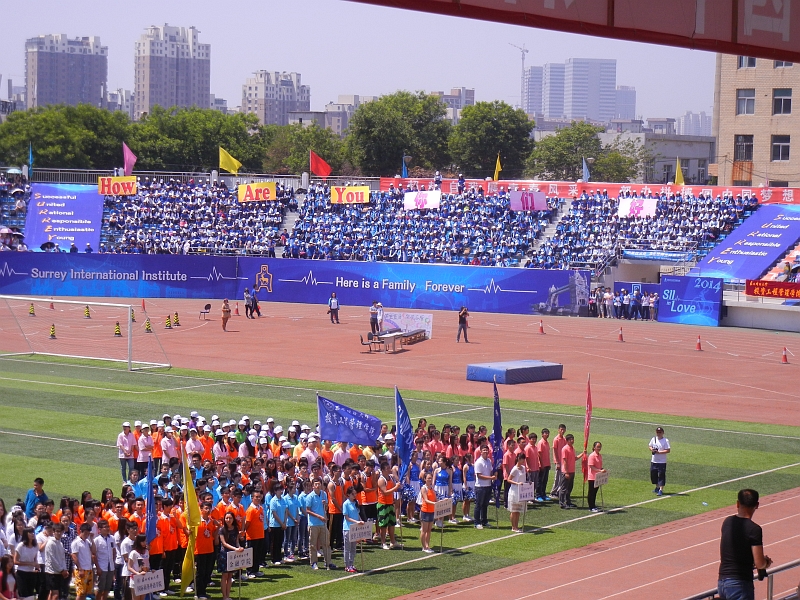
Surrey goes all out, image-wise. They're the blue-clad spectators, here during the "march of the somebody-or-others". Like me.

Surrey goes all out, image-wise. They’re the blue-clad spectators, here during the “march of the somebody-or-others”. Like me.

When I wrote last June about my first in-depth experience of a Chinese university’s annual “Sports Meeting” — a low-performance track and field meet — I was still quite flabbergasted by the whole thing. It was an incredible show that put the circus into the “bread and circuses” recipe for keeping the mass of people contented and amused, and yet everybody takes it so seriously. I swung wildly between my reflexive love for young people giving their hearts to sport — even for a day — and my disgust with what a paltry, occasionally harmful and clearly manipulated “opportunity” the kids actually had. I liked that athletic kids got to run and jump, and hated that many participants and nearly all the spectators weren’t there by any shade of their own choice. The whole thing really wasn’t for the students at all. Mianzi, it’s called. “Face”: making the university and its officials look good, and the university experience a “colourful” one for a day or two between the grey student months. Look, you had the Sports Meeting. Wasn’t that fun? Umm.

I was also a little ticked that I and younger foreign staff hadn’t been invited to join in. Oh, we wore our hats and marched (badly) in the mini-olympian opening ceremonies, but there were faculty races, too, but no wai guo ren had been asked. Then, a week ago, I got a surprise text, asking me to join one of the funky sprint relays that Chinese meets feature. In this case, it was six men and five women, with two 100-metre, six 200-metre and three 400-metre legs. In a “training session” last Monday, I got smoked by young Mr. Zou in a 400 trial, which meant that I’d be a 200 Man, with a shorter distance to lose time in. The goofy thing is that 50-something males – well, at least one that I know of – can still get pumped about silly athletic contests. (Okay, love, I’ve got a week to lose five pounds! Did, too.)

Continue Reading >>

T&F in China (Pt. 2): Running Hard, Who Knows Why?

Part 1 of this piece, a rundown of a track and field meet in a Chinese university, can be read here. It ended with the writer noticing more people out for a run at his campus’s outdoor stadium:

…I liked the athletic company, though there were nearly always as many walkers as runners, and some of the runners looked pretty grim about the whole thing. On the day of the meet, I saw why their training looked so dour. They weren’t exactly staring death in the face, but perhaps they couldn’t help but notice his pimply younger brother.

My feelings careened all over the emotional map during the women’s 3000-metre race. It was glorious, pathetic, dramatic, and a complete mess. (So was I, by the end.) Contrary to all the rules of track competition, many of the schools had conscripted a young man to run alongside their female entrant, while others had a relay team taking one or two hundred-metre turns urging the runners on and charging pell-mell across the infield. Some of the go-go girls carried water bottles, and would fling handfuls at the faces of their favourite athlete on this warm day. Some competitors plodded drearily, hands on exhausted hips. There were two heats of this spectacular struggle session, so as the lead runner was heading for the home stretch, she lengthened her stride trying to achieve a winning time. A dozen young men ran with her, just inside the infield, occasionally barrelling over a race marshal or spectator. Her desperate effort across the last hundred metres had me choked with admiring emotion. The glory of sport! Even here! What a noble effort! But as I moved closer to the finish line, I saw a growing collection of young women, dazed and prone, or in a couple of photogenic cases (but sorry, no photo!) a limp body being carried in the arms of a young Galahad towards a patch of shade. Anxious teams of friends and first-aid volunteers (with no training) fanned and flung water in a flurry of urgent and useless ministrations to fallen warriors. That’s when I started to get angry.

Continue Reading >>

Sports Day 1: Track & Field With Chinese Characteristics

JamesHowden.com is always concerned about the reading pleasure of its visitors. Because the report on my university’s June athletic competition is full of dudgeon and joy, it has been split into two parts. (Well, okay, my bride also said, “It’s too darned long!”) This is Part 1, while Part 2 is here.

I wrote earlier about the (nearly) annual Sports Day at my university (though that story only covered the day’s first 90 minutes). It is a mark of how deeply North America-centric I was (and likely still am) that I was mildly shocked, on arriving in China four years ago, to find that universities had no sports teams. The alliance between higher education and elevated levels of sporting competition is mainly an American thing, so I should’ve known; non-academic sports clubs and academies are the rule in Europe, Asia, and South America.1 There are glorified intramural basketball or volleyball games involving different faculties, which sometimes draw hundreds of drumming, shouting supporters. Yes, and there is (usually) a track and field meet, bumped off the schedule last year for the 60th anniversary commemorations of my university.2 In my earlier piece, I didn’t get past the pageantry, so here, by popular request3, is the sporting part of the story.

1 I may have been fooled by watching Kung Fu Dunk, starring Taiwanese singing sensation Jay Chou, known here as Zhou Jielun, on my first flight to China in 2009. A disgraced Shaolin monk (Chou, whom you might have seen as Kato in the movie version of The Green Hornet), is recruited by a semi-criminal sleazeball to transfer his other-worldly martial skills into stardom in the C.U.B.A. (Chinese University Basketball Association). It was spectacularly and delightfully bad. Anyway, only a few prestigious universities participate in the CUBA, which it turns out is mainly a place to enroll unqualified students – those who came up through State basketball academies, but have no future as pros – for the glory it will cast on school administrators. Hmm. Maybe it’s not completely different from American schools…

2 That day had pageantry and enforced student enthusiasm by the bucketful, so apparently there was no need for running and jumping that year. This reinforces my suspicions about what this “athletic meeting” is for, and for whom.

3 Well, my buddy JP has been bugging me about it. And my wife. That’s popularity!

A view of the finish line area from across the infield: officials, marshals, timers, medical volunteers, team spirit leaders, and a bunch of random people milling about. Photo: J.P. Mayer

Continue Reading >>

The Party, the Bread, the Track, and the Circus

God knows that I love bread. (Bread and I, however, are in the midst of a relatively amicable separation, and my waistline has noticed.) The student body at my university, and especially at the rich-kid college within it where I teach, is of a particularly well-fed demographic, and they see their grindstone bachelor’s degree exclusively as job training, nothing more. (The majority work in majors chosen for them, often with no real interest or aptitude in the subject but only faith in the promise of the “comfortable life” that most Chinese — understandably — seek.) Though privileged within Chinese society, they do endure acres of boredom and megatons of rote learning, so the circus does come to town. And though I am not above the occasional superior sneer at the circus entertainments chosen by others, I’m still a sucker for the Olympic march of the athletes, small-town parades, the communal experience of fireworks. Even loners like me love a good show, some high-wire performance, but I was recently put in mind of the ancient Roman poet Juvenal’s scorn of the use of “bread and circuses” to pacify a population.

It was Sports Day at my university in northeastern China, a day common to most schools here. It is a more of a show than a track and field meet, and actually two days of class are

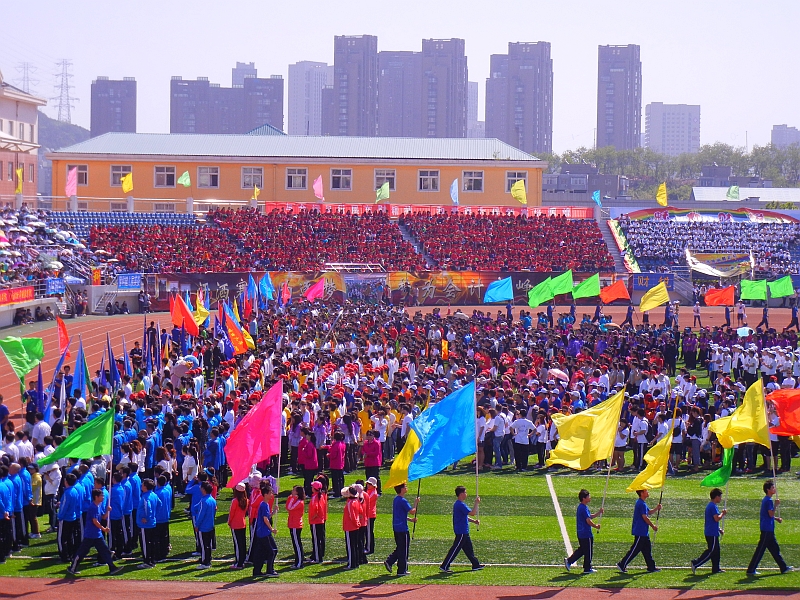
The March of the One-Time Athletes. A beautiful day for a show. (Photo: JP Mayer)

sacrificed for it. Many students are required to miss class sessions in the days before in order to prepare, but not for their events. In a country where precious little importance is given to physical education – except, that is, for the tiny minority selected in their youth or childhood to attend State sports schools and bring sporting honour to their province or their Olympically-ambitious country – this once-yearly festival of geng kuai, geng gao, geng qiang (“faster, higher, stronger”) sees astonishingly little athletic preparation, or even the possibility of it. It drives my Canadian friend JP, a masters decathlete and long-time high-school coach, just slightly bonkers.

Continue Reading >>