Rss

Trust Me, They’re Tired: Venezuela’s Pain, and the Emptiness of Cliché

[3-minute read]

Martin Amis wrote a fine book called The War Against Cliché. He’s mainly known as a novelist, though for too long he was just “Kingsley Amis’s bad-boy son”. That cliché, at least, had been retired decades before Sir Martin’s long and accomplished life ended in 2024. But why would a collection of his essays have been titled as an all-out attack against familiar language? I couldn’t carry his pen-case, but I’m with Amis: “To idealise: all writing is a campaign against cliché…”

Listen: we have the expression “it’s a cliché for a reason” for a reason. Sometimes an old saying is a useful reminder or a profound comfort; my mother never wearied of gently saying, in the face of misfortune or gloom, it’s always darkest before the dawn (Thomas Fuller, 1650) and all things work together for good (Paul’s epistle to the Romans 8:28, about a millennium and a half earlier). And yes, whoever first said, about some sport or another, that “it’s a game of inches” knew what he was talking about. It expressed an evergreen truth about the games we watch and play. Still, the best jock commentators try to avoid saying it, or give a rueful shrug of apology when they do. Because it’s OLD. It’s TIRED.

But there’s more to Amis’s war, to every good writer’s battle against cliché, than simple fatigue or a wish to seem stylish. And it applies, to a less obvious but maybe even more essential degree, to all of us. It’s this: How can we know if we’re actually thinking if we merely recycle a set of phrases that we have heard from others? The creative writer (painter, film-maker, dancer) restlessly desires to make – even though there’s nothing new under the sun (Ecclesiastes 1:9, several centuries before St. Paul) – something novel, illuminating or (at the very least) interesting. Some describe poetry as the constant renovation, the organic renewal of language. Is that process merely about the quest for a fashionable phrase, some nifty bit of in-group vocabulary?

No.

There’s a crucial and mightier argument. If we’re not actually thinking, actively seeking understanding for ourselves, then we are subject to, in no particular order, empty-headed and derivative pop culture (bingo!), a heartless and bland societal conversation (John Ralston Saul’s “unconscious civilization”), endlessly persuasive Mad Men media urging us to Buy What They’re Selling! (now!), not to mention tyrant business monopolies and their pet politicians greasing the skids for autocracy. (I apologize. “Greasing the skids” is a cliché, though perhaps you’re young enough that it feels refreshing to you as an alternative to “paving the way”.) Thinking as I was about Martin Amis et sa guerre, I ran across a 15-year-old column from The Guardian lamenting, even back then, how decisively Mr. Amis had lost his War. (It’s rather British, but a lively rant against cliché.)

All of which leads me to this morning’s encounter with an online news digest from National Public Radio, an American treasure that is under attack. (Not by me, understand.) My bride and I have been touring Ontario, but our ten days of relatively news-free travel are over. I was having an oh shit re-entry into dismay, mostly at the fate of poor suffering Venezuela. For that country to endure monstrous natural disasters, on top of the human-made kind, feels like cruel and unusual punishment. (A cliché, yes. I’ll stand by this one.) From NPR: 

“The search for survivors continues nearly five days after two powerful earthquakes hit Venezuela. The official death toll is nearing 1,500, and thousands of people are still unaccounted for. Families and volunteers are tirelessly digging through collapsed buildings throughout the northern coast and in neighborhoods of Caracas, the country’s capital, in hopes of finding people alive.” (NPR’s second bit of “news we’re following”; Iran and the United States ceasing to cease fire, surprise, was number one on June 29, 2026.)

It’s awful. And just to be foolishly clear, it’s not the journalistic blandness in general that has my Cliché Alert sounding on a sunny Monday morning. Yes, “search for survivors”, “death toll” and “unaccounted for” are over-taxed phrases, but this is not poetry. Readers want to get their information efficiently, and NPR points them towards more detailed accounts if they want them. No notes, no complaint. It’s just that I have grown chronically fatigued with the adverb “tirelessly”. Obituaries of any respectable professional or half-diligent labourer are almost never without it, but it’s not just the overuse and the lack of genuine thought. It’s the lie.

Don’t start my obituary yet, but I’ll ask in advance: Please don’t use “tirelessly” to describe my life’s work as a dad, or as a midnight grader of English assignments, or as a basketball coach addicted to “the grind”. I wish we could retire the word tirelessly, and for good. (“Indefatigable” is less shopworn, but has too many syllables and is equally untrue.) I was exhausted by all of that. I still am. Life at its best, for most of us, is still tiring.

But widen the scope. As they find themselves in an epic tale of tragedy and pain and heroism, too, I am unsettled by the mere thought of that South American aftermath. Consider that legion of unhappy souls, labouring desperately to find loved ones, neighbours and strangers in a deeply shaken Venezuela!

They’re tired as hell. And they’ll keep going. It’s human nature.
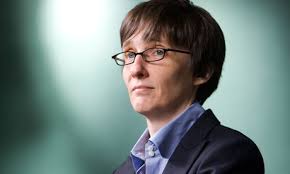
A.L. Kennedy (on rewriting and joy and justice)

Wendy-joon, who doesn’t Tweet – who doesn’t even write much, that I know of – is nonetheless a chronically well-read haunter of libraries. If you see her driving ‘round town, you may see a slightly open-mouthed look of attention on her face, an intense calm, if she’s listening to one of the books-on-CD that is among the 7 or 27 that she’s borrowed from her local branch. (Libraries! What pillars of civilized living they are!) And now that I’m officially an Automobile Owner again, she even has me hooked on the habit of listening to books. Yesterday, a 20-minute stick-shift errand turned into a two-hour drive because of Marilynne Robinson’s novel Home, but that’s not what this post is about.

I like this person. This photo courtesy of The Guardian, where I think her blog appeared. (Or appears.)

I like this person. This photo courtesy of The Guardian, where I think her blog appeared. (Or appears.)

My Wendyful friend wouldn’t let me leave her home the other month without A.L. Kennedy’s On Writing. Stephen King’s same-titled look at the scribbling life was great, and I was up for another even if I’d never heard of Ms. Kennedy. She’s a wordsmith and often a funny one, but her artistic aim is true. Much of the book is simply a collection of her blogs on the writing life over a few years. They’re short, witty, wise, and not infrequently they draw blood.

So now I’m a Kennedy fan, though I’ve never read any of her six collections of short stories or half-a-dozen novels. She also teaches creative writing, an activity about which she is amusingly and reasonably doubtful. Yet as she went back to start a new term at Warwick University, she focussed on the delights of the job. One of those deep pleasures, in the midst of the general deafening solitude of her writing life, was the mere collegiality of the thing, the fellow-feeling, being among others for whom word-spinning is also bread and hearth and home.

The second great delight, she says, is in re-writing.

Continue Reading >>

Robert Frost (on (not)thinking)

“Thinking isn’t agreeing or disagreeing. That’s voting.

Robert Frost, 1874-1963, American poet, in a quote I’ve saved for years.* It makes for a fine back-to-the-future companion to my own, decidedly-less-concise March ’13 ramblings about the nature of thinking and not-thinking, here. I fear that our predominant culture — infotainment, media saturation, the obsession with the unimportant — makes the mature arts of reflection and profound knowing ever more difficult to cultivate. The Baha’is are doing some wonderful grassroots work to counter this tendency. The more I think about it, the more revolutionary, counter-cultural and necessary it appears. I don’t know much about the great Frost’s spiritual inclinations, but I think he’d dig the methodology, the “promises to keep / And miles to go before I sleep / And miles to go before I sleep”.

* Faithful readers of this site may have noticed that I’m gradually re-posting quotes that appeared over the years on the earlier incarnation of JH.com, and we’re up to 2010 already as of March 9, 2013. Hurray!

Are You Thinking Yet?

How do we know when we’re actually thinking? Someone once said that if you don’t know a second language, you can never know whether you are thinking or simply replaying a skull-encased recording of other people’s views, Coke jingles, cultural driftwood and stale tales that pass from gossip to “common sense”. But I speak a second language and shards of other ones, and while I love to find the way another coding system expresses an idea or an action, I don’t think that mental access to another manner of speaking is any guarantee of thought, either.

All this in light of the Robert Frost quote I recently found — “to learn to write is to learn to have ideas” — and use in every class and in my own auto-peptalks. Sometimes — I think — I come closest to genuine thinking when I’m writing. How can I know what I think ’til I see what I’ve said? (Somebody. Another orphan quote.) And maybe the repeated citation of other people’s bons mots is also a sure way to avoid original thought. But I doubt that. (!)

Return of the LitWit

So I raise my head blearily from the long, muddy furrow in which I’ve been crawling for several months – it looks, to the inexperienced eye, like a clean and well-lit classroom – and I remember I used to believe in a question.

How can I know what I think till I see what I say?

That’s the novelist E.M. Forster (A Passage to India, Howard’s End) reminding himself and any would-be-wise guy that writing is, among many other things, a way of understanding. Judging from my strangled output over the last year and more, I don’t understand much when I’m teaching full-time. (And coaching. And trying desperately to influence the young, face to face. Madly off in all directions. (Thank you, Stephen Leacock.) Running to stand still? Sometimes.)

I do know exactly where I am when I face a group of students. It’s natural, it’s demanding, and I’m only slightly less manic-energetic than I used to be. But the sense of déjà vu sometimes weighs heavily, and while I know exactly what I’m doing, and while even a ninth-grade French class can turn into a chance to clarify and express my views on matters mighty and minor, I am not finding Forster. I have not been stretching and stressing my brain and typing fingers. More and more, lately, I’ve been feeling this absence from my life, hence today’s self-involved posting.

I’m back, not that cyberspace missed me much. Today, I like writing.