Rss

Ursula K. Le Guin (on the alleged decline of reading)

[6-minute read]

One of her mightiest novels, but she wrote *everything*.

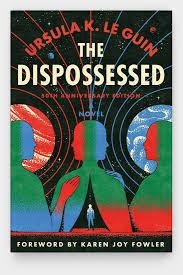
Ursula Le Guin is a hero of mine and, though often labeled as a ‘genre writer’, she is a giant of 20th century American literature. Her series of so-called “young adult” fantasy novels, beginning with A Wizard of Earthsea, were the first Le Guin books that I read. I recently finished The Dispossessed, a remarkable invocation of an extra-planetary society built on the principles of Anarchism, for a book club. (I’d read it before; I loved it again.) I’m midway through a fascinating, diverse non-fiction collection of hers, called Dancing at the Edge of the World. I was lucky enough to see her in conversation before an audience that packed an otherwise underused Anglican cathedral at the Ottawa Writers Festival in 2009. I cannot un-hear, from that electric evening, what her fiction so regularly upheld: her rejection of the trope, so common in speculative fiction (and Westerns, and comic books), of what she called “redemptive violence”. For her, this was an especially ugly non sequitur, a strikingly vulgar contradiction in terms. She radiated intelligence. Wisdom. There was someone to listen to.

Not long before this downright reverent reception at Christchurch Cathedral, in February 2008, Harper’s magazine had published her essay “Staying Awake: Notes on the alleged decline of reading”. I keep a photocopy of it. It anchors a school notebook where I keep irregular tabs on my own reading. “Staying Awake” begins: “Some people lament the disappearance of the spotted owl from our forests; others sport bumper stickers boasting that they eat fried spotted owls. It appears that books, too, are a threatened species…” and she goes on to cite both alarmed and shoulder-shrugging so what? reactions to the “alleged decline”. In the essay, she challenges mass-media’s sometimes gleeful response to surveys indicating that we read less, especially in book form. She takes the publishing industry to task with “amused contempt”; she is deliciously snarky as she bites the corporate hands that (carelessly) feed her craft. She analyzes historical and contemporary trends in literacy and what it means, and has meant, to our culture.

Most importantly, though, she centres her argument on what the act of reading actually is, and what it does with our minds. And what is a book, exactly? But wait. Before quoting the Le Guin perspective that brings us together here in electronic communion, please allow a short side trip. (If you jump ahead to read Ursula, who’s going to know? And how could I complain?)

So here’s a personal, but also amazingly planetary, narrative tangent. It’s all about BOOKS.

An abundance of good luck – and a massive adolescent absence of caution – has meant that I have hovered at the margins of the worldwide Bahá’í community for a long while now. This has meant several sweet things. I have a taste and an ongoing hunger for Persian food; the 19th-century foundation of the Faith in what is now Iran means that I’ve come to understand and love many Persian things and people! I have also known two hopeful and fruitful marriages to believers, the second of which is alive and well, and the first of which is now remembered with fondness and gratitude. I guess I could mention, too, that my worldview has been constantly expanded, enriched, interrogated and confirmed; the globe’s move toward unity and peace and justice is inevitable.

That’s the kind of mindset you can sustain if you hang around with the Bahá’í teachings  and those that seek to apply them. So, lucky me!
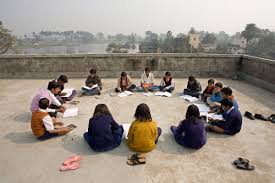
Literacy, learning, society-building in action. Where in the world?

Now, speaking of “the alleged decline of reading” mentioned by the great Ursula K., the Bahá’í community reads like crazy! The ancient references to the “people of the Book”, applied notably (and approvingly) by the Qur’an to Jews and Christians, also pertains to the followers of Muhammad themselves. In the Faith of Bahá’u’lláh, reverence for these and other holy scriptures is deepened by adding a whole modern canon of the Word. “In the beginning was the Word,” says the New Testament (John 1:1), to which I dare to add this: the Word has remained alive, and been renewed, and shall ever continue as the foundation of human progress and comprehension. That’s my take on the Bahá’í take on the power of the Word.

The Bahá’ís, too, are “people of the Book” in their high regard for the sacred teachings and writings of the major world Faiths, as well as the traditional wisdom of Indigenous peoples. It is not some passive, token respect for holy writings. They actually read them. For example, faithful believers are asked to read from the Faith’s writings twice a day; not for long, necessarily, but as part of their spiritual hygiene. What’s more, the worldwide community has adopted, as one of its core activities – all of which are open to the wider public – a series of “study circles” that enhance one’s understanding and application of the Bahá’í principles. (Check ‘em out: truth, justice, love – the old faithfuls – as well as the essential oneness of humanity, the equality of women and men, the fundamental harmony of science and religion, and the eradication of all forms of prejudice and oppression. Yup. Astounding stuff.)
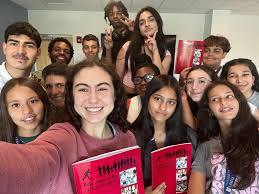
These young’uns are from Boston, could’ve been my town or yours.

The initial sequence of courses has titles like “Reflections on the Life of the Spirit”, “Arising to Serve”, and “Releasing the Powers of Junior Youth”. For the Baha’is and their friends, though, in-group shorthand just calls them Book 1, Book 2, and Book 5. (People of the Books!) And you’ll find such study circles, if you look a bit, just about everywhere in the world. They work. Learning happens, habits build, trust is established. And more: the act of reading, and of education generally, is celebrated and valorized in the most grassroots way. I’ve seen photos from all over the world — what happens when a study circle is complete? In a most charming and counter-cultural tradition, the group will have a photo taken, smiling friends holding up their red or yellow or green manuals. They might be saying, with their grins, We love our books! It’s been great to study and learn together! We even memorize certain passages! We are learning to not only read the Word but to read the reality of our place and time, and we find great hope in our shared community-building. How’s that for enthusiasm for the importance of the written word?

Thanks for staying with me! And now, back to Ms. Le Guin, for one of the clearest and most emphatic arguments for the power of the word (not to mention The Word) that I have read.

“At about the two-thirds mark in her essay, Le Guin acknowledges the variety of ‘entertainment media’ available to the modern data-consumer; after all, “the Internet offers everything to everybody: but…there is curiously little aesthetic satisfaction to be got from [it].” And then she gets to the heart of the matter; here is why reading matters SO MUCH to so many of us:
Reading. Trees.
(Public Domain)

“…[R]eaders aren’t viewers; they recognize their pleasure as different from that of being entertained. Once you’ve pressed the on button, the TV goes on, and on, and on, and all you have to do is sit and stare. But reading is active, an act of attention, of absorbed alertness—not all that different from hunting, in fact, or from gathering. In its silence, a book is a challenge: it can’t lull you with surging music or deafen you with screeching laugh tracks or fire gunshots in your living room; you have to listen to it in your head. A book won’t move your eyes for you the way images on a screen do. It won’t move your mind unless you give it your mind, or your heart unless you put your heart in it. It won’t do the work for you. To read a story well is to follow it, to act it, to feel it, to become it—everything short of writing it, in fact. Reading is not ‘interactive’ with a set of rules or options, as games are; reading is actual collaboration with the writer’s mind. No wonder not everybody is up to it.

“The book itself is a curious artifact, not showy in its technology but complex and extremely efficient: a really neat little device, compact, often very pleasant to look at and handle, that can last decades, even centuries. It doesn’t have to be plugged in, activated, or performed by a machine; all it needs is light, a human eye, and a human mind. It is not one of a kind, and it is not ephemeral. It lasts. It is reliable. If a book told you something when you were fifteen, it will tell it to you again when you’re fifty, though you may understand it so differently that it seems you’re reading a whole new book.

“This is crucial, the fact that a book is a thing, physically there, durable, indefinitely reusable, an object of value.

“…[Meanwhile] [e]lectrons are as evanescent as thoughts. History begins with the written word. Much of civilization now relies on the durability of the bound book—its capacity for keeping memory in solid, physical form. The continuous existence of books is a great part of our continuity as an intelligent species. We know it: we see their willed destruction as an ultimate barbarism. The burning of the Library of Alexandria has been mourned for two thousand years, as people may well remember the desecration and destruction of the great Library in Baghdad [during the 2003 Iraq war]…”

[Italicized emphasis in the quote above is mine, not Le Guin’s. Read the whole essay here.]

There’s a party in my mind / And I hope it never stops

Party at Farm Boy! It’s my party, and I’ll write if I want to². (Behold: the second obscure pop-musical reference. Didja get the first¹ one?)

I don’t always write when I want to. I am not, and have never been, blessed with my bride’s Do It NOW! gene, at least when it comes to things requiring effort. TV, and fridge doors (see: opening of), and thinking about sports, and reading whatever falls under my eyes – these things come as naturally as does scrolling through a Twitter feed long after my original sharing-impulse or micro-news hunger has expired. Yes: a fresh entrant to this category of Indomitably Easy Activities.)

But I am writing now.

I sit upstairs at a high-end supermarket called Farm Boy. It’s across the street from Tom the Mechanic, where my wheels are getting readied for summer. Breakfast has merged into lunch. I like buying groceries and eating them at the store. There’s even a chance to be healthy. (-er)

(And yes, music historians, the title was a pop lyric, too. I now have Spotify³ on my phone. Most of my downloads are decades old, but surely “To Pimp a Butterfly” will join my invisible milk-crate library.)

It’s my mother’s birthday, and I’ll cry if I want to. I don’t think I will, though. She’s been gone 10 years now, and I’m easy about it. I will admit, though: when I went by the asparagus downstairs in the produce department, I pronounced it “Ass-per-AG-us” in my head, because that’s what Enid just about unfailingly called it. She was never a teacher – heck, never went to university, why would she? She was female! – but reliably pronounced words in such a way as to make their spelling graspable. “Skizzers” for scissors, “fatty-goo” for fatigue, and so on and on. Whether this was with her five kids’ spelling tests in mind – we all aced ‘em, always – or just a mock-fashionable bit of extreme word-nerdery, I couldn’t say. Ennyhoo, as she also serially concluded: Hi, Mum. You had an effect.

Mum was a Christian, less nervous about death than about tidying up before Mrs. Adams, our housekeeper, got to our place for a weekly clean. She was ecumenical before it was cool, absolutely friendly with those Presbyterians and United Churchers, and dismissive of attempts by an earnest young Baptist pastor to condemn her weekly bridge games as the devil’s playground. When one of her sons was allegedly barred access to the gates of heaven because of consorting with Baha’is, she sniffed, “Well, it won’t be much of a heaven for me if my kids can’t go there.” She hated confrontation, but as I recall it, her comment snuffed that pseudo-theological debate right quick.

Maybe my mother would have liked Benjamin Sledge. I don’t know Mr. Sledge, but in the way of Internet Things I read a blog post of his on a stealth-Christian site called Heart Support. In the article, “Let’s Stop Pretending Christianity is Actually Relevant, Okay?”, Sledge jumps from the Vans Warped Tour (a travelling rock music fest with faithful underpinnings) to 2nd-century Rome, and then back to a moral landscape – modern America – that obviously troubles him. What troubles him most? “Christians”, mainly, both the mainstream don’t give it a second thought kind, on one hand, and the minority have you accepted Jesus Christ as your Lord and Saviour and hated gays and abortionists enough? brand. It’s unclear which type is the supreme irritant, but he “welcomes”, actually seems to long for, the growing irrelevance of the Christian faith in modern America. He prefers the heroic, supremely loving and sacrificial expressions of the Gospel that he finds in early Roman history, the reason Christianity originally achieved a civilizing groundswell of popularity in the centuries following the life of Jesus. Ennyhoo: you can read the piece yourself. It’s quite refreshing, especially if you reflexively shudder at the excesses of faith-gone-political. It’s not that, not at all. It gives Christianity a good name, actually.

I’m writing in a Farm Boy supermarket, and yes, it’s been awhile since I got anything Out There. And Mr. Sledge has been pleasantly irritating me: a small snippet of the “Relevant” piece has been a brain-worm, burrowing about because of its significance and its craftiness. So thoughtful and cleverly written it was, in fact, that I Actually Wrote It Down in my sorely neglected paper’n’pen journal, as well as a handy just-in-case-I-get-the-typing-itch Word doc. Sledge refers to a simple, under-acknowledged bit of cultural oddness: people hitting other humans over the head with a book they consider Holy, the Bible. Who DOES that? he basically asks. And what in the world do they think they’re DOING?

“It’s a strange practice to ask people who don’t hold the same beliefs as you to conform to your morals because you quoted a book they don’t read.”

Not bad, eh? One thing I’ve loved about the Baha’is is that they bend over frontwards and backwards to avoid using sacred writings as hammers. Another story.

It’s good to write. Sledge’s article did come my way via Twitter – not that there’s anything wrong with that — but reasoned faith and my mother’s ever-living example (for example), are far less momentary. And all these things — along with old tunes, and squeaky-cheese curds ‘n’ apples for lunch, and sunshine on a day of swapping out the snow tires — got stirred into a bloggy stew. I feel good! Like I knew that I would.₄

And if you’re a long-time reader here, thanks for sticking around. I know this could have gone in the He Said/ She Said section, but as I said:

It’s my party.

¹ “Memories Can’t Wait”, by Talking Heads, from their 1979 album Fear of Music. Spooky good. I like old music, but this doesn’t even feel dated.
² “It’s My Party”. It’s the 1963 Lesley Gore version that I hear, one of my big sisters’ 45s. Quincy Jones’s first big hit, the writer learned!
³ Spotify is tremendous, but I still haven’t given away my vinyl yet, even if it’s no longer in milk crates that I can hunch over as I read liner notes and enjoy album art. I miss the bigness and tangibility of LPs, not gonna lie.
₄ James Brown, of course! 1964. The horn break — da-dum da-dum da-dum DA — was included on the imaginary spoken-and-sung-word version of this post. First heard this on the 8-track player of my high school coach’s faux-wood-sided beat-up station wagon. That was a trip, Donny.

(Building Anew)

Blurt 22: I’m not Christian by orthodox definitions, but I know the need to be “born again”. I renew my vows irregularly and often. My physical birth is a myth in black and white, and it’s body downhill from here, but there is a mind to be mined and loves to be learned. Individuals long for it, so why wouldn’t whole creeds and congregations also need renewal? What would a born-again Christianity look like? Where is the rebirth of Buddhism? Islam, remade?

Gandhi Again (on Jesus)

“Why is it only Christians who cannot see the non-violence of Jesus?”

MOHANDAS K. GANDHI, pithily, soul of wit-tily, but I’m not sure where or when.

Another Shot at Understanding: Learning About Islam

One of the good Doctor’s opening salvos was this. Imagine if what others knew about Christianity began and ended with Hitler. He was nominally a Christian. His troops stormed into the Sudetenland with the words “God is with us” engraved on their belts…For this, Dr. Lawson argued, is precisely the skewed perspective of Islam that too many of us have swallowed with our supper-hour newscasts. Bombings = Islam. Islam = opposition to progress. Islam = two thirds of the Axis of Evil. (Oh, the curse of speechmaking!)

Lawson is a professor of Islamic Studies at the University of Toronto, and our little family had run away on this weekend of thought and refreshment largely to hear him speak. He wanted us to think about revolution, one of the main casualties of which, no matter how praiseworthy are its aims and programs, is history. And among the histories we may think we know (but emphatically don’t) is that of Islam.

Dr. Lawson argues, for example, that “Europe was precisely defined  (geographically and otherwise) by its defensive and offensive resistance to Islam”. In large measure, this is why Europe was so dark in the Dark Ages, whereas northern Africa and western Asia shone with Muslim civilization. Islam predominated in Spain, for example, for 800 years, more than three times the duration of the United States of America. In addition to co-existing amicably with Jewish and Christian communities, Islamic cities like Cordoba (and, not incidentally, Baghdad) were centres of arts and architecture, medicine, science and commerce.

The European Renaissance can be traced to its eventual increased openness to the scholarly, artistic and other resources of the Islamic culture that surrounded it. Avicenna – the Latinized name of the Persian Ibn-Sina, a gifted astronomer, physician, poet, mathematician and philosopher – was an 11th-century Muslim that Lawson terms “one of the four or five greatest geniuses of world civilization”. We know Leonardo, but we are ignorant of those that preceded and made him possible.

Our tour guide of Islamic culture and contribution debunked the standard criticisms of Muslims: their treatment of women and of apostates, their so-called “conversion by the sword”, their relative cultural decline in recent centuries, the much-muttered but sorely misunderstood concept of jihád. Lawson also emphasized the deep-rooted garrison mentality of the European heritage, in which a more powerful and more advanced Islamic civilization was feared and demonized as the “barbarians at the gates”. Those bogeyman whispers can still be heard in our contemporary public discourse.

Lawson, while not himself a Muslim, argued passionately in defence of Islam. One of the silver linings of the West’s forced encounter with Islam is that understanding is slowly growing. Muslim and other educated voices are raising the image of the Faith of Muhammad around the world. Dr. Lawson pointed out a remarkable irony: members of the Bahá’í community, branded as heretics and victims of persecution in some Muslim countries, are called upon to understand and defend all that is noble and good in Islam.

There was much more, brilliant and fascinating. (And oddly reassuring. This stuff CAN be understood. Okay!) I’ll offer more snippets another day.