Rss

Shocking. Routine.

[A day late and a 1000 words short, so it’s barely a 4-minute read; you can finish it in one Olympic sell-you-stuff competition, but there are HOT LINKS to extend the pleasure!]   
Guess they were. Shouldn't have been.

Guess they were. Shouldn’t have been.

And yes, you’re safe. This is NOT more hand-wringing about American gun violence. It’s not even about my bride’s violent dismay at a quick tour of the TV landscape last night, though her horror at what passes for normalcy was real enough. (Our brief fling with hotel television – mainly Olympic coverage – was a side benefit of our one-night stand anniversary getaway.) This was in another sporting arena, a modest one and far from Rio, where a team known as the Shockers¹ were in for a surprise.

¹And I do know, the Wichita State team name is not about horror movie results or bad interactions with electricity. It’s a Kansas thing. It’s a wheat thing.

No shock for me, though, especially once I knew that Fred VanVleet and Ron Baker from last year’s NCAA Tournament “Sweet 16” team had indeed completed their eligibility² at Wichita State, a strong fixture in recent bouts of March Madness. Surely, too, Coach Gregg Marshall was better prepared than he let on in a pre-trip press conference in Wichita, before heading off to Canada for a four-game pre-season tour. He must have known about the reputation of Ottawa’s Carleton University Ravens, not only their twelve Canadian Interuniversity Sport titles in fourteen years, but their tendency to beat NCAA teams when they come north.

²I wish I could more confidently write “graduated” rather than “completed their [athletic] eligibility”.

The Shockers’ first game was in Montreal, and they dismantled the UQAM Citadins – ostensibly a peer to the Ravens, a CIS squad competing for national honours – 54-18 in the first half on the way to a 50-point win. But surely they’d heard about Wisconsin or Memphis or Indiana (and many others) coming into Ottawa and losing in prior summer junkets by top-drawer Division 1 teams? Of course they had. They weren’t driving blind, but it didn’t matter a bit. As my buddy Seb grinned as the game got out of hand, “I always like to look at the bench of the D1 teams as it sinks in what’s happening to them. Getting rocked by Canadians?” Meanwhile, a less-heralded Stetson University (Fla.) Hatters team had been on the verge of being blown out by the Ravens the previous Friday evening, but managed to keep the score respectable, losing by 9.

Beating the Americans is actually fairly routine for the Ravens. They’re used to this WINNING thing – but don’t tell me those non-scholarship lads don’t take sky-high pleasure in schooling the Americans at the game they’ve dominated for so long. (They do get financial aid, many of them, but it’s no “full-ride” athletic scholarship. And yes, that’s an oxymoron, but nobody notices anymore.) And longtime readers of this site will know that I’ve written this story before. Most recently, the twin killings of Josh Pastner’s Memphis Tigers two summers ago made me wonder. Incredible. I watched it. You should read this and then this – they show how the systematic dismantling of a bigger, more “athletic” team by a bunch of Canucks was done. They also tell most of the story, if I do say so myself, about CU’s rising dominance of incoming NCAA teams.

Continue Reading >>

Everything’s Coming Up *Marilynne*

[5-minute read]
Robinson receives the National Humanities Medal from Obama in 2012.

Robinson receives the National Humanities Medal from Obama in 2012.

#ObamasFavoriteWriter is the most reductive, semi-dismissive and ‘Net-friendly way to capsulize her, so I won’t. (Um…)

Let’s start this way: Before 2016, I had never heard of Marilynne Robinson, or at least her name never stuck to my brain casing. Now, I have read all four of her novels, listened to a lecture and two interviews, and read and re-read her Paris Review discussion and one book of essays while ploughing through a second, which was my main accomplishment yesterday and the day before. I think about her work, and about her – where does such a person come from? – constantly. I find myself pestering everybody I like whom I consider might be even a remote candidate to read her. She’s a glorious read.

It started with Phyllis¹. She is a retired university prof who decided, as one of her several voluntary teach-ins, to start a book-club looking at great modern fiction with spiritual themes and underpinnings — as if such literature could actually be found in what often seems to be a doubtful, jaggedly ironic and chronically disillusioned age. Surprise! It can be! Phyllis knew where to look. And so, I got to be the token male among a dozen-and-a-half thoughtful, quietly eager book-types. We read Louise Erdrich and Bahiyyih Nakhjavani and the conversations were fun and light-shedding.

¹ Nobody names a daughter Phyllis anymore, yet once upon an old time it was a beautiful name suggestive of green leaves and ancient Greek loyalty and goddess-love. Not bad, Phyll!

But mostly, we careened off on a helpless Marilynne Robinson jag. We couldn’t stop. We didn’t include her 1980 first novel, Housekeeping, which brought her critical praise and a “writers’ writer” designation and a faculty position at the University of Iowa. (I went back and read that one on my own, after I’d finished her Iowa-based sort of a trilogy but not really.) Our little group pulled its chairs up in a circle and started talking about Robinson’s Pulitzer Prize-winning Gilead, which had stunned me and shaken the ground of American fiction at its 2004 publication – not that I noticed! (I show up late to some of the very best parties.)

Gilead came nearly a quarter-century after Housekeeping. I remember Frank McCourt’s reaction to questions about how late in his life his “overnight success” had come. (His 1996 memoir, Angela’s Ashes, was an international publishing sensation; he was well into his 60s when it came out.) “I was TEACHING,” he wrote, “that’s why it took so long!”² Robinson might give the same explanation, as she is a long-time faculty member of the legendary Iowa writers workshop. However, she has said in interviews that, not wanting to contribute shallow or derivative novels to the stream of American literature, she wanted to read. And think, as well as teach. And well she did, and does. She is a profound scholar: history, literature, religion, philosophy. Gilead, far from being a work that she laboured over for the intervening decades, came to her quite quickly in the voice of John Ames, a rural Iowa pastor.

² Ever grateful, I am, for McCourt’s lesser-known third book Teacher Man, an in-depth account of his locally legendary career as a high school English teacher in New York City. My review of Teacher Man has a special place, one of the few JHdotCOM pieces to run elsewhere before it ran here, and as a free-lance piece for which I Actually Got Paid.
The NY Times review is worth a read, if you're hungry.

The NY Times review is worth a read, if you’re hungry.

As I read Gilead, I kept asking myself, How is Robinson doing this? How can a novel about a Christian minister in a nowhere town even get published, let alone be this gripping and so smartly written? Simply put, it is a literary miracle, and our little group couldn’t stop, since neither could Ms. Robinson. She wrote Gilead – it is a tiny actual town in Iowa – as the letter that the aging Pastor Ames writes to his young son, the product of a strange, late and utterly unexpected marriage to a much younger woman. Ames wants to explain himself before he dies, so that the boy will, when he comes of age, know something of his departed father. As a novelistic result, so do we, as well as making other compelling acquaintances  of the imaginary kind: Ames’s young wife Lila, his lifelong friend and intellectual sparring partner Robert Boughton, and Boughton’s troubled and troublesome son Jack. Robinson couldn’t get enough of these characters either, to our good luck and delight.

Continue Reading >>

HimBits: Poems on a Man I Never Knew

[2-minute read, tops]
Pinched this image, but glad to promote this collection; sounds like a book to own.

Pinched this image, but glad to promote this collection; sounds like a book to own.

I was subtly slain by a friend’s quick response to an end-of-July piece I wrote for a trio of birthdays: one was my big brother’s, which immediately followed that of a sorely missed coach and friend, which in turn was the day after the anniversary of my long-dead father’s entry into the world in 1911. My buddy Buck had known them all, for nearly as long as he’s known me, and he was especially moved by the paragraphs about my Dad. He slipped a dagger between my ribs with one brief, benign sentence: “In the years I’ve known you, you’ve never spoken about him.”

Really? Come on! That can’t possibly be true, forgetful and faithful friend! I said to myself, or sin-covering words to that useless effect. Of course, the absolute truth of the thing doesn’t matter a bit, and besides, in that same piece I did confess that, other than oblique and occasional references, I had never written about my father in the fog-bound annals of my Blogdom.

But as a kid – and, incidentally, inspired back then by teenaged forays into poetry that buddy Buck had startled me awake by making – I did write some rarely shared, bemused poems about my Dad. They were clumsy, but had a good heart. I reworked them 17 years later, and they were read by, I believe, three or four people other than me. Prompted by the point of Buck’s gentle stiletto, I took another look at them, and now have officially pronounced them Not Awful. I decided to give them a little air.

I couldn’t help playing with them a bit, but here are two poems about a Dad, mine – businessman, father of five, steadfast husband, demon-fighter, melancholic, man of principle and provision – nearly 40 years gone and still a mystery to me.

Continue Reading >>

Hundreds! The 700 Club. Double Century Descending. And Other Not Really News.

Twitter made this just for me. Thanks, Twitter!

Twitter made this just for me. Thanks, Twitter!

[2.5-minute read.]

It’s a day of hundreds, centuries, and numerical landmarks that end in double zeroes. (N.B. Not *that* 700 Club. Relax.) Because hundreds! Because, why NOT? Because you’ll see, that’s why! [UPDATE: And thousands, too, ‘cuz ’bout a month after this breathless report, JHdotCOM — this humble effusion of my thinkings — hit its 30,000th page view, which sounds like a lot. (If I cut back on the thinkings.)]

The 100. This is a TV show I have never seen, and only know because I follow a guy on Twitter who’s brilliant but weirdly seduced by gobs and gobs of television. What’s more: a hundred? In the folly of my middle age, I feel I want to live to that age, partly because I’m afraid of missing out on grandchildren if I don’t¹, partly because though allegedly a man of faith I’m afraid to croak, and principally because my hero, the basketball coaching legend John Wooden, fell a few months short and I’d like to do something he couldn’t pull off. When he died in 2010, I was a long way from L.A., and my bucket list was one large item lighter.

¹ Well, of course this is a shot at my sons!

200. TWO HUNDRED? Before this blog existed, somewhere around the turn of the century, I hit two hundred pounds for the first time ‘round, and it hit me back. Hard. I found the never-published chronicle of my comical lard-based dismay a couple of years ago, when I was flirting (again! still!) with that flagstaff of fatness, and included it in a 2014 blog-post. My China years of playing basketball, walking everywhere, and reduced access to my preferred vices had gotten me down. Weightwise, that is. Sometime this past year, I cow-tipped my new scales at 200 again, and it ticked me off, so I instantly did nothing about it.

HOWEVER! This very morning, friends and strangers and aliens and all my flat-bellied players, my scales said THIS: 199.5  (Pounds, that is.) So: YES!! And ‘BOUT FRIGGIN’ TIME!! And more brave muttering about how this is just the start and I can DO this and old-guy underwear ads, here I come! and so on. And Bruce Springsteen started singing in my head, so that’s good, too, though I think he had a different kind of descent in mind.

300. I refused to see the movie, and I still think it was crap. * he limps off to growl at children* But I was a pretty consistent .300 hitter in my bat-swinging days. *he prepares to launch into “boring stories of / Glory days…*   Springsteen’s everywhere today.

400. It has been four centuries since Shakespeare died. So whatcha gonna DO about it?

500. Nothing to say about this number, except that it’s linked to Fortune, which is a fickle and ephemeral thing (and I haven’t made mine yet but this blog post could change all that).

600. Tennyson, anyone?

(Give yourself a banana split if you guessed “The Charge of the Light Brigade”.)

“…’Forward, the Light Brigade!’ / Was there a man dismayed? / Not though the soldier knew / Someone had blundered. / Theirs not to make reply, / Theirs not to reason why, / Theirs but to do and die. / Into the valley of Death / Rode the six hundred…” Because poetry.

700. SEVEN. HUNDRED. BLURTS. SEVEN HUNDRED! (In which the bloggish typist finally gets around to the point of what this post is, sort of, about. Don’t miss it!!)

Continue Reading >>

Triplet Homey Birthdays: Wise Guys!

[5-minute read.]
Some of my readers are family, but most of you won’t know who I’m talking about at all. You may think, Why should I read this? These people mean nothing to me. But I think they will. I suspect that you know gents kinda like these. Listen: they were good men. (One still is.)   

The end of July is reflection time – yeah hey, another one! Rumination. Ponderables. Wonderings and wandering attention, the occasional WHY and a whole posse of what-ifs. As July finishes baking, three sweet’n’sour birthdays follow one another, three days for three men that raised and sandpapered and marinated and confused and strengthened me. Do you know these guys, or men like ’em?

Today, my big brother is 6264. (Yikes! Nice math, Einstein!) We have the usual, the far-too-standard fraternal bond. We love the other guy but never mention it, unless you count the kind of merciless-but-never-toxic teasing that comes with confidence and a certain deep kind of knowing. We would do anything the other one asked, though we know he probably won’t request anything beyond a bed to sleep in or a pool table to move. We rarely call each other, and when we do there’s always a practical reason; we don’t write much, but are surprised at what a brother might say in an email and how good it feels to read it. Despite the obvious facts that we both love sport and are often more willing to explain things than some around us might prefer, I’ve always dwelt on noticing how different we are. I find myself chronically restless, incurably dissatisfied, and find Bill, my father’s namesake, eerily content. (I don’t believe in it, to be honest, but as the decades pile up, so does the evidence of his satisfaction. The guy seems to know what he likes and like what he knows! At a fundamental level, this strikes me as amazing. I can’t quite grasp it.) He’s a business man, good and smart with money, while I eagerly avoid thinking about cash and have most enjoyed work that mysteriously put monthly sums in my bank — or didn’t pay me at all. My brother signs cheques and legal documents with a painstaking, patient cursive signature where each letter is roundly formed. I practised a snazzy, jazzy penmanship designed to look good on the first page of the books I’ve never published and the autographs nobody asks for.

The longer I interact with the lying mirrors in my life, though, or actually listen to my own spoken rhythms, the more I’m forced to admit that we look and sound a lot alike. I still listen to music that he had fairly brief adolescent enthusiasms for, and well into adulthood have feverishly played (and later coached) sports that he taught me to play. I continue to dream of baseball; I presume he was my first pitcher and catch-and-throw partner, but it predates my conscious memory. (I do, however, bat from the opposite side of the plate than he did.) It was because of playing road hockey with him that I became a goaltender on ice. I had to learn not to lean to the right in shooting my first basketballs, once I’d gotten tired of being a slapshot target, because that’s the way he did it. Ask me to punt a football, and I’ll be inclined to slip off my shoe, since Bill hit his high boomers off a bare instep and I learned that way, too. Though I hit a golf ball only very rarely (and that from the goofy side of the tee), while Bill is an avid golfer, I have to admit that we’re more similar than I used to think.  I’ve spent a lot of time searching for brothers in my life. I think we all need brothers, and I’m glad, and still mighty curious, about the one that I was given. (Hello there!)

July 28, yesterday, marked the birth day of another guy who formed me.

Continue Reading >>

I, Too, Certainly Get Irked

(2.78-minute read)

Get your IRK on, people!

And no, this is not a deeply serious plea, but I will clarify anyway: I don’t mean bombastic, cowardly and bullying bleats that do nothing except divide people. (Buy a bigger truck. Get bigger or more self-righteous hair. Shout louder. Use more invective. AR15 the messenger. Show your Inner Dick is bigger and dickier. More implants. More vitriol. Um, Fox News. None of that junk. Irkery is smarter than that, and has a better sense of humour.)

We need IRK. When we are irked, we hang on to some sense of propriety; we know that what irks us might not actually be All That Serious In Heads Other Than Ours, and that the next person in line might just get twirked¹ by what irks us.

¹ Not a real word, but you know what I mean. (Right? No? Well then: amused, modestly titillated, sparkled up just a little…)

I got more than a little irked by basketball player Kevin Durant’s Independence Day DUREXITfrom Oklahoma City, so if you’re not afraid of basketball references – and hey, my bride read the whole durned thing! you might want to nip over to the It’s All About Sports! section of this humble electronic mutter. (SELF-DEFENSIVE YEAH-BUT: I know that an athlete switching teams is no more than a tidal wave in a two-litre pail, but I was irked and consternated: whither loyalty? why does everybody want the EASY way? (DUH!!) why would I or a saner dude or SO MANY PEOPLE care so deeply about a job relocation by a stranger?) So as always, irked as you might be by Another Howdy Ramble About Sports As If They Mattered, remember that there’s always more to basketball than just basketball! (End of plug for yesterday’s post, which I really liked writing, which is storming the outer fringes of the Galactic Comms, which you haven’t read yet and what’s up with that.)

“I certainly get irked.” My comment section irks me. It’s not used very much, for one fairly major Thing, which means I’m messing up in several somehows. (Posting droughts might have something to do with that, though I’d rather blame YOU guys.)

Continue Reading >>

Really, Kevin? Can’t Beat ‘Em?

(twelve-minute read)
One of the good guys, from what I can tell. Wearing the dark hat (and a bullseye) now: Kevin Durant.

One of the good guys, from what I can tell. Wearing the dark hat (and a bullseye) now: Kevin Durant.

Young sir, may I call you Kevin?

I’m sure They have been calling him lots worse, though I’m not looking under bridges to check. I’m guessing “traitor” and “chickenshit” and “turncoat” and “ungrateful bastard” are making the more printable lists. “Benedict Arnold” might be favoured by those who know a little American history.

So: Basketball Star Kevin Durant Signs Free-Agent Contract With Golden State Warriors. There’s your lede, not going to bury it. This being July 5th, it’s no longer news in the antic spin-dry cycle of what-have-you-hot-taken-from-me-lately entertainment/journalism. But to me it’s still novel, a bit shuddery and uncomfortable, sort of bewildering yet all-too-familiar, a cause of naive dismay and even a spur to misplaced and minor outrage. Hey, wanna come along? 

This is literally unmediated. I haven’t had the chance to filter my jangled thoughts through what must have been a torrential downpour in the Twitterverse sports teacup, a tempest in the chatrooms and sports blogs of the world. (At least in North America, this must have outdone Iceland over England by far, and may have even outstripped Trump and cute animals for an Internet spell.) I spent the very best part of yesterday hanging around in my corner of Ottawa with some of the finest young people you’d ever want to know, and many of them barely know who Kevin Durant is. The day was about selfless service. Voluntarism. Youth leadership by the young. (Hence, I wasn’t much more than a bystander, but an inspired and committed one.) Moral purpose. Community. Educational vision. Societal transformation. All that grassroots jazz. (And walking. Lots of walking.) There was no time for Twitter.

But some of the youngsters do know KD, and their phones are smarter than mine is. As we hunted for idealists in Overbrook on the fourth of July,

Continue Reading >>

John Updike: On Race and Being American

(3-minute read)
Grampa Up.

Grampa Up.

Today, we look back at the insights and perspective of one thoughtful White American on his society’s racial culture, and his worried-grandad prospectus for two young Blacks that he loves like family, because they are.

In Updike’s Self-Consciousness: Memoirs (I reviewed it here), he knits together six themed reflections on the life that he lived. In nearly all of them, the world being what it is and the United States playing the role within it that it does, he refers to the question of race, even if only obliquely. One of his essays, though, addresses it straight on: “A Letter to My Grandsons”, second-last of the six, speaks directly circa 1989 to the two young boys born from the union of Updike’s eldest daughter and her West African-born husband, who “are about as black and white as people can be”. The boys’ names are Anoff and Kwame, and who knows who and where and what they are today? I wonder what they make, as grown men, of the 48-page public rumination that their deceased and famous literary grandfather bequeathed to them, to say nothing of the country left behind by his and subsequent generations.

For my taste, too much of the letter was preoccupied with obscure and distant Updike-side genealogy. It made for dull reading. However, other parts were electric, for me, and these are the places where the writer frankly assesses the American racial culture and bares his fears and hopes for his beloved young grandsons’ place within it. Updike was an honest, perceptive and profoundly eloquent writer, in 1989 and before, and until his death in a subsequent century. Here is a small chunk of what he left behind for his dark wee darlings to read when they came of a suitable age;

Continue Reading >>

Better Read Than Never: John Updike’s SELF-CONSCIOUSNESS

(10-minute read)
(If 10 minutes is disheartening, I just took a shorter look at a particular section of Self-Consciousness, the one addressed to his biracial grandchildren, in my He Said/She Said compendium of pithy quotations. It’s about growing up Black in America, by a loving White granddaddy.)

I haven’t been a huge John Updike fan, but he’s growing on me. Naturally, I read Rabbit Run,

My local library's edition.

My local library’s edition.

the first of what became the “Rabbit” tetralogy following the life course of Harry “Rabbit” Angstrom. For me, it was pretty much required reading, since the protagonist had been a high school hoops star and basketball profoundly colours his youthful experience. I liked it, though I wasn’t crazy about Harry. Despite periodic and ephemeral resolutions, I never did get to the subsequent novels. I will. The closer in age that I get to Rabbit at Rest, the final chapter, the more Mr. Angstrom seems like a character I should know better.

The second Updike novel I read, The Centaur, really was required reading: to keep my brain alive during a period of professional drudgery, I took some Lit courses at the University of Ottawa. Unsurprisingly, Updike appeared on the American Novel course, though the choice of The Centaur was less obvious. Perhaps because I read and re-read and wrote about it¹, I love and know that novel better than the one about the basketball hero-turned-typically-jaded-American. My affection and enduring memory of the thing might have had to do, too, with the father-son tension and the high school cum mythological dream-park setting; sonsRUs, certainly, and I still haven’t finally left the halls of eternal adolescence. I coach high school hoops still, after all.

¹ It’s academic stuff, but not terribly unreadable. However, I have placed electronic drones around the text in case some undergraduate thinks to plagiarize. You will be shocked, assimilated, and outed to the Weenyverse, if you do. Reading the essay won’t hurt, though. Reading the NOVEL would be downright healthy.

But recently, not long after seeing the great and gracious radio voice of the superb literary interviewer, Eleanor Wachtel, embodied on an Ottawa stage, I heard her 1996 interview with the famously media-shy Updike. (He died in 2009, at 76.) Wachtel interviews are always extended, thoughtful, generous expositions of the minds and hearts of many of the greatest writers we’ve had. John Updike was no exception, though I was mildly surprised to find what a humble, gracious and thoroughly engaging voice his was.

Young, and with yellowed fingers.

Young, and with yellowed fingers.

Perhaps I’d been swayed by some of the backlash against the privilege of the white male Authorial Voice of the mid-20th century. One of the nastiest was the dismissal of Updike as merely “a penis with a thesaurus”, but a pervasive view is that, though a big-seller among literary fiction-writers, he was over-rated simply because the voices of women – especially women of colour – had been suppressed. Time will tell, I suppose, but this cuts two ways. As unpopular as it may be to say it, there must be certain much-praised contemporary writers who benefit from the opposite current: the explosion of interest in and production by the previously under-published and under-privileged, those other voices from other cultural rooms that we now (wonderfully) get to hear more from. Some of these, I suspect, will have their ecstatic reviews and audience responses tempered by the sifting hands of critical hindsight. There’s nothing wrong with that.

To return to Updike, his was a voice that I was moved and inspired to hear, and hear more. He didn’t do many interviews, certainly not such revealing, appealing and lengthy ones as he had with Ms. Wachtel. I was moved particularly by a thread of their conversation in which he shyly but eloquently offered that he had always been interested in unnoticed little corners of life: odd bits of geography, obscure perspectives, his childhood view from under the kitchen table. (The ego-mad writer in me, inevitably I suppose, thought Hey, I got me some corners. But then, who doesn’t?) It was a gentle, humble, profound, a personally revelatory reverie, and I also felt that it was part of Wachtel’s genius that got him to speaking about it. I thought I heard a little wonder in his voice, that he’d been nudged to notice a slightly new perception of his own work.

That could’ve been sheer imagination, but it was one of several minor heart-quakes that urged me to read more Updike, especially his 1989 Self-Consciousness: Memoirs. It goes to odd corners. It is no standard autobiography,

Continue Reading >>

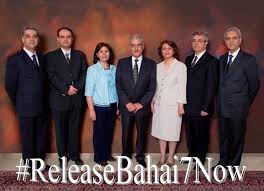
Enough? The Baha’i Seven Are Still There**.

**(Lest We Forget)**

The campaign is over now.

There have been several concerted efforts to raise global awareness. One proclaimed the passing of 10,000 hours of unjust, of ridiculously tragic imprisonment of seven Baha’i leaders in Iran. Many fine words were said in numerous dignified contexts, but the “Yaran” – it means “friends” in Farsi – remained in jail. The five-year mark of their astounding 20-year sentences brought another crescendo of polite indignation, but these five years of loss, not only to the persecuted Baha’i minority but to all of Iranian society, moved the Teheran government not a bit.

Will a new logo be needed for nine?

Will a new logo be needed for nine?

In May of 2015, the hashtag #SevenBahaisSevenYears achieved not quite the currency of, say, #BlackLivesMatter (to say nothing of tags for TV shows or celebrity break-ups), but it circled the globe with awareness and a renewed call for justice. Earlier this month, #EnoughIsEnough and #ReleaseBahai7Now had their moments of trendiness as the Yaran’s captivity reached its eight anniversary.

The campaign did its best. More people than before are aware of the human rights situation in Iran, one that puts the Baha’is at the centre of the issue – not that they are the only, or even the largest, group that is oppressed and unjustly incarcerated. In fact, the Baha’i community wishes only to serve the broader population, and is dogged, even when its brightest young people are excluded from university admission, in its pursuit of education for all. Their “crime” is one, plainly and simply, of belief in the teachings of the 19th-century Persian nobleman known as Baha’u’llah, considered a heretic by Shiah Islamic clerics. All the noise about “sedition” and “immorality” and “spying” is nothing but bigoted, ignorant and baseless slander; religious intolerance is the reality.

So here I am. I tweeted and liked. Did my bit, I guess. Maybe so.

Continue Reading >>