
Rss

A Boy, a Man. And All Those Nutbars In Between.

It’s never really about basketball.

These boys were neither cute, rambunctious children, nor young men launching themselves into the orbit of their adult lives. Not quite yet: they were “my guys”, a coupla dozen nutbars (he fondly called them) entering grades 8 to 10, students working on their basketball skills in anticipation of a new academic year and school team tryouts. It was August 14. It was our last of 23 training sessions. There were Freezie pops for everybody, and a chocolate bar (or two) for the guys who showed up the most and weren’t afraid to be “try-hards”. (Try-hards. In the joy-killing cynicism of youth basketball “culture”, this is a term of dismissal and a weird sort of shame.) I preached courage all summer. And concentration. And yes, competitiveness, the willingness to rise to the challenges presented by other players, by a keen and pushy coach (me), and by the ever-green imperative to improve on our previous best selves.

So. Good last session. We tried hard. I was glad to be finished. Eleven more days until school begins. But only two boys of that final day’s 20 thanked me for the summer’s (volunteer) work. Empty Freezie pops were left on the gym floor. Ideal outcomes were unachieved. Irritating realities intruded. Mainly, I wanted the gym cleared and the equipment stored and the boys gone. The coach was weary, and fighting off the typical post-feverish-engagement voices: shoot, I thought we’d get more done and wish I’d seen more of *those* two but also there *was* massive improvement, admit it and don’t forget that C is really starting to lead…

The gym was finally quiet when Amalia’s text came. WHAT? That little boy I had loved was suddenly gone? That 20-year-old man I was longing to meet in his adult flowering? Won’t ever happen. That gorgeous family — an Italian sweetheart and his lovely American wife and those three delightful little boys – the one that I loved to meet whenever our ex-pat group in Dalian (China) could get together? It is devastated now.

It’s less than two weeks since we reunited with Piero and Tannaz at a large conference in my home city, a dozen years after leaving Dalian. Our periodic connection during our shared years in China was especially sweet for me; I had been father to a three-boy family, a second try-hard at marriage had brought along a fourth son, so I was helplessly smitten by Jian and his littler brothers. Tannaz and Piero brought us up to speed about their boys, on a convention centre escalator and in between conference sessions. Jian was now 20, a lean and handsome extension of the bright-eyed 6- to 8-year old tornado I had known back then and there. He was now a college kid, spending a few weeks at Green Acre Bahá’í  School, deepening his knowledge and commitment in summer sessions of the Institute for Studies in Global Prosperity. (ISGP is a phenomenally impactful institution, dedicated to training young people to transform their worlds.) I had a hundred questions for him, which would have been summed up in one basic query: Who are you NOW, young fella? 

Amalia’s text was a sudden lament. There had been a drowning. The Piscataqua River, near Green Acre, empties into the Atlantic. A young man, our dear Jian, full of energy, intelligence, deep commitment and enormous potential (and so handsome, and how could he have been otherwise considering the parents who had raised him?), had suddenly leapt from the worldly stage he seemed destined to stride with grace and purpose, with joys and usefulness.

I had been relieved to have the gym to myself for a few minutes before I got on with my day. Now, I wanted to call my players back. I wanted to tell them about Jian Grant Morano, what a sweet small boy he’d been and the grief and loneliness I felt about a young man I would never know. My loss is nothing against the earthquake of a father, a mother, two younger brothers and the tide of people who knew and loved this family. I wanted to warn adolescent boys: nothing is guaranteed, life is sudden, don’t waste a second, all those earnest cautions that I would not have heeded at their age.

Prayer helps. I am led to believe that it can stir distant hearts, even those souls that have passed on. What I know is that it helps me in ways that my oh-so-strained understanding cannot. So does the Old Testament, specifically the blunt comfort of Ecclesiastes 9. The voice in that book, the Teacher, has been telling us for millennia that our limited views of human justice are inadequate for the scope of the life of humanity, and that a Creator infinitely beyond our comprehension should not be judged by our petty standards. Death comes to all:

For I considered all this in my heart, so that I could declare it all: that the righteous and the wise and their works are in the hand of God….All things come alike to all:…(Ecclesiastes 9:1-2)

In Chapter 8, the Teacher had famously advised his hearers that “there is nothing better under the sun than to eat and to drink and to be merry“. Similar encouragement follows later in the ninth chapter, which I was coming to know when I was the age Jian was, back when we were together in Dalian, twelve and more years ago:

Live joyfully with the wife whom you love all the days of your vain life which He has given you under the sun, all your days of vanity; for that is your portion in life, and in the labor which you perform under the sun. Whatever your hand finds to do, do it with your might;…I returned and saw under the sun that—

The race is not to the swift,
Nor the battle to the strong,
Nor bread to the wise,
Nor riches to men of understanding,
Nor favor to men of skill;
But time and chance happen to them all… (Ecclesiastes 9:9-11)

(Sigh. Nobody gets to marry Jian.) However, for those who believe in what we blithely call the “hereafter” — I count myself among them, though I can’t say I’m very good at it — there are comforts beyond Ecclesiastes. For example, the New Testament’s vision of the soul’s continued existence (“in my Father’s house are many mansions”) is confirmed and amplified in the Bahá’í teachings, which at one point compare the untimely death of a young one to the actions of a “kind gardener” who transfers a tender plant to a wider and lovelier place. Furthermore, a treasured prayer of ‘Abdu’l-Bahá has been on my mind and tongue since I learned of Jian’s death, one in which we beg the Lord of the universe, on behalf of someone whose loss we grieve, to

…cause him to enter Thy glorious paradise, and perpetuate his existence in Thine exalted rose garden, that he may plunge into the sea of light in the world of mysteries. Verily, Thou art the Generous, the Powerful, the Forgiver and the Bestower.

But how do I make sense of this loss? I keep learning to pray, yes, and hope that perspective sets in. I also hope to keep hearing the Teacher, to do “whatever [my] hand finds to do” with all my might. I’ll try hard, and remind my nutbar ballers that there’s no shame in that! (Not ever.) And when I’m coaching or otherwise working with the youth I am so drawn to, I will look to Jian and his example. We all need help down here.



Guided Tour, Subscription Drive, and a Birthday Bucket

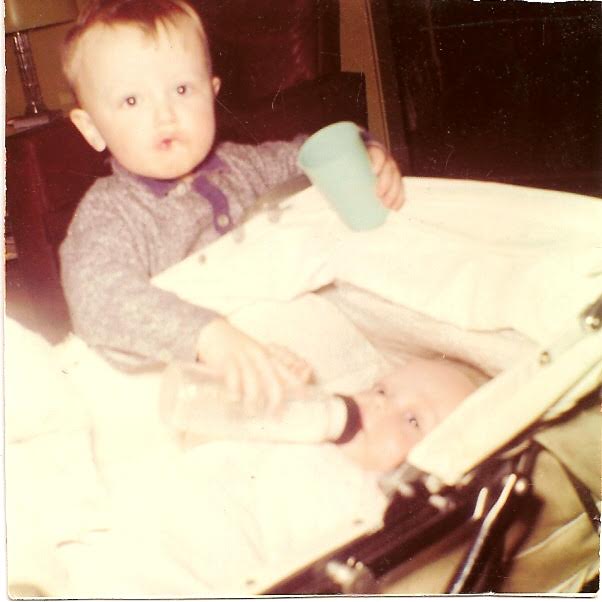
One of these little people was me. (Aren't white babies CUTE?) This is just a nudge to read below-the-page-break.

One of these little people was me. (I am the upright one, but I’m not sure I want to know what was in my mouth, either.) This is just a nudge to encourage you to continue below the Read-More button. Trust me: we’re still cute.

[8-minute read if you love me, 3 if you’re still not sure. This will soon make sense to you.]

August is yearning to become September. The world wants to go back to school. (I do, don’t you?) Naturally, every time I prepare to post something here on JHdotCOM, I do go back to school, figuring out some of what I think I think and what I’m nearly sure that I feel. To “see what I say,” as one writer put it.

What immediately follows is a guided tour¹ of this virtual place — good to see you! make yourself at home! and a shameless attempt to nudge you into subscribing to the writing I scatter around it. See the command in the upper right corner? Don’t be afraid to obey it. Thanks for coming. (And please remember to shut the door when you leave.)

¹ Wait, you’re an old friend? Skip down to the ‘Read More’ button if you already know your way around. I had an August birthday. I wrote about it, and have decided to share some of my restlessness, doubt and inextinguishable intentions. You’re welcome.

So, THE TOUR:

Just below where you are right now – in the “At First Glance” section of the site – I most recently was reporting on someone about whom I’ll write more, or call me a procrastinator. (Quick! This is an emergency — get this man a procrastinator!) Marilynne Robinson is a superb writer of luminous and sharply spirited fiction and coolly brilliant essays on everything from science and religion to the culture of fear. (Libraries. Writing. Democracy. Liberty. Grace, too.²) And farther down the “AFG” queue is another sort of celebration: the appearance of my 700th Web-log post. [UPDATE: Not long after this post, the site registered its 30,000th page view, which could be construed as a YUUUGGE number. Just yuge.]

² Bonus points if you got the Tragically Hip song reference there. Your reward is in your heart.

Over yonder on the right, in the “It’s All About Sports!” section (just below the SO EASY TO SUBSCRIBE IT MIGHT AS WELL BE FREE area), I wrote earlier in August about Ottawa’s Carleton University and its brilliant, undersung dynasty of a men’s basketball program, after the Ravens had chaffed the Wichita State Shockers. There, I predicted that the Ravens would finish 6-0 against their American NCAA guests. Last night, they proved me right with their second conquest of the St. Thomas Aquinas Spartans from downstate New York. I also wrote, and not for the first time, about the wondrous women of Canada’s Olympic Team in Rio de Janeiro. (Hey, that’s all over now, isn’t it!)

Just below my playground excitements is a collection called “He Said/She Said”, which doesn’t just fire out an endless stream of out-of-context bons mots but meditates on them. (Marilynne Robinson will be making more appearances there.) I just shared a beauty on solitude from American writer Fenton Johnson, and as usual tried to set it up so that readers know where it came from and why it got my attention. And just before THAT, I quoted something profoundly simple from the dying (but not fading away) Canadian rock idol/poetic conscience Gord Downie of the band The Tragically Hip. They just played what is likely their last concert together, and (most of) a nation is still talking about it over a week later.

The fourth and last section, “On Second Thought”, doesn’t get frequent treatment, but I did throw in some Howdy Poetry about a month back, which is a rarity (and not only because it references my long-departed Dad). “OST” is generally for pieces that I’ve sweated over for longer periods.

And would you consider, now that you know your way around, subscribing to this thing? ‘Cause it’s so easy and FREE and everything. Okay, no more nagging.

TOUR ENDS.

And now here’s the Birthday Thing, which got away from me. I was surprised how personal it became – I blame my little sister as much as possible, have from her cradle days – and so you may or may not be keen to carry on. As Neil Gaiman sometimes warns of his blog posts, Contains ME. This has quite a LOT of (possibly self-absorbed) me, actually, but I decided to run it here below the “Are You SURE You Want to Read More of This Stuff?” break. Some of you may identify with the daunting feeling of Another Trip ‘Round the Sun, another non-youthful number attached to your biographical file. Birthday Blues. This one hit me hard, about two thirds of the way through August, right when and how I was afraid it might.

Continue Reading >>

Coaching, Hoops, and Young Men: A Tale of Two Teams

If you’re going to be the best, you have to play the best.

Yeah, coaches like to say that. Yup, I’ve used it myself, trying to convince basketball players in several Ontario high schools that getting hammered builds character, that a 40-point loss is an exercise in improvement. (And, on the other side of the scoring table, that 40-point wins mean nothing, most of the time.) “With fire we test the gold…”¹ is a thing I believe, but after last night’s drubbing, I have to wonder if there’s enough gold in them thar hills. I’m a heckuva good digger, but I don’t always stick my spade in the most promising ground. It’s deja vu all over again. (Thanks, Yogi.)

¹ From The Hidden Words of Baha’u’llah. (And how ’bout them references? A Persian Prophet in one line, a great ballplayer and language-mangler in the next!)

Linus doesn't play for Lisgar, but I might have to give him a long look...

Linus couldn’t make my OYBA team, but he’d get a long look at Lisgar…

It’s a tale of two teams, both of them mine. My young friend and assistant coach Seb and I picked a group of ninth-graders from 10 high schools across my Canadian city in August, the Under-15 squad representing the Ottawa Youth Basketball Academy (OYBA). Its teams are known as (and strive to be) the Ottawa Elite. It’s a name I don’t love, with all its potential suggestions of class privilege and superiority, but I repeatedly tell those lads that “elite” is more of a high-expectation mindset than a description of what we are. The young men are learning to work hard, and though I clearly chose several players based as much on potential as on present skill — “up-side” being the jock label of the moment — they’re also pretty good.

They will have to be: these boys will be playing the best. Our main competitions will take place in Toronto, where some of the world’s finest youth basketball development is taking place. (You may have heard of Andrew Wiggins. Tristan Thompson. Cory Joseph. The list of NBA players from the GTA gets longer.) Once high school season is over in February, my attention will turn more completely to these ambitious young dudes; in the fall, we trained twice or three times per week and got a few exhibitions played, but with many of them playing demanding school schedules, now we work out once a week. I push them hard, and many of them are looking for nothing other than that. That makes coaching fun.

My other team is a junior varsity squad at one of Ottawa’s outstanding academic schools. (Spoiler alert: it’s a whole different ballgame…)

Continue Reading >>

Jerome K. Jerome (on love and time)

My bride and I don’t think of ourselves as old. (Well, not old old.) I run around with athletic teens and 20-somethings, and that can make me feel a tad creaky and lardaceous by comparison, but still. We did celebrate (and celebrate) a significant anniversary last month, which compels us to accept that, while we can still find some giddy in our good coupling luck, we’re not exactly newlyweds. We felt like it at certain August moments, which for me was like dozens of non-fattening banana splits in one hand-delivered magic box.

Days back, during my ongoing organizing and an attempted material purge, I ran across the quote below from writer Jerome K. Jerome. I had long ago photocopied it (and its accompanying sentimental snapshot of an elderly couple) from somewhere onto coloured sheets of paper I used to use for something that we dinosaurs used to call “letter writing”. I have a whole stack of them. It makes me want to write letters to people! (Confession: I even have stamps.) With a little new-fashioned research, I easily found that Jerome’s comments on love and marriage – I hadn’t known the source – came from an early 20th-century play of his.

It’s the sort of play whose subtitle has a subtitle, whose dramatis personae includes “Mrs. Sharpe”, “Miss Kite”, “Mrs. Tompkins”, and The Major (“Troublesome creatures, these girls! Troublesome creatures!”). There is a mysterious Stranger, who quickly becomes everyone’s confidante. A young man is described as a “cheerful bounder” – now there’s a word we’ve lost, if we ever really had it in the Colonies – and another is said to speak with “gallant jauntiness”. (Jaunty! Don’t you think we should be, in general, more — and more frequently — jaunty?)

Enough preamble to the prologue:

Continue Reading >>

Michael Chabon (recalling youth in fiction)

I am a growing fan of this American author. His Manhood for Amateurs is a smart, humane, and often very funny non-fiction discussion of what makes for modern maleness (and what we can make of it). He’s best known for his fiction, and here’s the last paragraph — no “spoiler alert” necessary, no details are revealed — of his rather amazing debut novel, The Mysteries of Pittsburgh, which tells of one summer in the life of a recent college grad:

“When I remember that dizzy summer, that dull, stupid, lovely, dire summer, it seems that in those days I ate my lunches, smelled another’s skin, noticed a shade of yellow, even simply sat, with greater lust and hopefulness — and that I lusted with greater faith, hoped with greater abandon. The people I loved were celebrities, surrounded by rumor and fanfare; the places I sat with them, movie lots and monuments. No doubt all of this is not true remembrance but the ruinous work of nostalgia, which obliterates the past, and no doubt, as usual, I have exaggerated everything.”