Rss

Vladimir Nabokov (on disobedience and purity)

Perhaps I will do my usual rambling opinionation on today’s quote some other time. It captured me as I was gobbling up Azir Nafisi’s Reading Lolita in Tehran, this unruly Iranian literature professor’s memoir of her last years in her homeland, and especially her Thursday mornings with one hand-picked class of book-mad young women.

Nafisi has her students read this exceptionally challenging novelist, not only Lolita but other texts as well. Of course, this did not go over well with the authorities of the Islamic Republic. Speaking of her father’s imprisonment before the 1979 Revolution, and her own and her students’ restricted lives after it, Nafisi recalls “a sentence by Nabokov” that she later learned. Here it is: 

Continue Reading >>

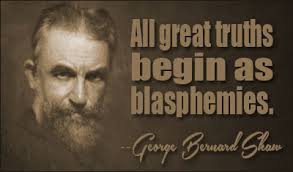
George Bernard Shaw (on the virtue of disagreeableness)

I’m reading Malcolm Gladwell’s latest, David and Goliath. Like most of his books, this one takes things that we blandly believe to be true and asks questions, tells stories, and cites research to suggest that they ain’t necessarily so. In Blink, for example, Gladwell challenged the idea that sound decisions come only after long reflection, that following an impulse is always a bad idea; his Outliers is one of several recent books that punch holes in our belief in the solitary genius, the I-did-it-my-way exaltation of individualistic accomplishment.

David and Goliath argues that it wasn’t such a big upset when the shepherd boy stoned the slow-moving giant — he made what appeared to be a disadvantage into his ace-in-the-hole, by not playing the game the way the Philistine Tallboy arrogantly assumed it would be. In a chapter that spotlights the unusual proportion of noted entrepreneurs who suffer from dyslexia, Gladwell cites an advantage they have: used to being outcast, at failing repeatedly, they are not only inured to difficulty but they may also be less afraid to be disagreeable. At which point, Gladwell quotes a beloved old chestnut from George Bernard Shaw, and I get to my point!

Contrarian, egalitarian, smarty-pants.

Contrarian, egalitarian, smarty-pants.

Continue Reading >>

Bruce Springsteen (on being born a 99% American)

Springsteen is singing in my living room. The album art is very 1980s, and Bruce looks like a boy, but he was writing and shouting like a man. It’s a pop-cult quote o’ the day!

Five years in China was five years removed from my modest collection of vinyl records and my turntable. Even on summers home, which gave me access to Hewitt’s Dairy and good chocolate and real hamburgers, yes, and libraries and bookstores, too, there was no listening to the old records because our home was rented out. I don’t have much of the collection that I had as a kid and as a young man, and (mainly) thank goodness and improving taste for that. (Divorce helped, too.) No John Denver, no Grand Funk Railroad, no diminishing returns of obsessively buying every progressively more disappointing Chicago album and only belatedly accepting that they’d left their soul in the ’60s.

I play through what’s left, though, and I’m about three quarters of the way through listening to the whole cabinet. After bouts of Talking Heads and Steely Dan, and a week of playing The Atlantic Family Live at Montreux – the Average White Band and a host of other jazz players blowing their brains out, fine stuff that doesn’t age for me at all – I flipped this morning to what is probably one of my bride’s earliest LP purchases, Bruce Springsteen’s Born in the USA. The title song slays me.

Continue Reading >>

Some Poor Sap in a Big-Box Store (on mis-education & fear)

So there I was, looking for a little brainless recreation, a (slightly) guilty pleasure that doesn’t expand the horizons of my waistline. It was the latest edition of Sports Illustrated, which is about sports (and has lots of photos). I thought I’d be reading about football and basketball, and I was, but I wasn’t far into a profile on an NCAA hoopster I’d never heard of before I got slapped in the face with a frozen sociocultural mackerel.

Honest, I wasn’t planning on extracting any Higher Meaning from this piece. Luke Winn tells the story of Alan Williams, a master of one of the less glamourous aspects of basketball, rebounding. Snaring missed shots is deeply important to successful teams (and even more to unsuccessful ones, like the one I’m trying to coach these days), not to mention under-valued. I thought maybe I’d try to convince a few of my players to read his story and learn from his approach, with no great expectations or hopes even on that lukewarm front.

But then this chunk of backstory happened: Williams, as a nine-year-old, offers himself as a translator for a Hispanic man in a Toys “R” Us. (Deep prejudices leapt forward from the shadows: I used to call the place Toys “R” Satan when my kids were young, because it was a hellish place to take little boys. I swore I’d never enter one again, and so far I’m good, something like 23 straight years.) Alan Williams is black, and his parents are prominent in the legal and law enforcement communities of Phoenix, Arizona.

Continue Reading >>

George Monbiot (on economic growth and the dreaded WHY)

For his quirky autobiographical note alone, I'd admire the man.

For his quirky autobiographical note alone, I’d admire the man.

For most of our politicians, in most of our countries — those who are elected to preserve and advance a governance system that appears unable to consider anything besides economic growth as keys to the good life, the good society — George Monbiot is on the lunatic fringe. His book Heat: How to Stop the Planet from Burning (2006) was unsparing, openly pessimistic and radical in the original sense — it called for fundamental change in how we look at our governance, our lifestyles, our future, everything. “Radical” means “going back to the roots”. Those that we invest with the authority to make societal changes aren’t often interested in radical thought, partly because it requires so much thought and partly because it undermines their own privileged positions in society.

Here was Mr. Monbiot earlier this week, concluding a recent commentary in the Guardian newspaper — “Growth: the destructive god that can never be appeased” — with questions that the elected don’t often consider, but which citizens must:

Continue Reading >>

Stephen King (on writing and magic)

On a day when I’m frisking about on my computer and getting lots of fine things done — none of which include me actually writing anything beyond overdue emails, which are not evil in and of themselves but do help me forget the Writing Plan (such as it was) for the day — I like to recall Professor King’s encouragement. This comes from his excellent book-length essay on the creative life, On Writing. 

Continue Reading >>

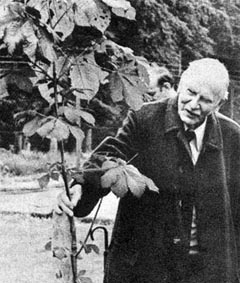
Richard St. Barbe Baker (on trees & believing)

I love trees.

My little town had looming, graceful trees on nearly everybody’s front yard. They surrounded the town square where I learned baseball, football, dare-devilry and cloud-watching. I was a boy of the trees: I climbed them, threw and hit balls over, through and around them, and sometimes could get an aching kind of wonder in my chest by just staring at the new greens of spring and the dry riot of fall. I can sometimes see the forest, but I prefer the trees.

He planted his last tree, days before he died, on the USaskatchewan campus where he had first studied forestry.

He planted his last tree, days before he died, on the USaskatchewan campus where he had first studied forestry.

Richard St. Barbe Baker isn’t well-known anymore, but he should be. The organization he began in Kenya, the Men of the Trees (along with another, the International Tree Foundation), is still active in dozens of countries. Its members are thought to have planted millions of trees.

Continue Reading >>

John Mitchell* (on commies, subversives, birdwatchers)

* Look, there’s no law that says all quotes must be inspiring, wise, profound or witty. And no doubt, Mr. Mitchell was loved, and possessed many good qualities. Besides which, NINETEEN SEVENTY! And Communist bird watchers!

“The conservation movement is a breeding ground of Communists and other subversives. We intend to clean them out, even if it means rounding up every bird watcher in the country.”

John N. Mitchell (1913-1988) was most famous as Attorney General in Richard Nixon’s first term as President, as a central figure in the Watergate scandal that engulfed American political life, and, as the Washington Post pointed out in the first sentence of its obituary, “the only United States attorney general to serve a prison sentence”.

Perhaps, as delicious as this snippet is on its own, a little context is in order. My father-in-law is an avid birder,

Continue Reading >>

‘Abdu’l-Baha (on truth and national limitations)

His father called him "the Master". He preferred to be known as a servant.

His father called him “the Master”. He preferred to be known as a servant.

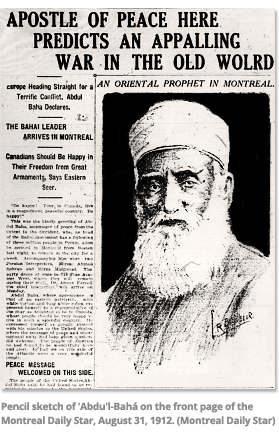
He was a big story in 1912, but aside from the Baha’i community and its friends, few remember ‘Abdu’l-Baha Abbas. For 239 days, he travelled about North America to considerable acclaim: he was heralded in newspapers from Montreal to San Francisco, New York to Chicago as an “Oriental Seer”, the “Baha’i Prophet”, as a “Wonderful Persian Mystic” and “Apostle of Peace”. He gave hundreds of talks in synagogues, churches, universities, public auditoriums and private homes. His topics were many, but the central core of his message was one of spiritual awakening, the hard but necessary road to global peace, and the essential oneness of all faiths, races and peoples. Imagine: 1912.

On May 3, ‘Abdu’l-Baha (it means something like “servant of the Glory”) spoke at the Hotel Plaza in Chicago. He analyzed what factors led to the advancement of civilization and the living of an ethical, productive life. He pointed towards what he called “universal educators”, those historical sources of spiritual, intellectual and material guidance around whom whole systems of belief and practice have arisen. Given where he was, Jesus Christ was his main example.

The quote below almost seemed a throwaway line given at the end of the talk.

Continue Reading >>

Maria Popova (on solitude)

“The choice of solitude, of active aloneness, has relevance…to all human bonds — even Emerson, perhaps the most eloquent champion of friendship in the English language, lived a significant portion of his life in active solitude, the very state that enabled him to produce his enduring essays and journals. And yet that choice is one our culture treats with equal parts apprehension and contempt, particularly in our age of fetishistic connectivity. Hemingway’s famous assertion that solitude is essential for creative work is perhaps so oft-cited precisely because it is so radical and unnerving….

Continue Reading >>