Rss

Alexei Navalny (on NOT GIVING UP)

[2-minute read]

Alexei Navalny died in February. I’m sure somebody knows why and how, but the great WE doesn’t. It is not impossible that nothing acutely nefarious happened in his Russian prison four months back. Maybe his body had just had enough after the earlier poisoning and years spent on the run or in jail. But there is no doubt that, aged 47, he had sacrificed not only his freedom but his life to oppose injustice and to offer hope to the despairing. His death should be remembered. I learned more about him after he left us, and his words and example still work on me.

This is dramatically capsulized in his “final words” to Russian compatriots in the event of his death; they close the Oscar-winning 2022 documentary film Navalny, which chronicles what the dissident lawyer had come to understand following his nearly miraculous recovery from an obviously sinister poisoning in 2020. He is about to return to near-certain imprisonment or even death in his mother country. His interviewer asks him what, in the event of his demise, he would want to say to his fellow Russians. His answer is powerfully simple.

“NOT GIVE UP.” He speaks quietly to the camera, but something in his eyes had me writing it in capital letters. That is his message.

Of course, the film-maker wants more, and Alexei Navalny provides it. He includes a well-known saying, often unattributed or wrongly so¹, but it feels true coming from him. In so doing, he leaves for his countrymen, and for anyone and all peoples facing apparently overwhelming oppression – and hey, even for a Canadian Bahá’í-guy basketball coach with a comfy life and a scribbling itch – these quietly defiant words:

“I have something very obvious to tell you. You’re not allowed to give up. If they decide to kill me, it means that we are incredibly strong. We need to utilize this power, to not give up, to remember we are a huge power that is being oppressed by these bad dudes.

“We don’t realize how strong we actually are.

“The only thing necessary for the triumph of evil is for good people to do nothing. SO DON’T DO NOTHING.”

Don’t do nothing, noble reader. And try to do it in ALL-CAPS.
¹ When attributed, it most often goes to the Irish intellectual Edmund Burke, who said something in the same vein but not in these words. Reuters Fact Check has philosopher John Stuart Mill writing a speech saying, “Bad men need nothing more to compass their ends, than that good men should look on and do nothing.” (Wasn’t that an enjoyable detour?)

He Said/She Said: The Universal House of Justice (on crisis and resilience)

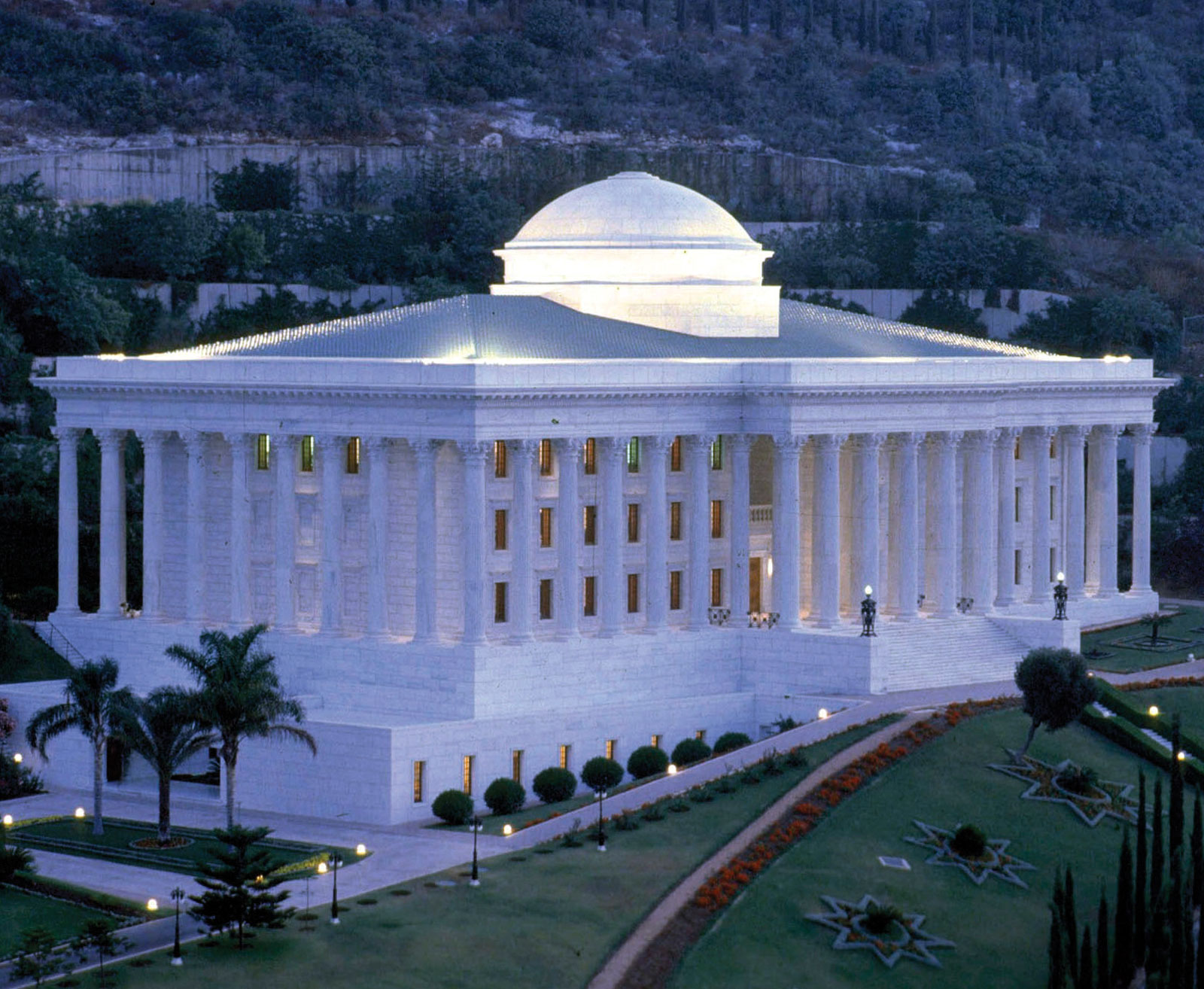
The seat of its deliberations: the Universal House of Justice, evening on Mount Carmel.

[2-minute read]

This is a “They Said” entry. They speak with one voice. None asserts individual privilege or claims personal credit. When they write, as with the samples below, one of them signs “The Universal House of Justice” for the group. This is no cultivated mysteriousness, no marketing shtick; it is just that their function as a body is all that matters, and their avoidance of egotism and arrogance is as complete as can be imagined…

The House of Justice, an elected council which directs the affairs of the Baha’i Faith, is an astonishing institution, though it remains unknown to most people. (I wrote about it on this site before, a long-ish read right about here.) Elected without fanfare or campaigning every five years by the global Baha’i community, it is beloved. It guides and inspires the Baha’is, and an increasingly large number of its allies and friends who admire the Universal House of Justice’s approach to the task of building global peace, unity and progress. I will not go on and on. Let me say only this: against the backdrop of the “furious storms lashing humanity” in November of 2020, what follows is part of this institution’s advice and counsel during the various ongoing crises of that time (and this). [I have italicized passages that ring the loudest in my mind.]

Your resilience and your unwavering commitment to the well-being of those around you, persistent through all difficulties, have filled us with tremendous hope. But it is no wonder that, in some other quarters, hope has become a depleted resource. There is a mounting realization on the part of the world’s people that the decades ahead are set to bring with them challenges among the most daunting that the human family has ever had to face. The current global health crisis is but one such challenge, the ultimate severity of whose cost, both to lives and livelihoods, is yet unknown; your efforts to succour and support one another as well as your sisters and brothers in society at large will certainly need to be sustained…

As usual, the House praises our community’s efforts in helping to build a new civilization — for that *IS* the call of Baha’u’llah, the Author of the Baha’i teachings and practices — and urges us to stay the patient yet urgent course that it prescribes. There are no rash promises or threats, yet the language of their diagnoses and prescriptions is uncompromising.

The following spring (April, 2021), the Universal House of Justice sent its annual “Ridvan Message”, a much-anticipated highlight of the community’s greatest festival, the 12 days of Ridvan (Arabic for “paradise”). We read it eagerly, and shared it with friends. The following extract is a small part of its assessment of the world’s condition, along with a brief reminder of Baha’u’llah’s central remedy: the overarching need for planetary unity.

[H]umanity, chastened by the exposure of its vulnerability, seems more conscious of the need for collaboration to address global challenges. Yet, lingering habits of contest, self-interest, prejudice and closed-mindedness continue to hinder the movement towards unity, despite growing numbers in society who are showing in words and deeds how they, too, yearn for greater acceptance of humanity’s inherent oneness. We pray that the family of nations may succeed in putting aside its differences in the interests of the common good.

I love to share and explore quotations that seize and galvanize me. It is amazing that I cite the Universal House of Justice here for the first time, for nothing provokes hope and purpose in me more than a letter from Mount Carmel.

Richard St. Barbe Baker (on trees & believing)

I love trees.

My little town had looming, graceful trees on nearly everybody’s front yard. They surrounded the town square where I learned baseball, football, dare-devilry and cloud-watching. I was a boy of the trees: I climbed them, threw and hit balls over, through and around them, and sometimes could get an aching kind of wonder in my chest by just staring at the new greens of spring and the dry riot of fall. I can sometimes see the forest, but I prefer the trees.

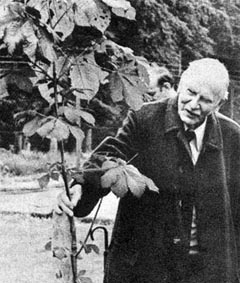
He planted his last tree, days before he died, on the USaskatchewan campus where he had first studied forestry.

He planted his last tree, days before he died, on the USaskatchewan campus where he had first studied forestry.

Richard St. Barbe Baker isn’t well-known anymore, but he should be. The organization he began in Kenya, the Men of the Trees (along with another, the International Tree Foundation), is still active in dozens of countries. Its members are thought to have planted millions of trees.

Continue Reading >>

About Boston.

I woke to a small explosion this morning, a mother-son dispute about laptop use. We worry about how compelling is our young teen’s attachment to headphones, computers and his PDA. Our little sense of post-dawn peace was – well, I can’t say shattered, just can’t, because my own little electronic window just told me about Boston.

Victory and crisis, crisis and victory.

When you love sport as I do, there is something especially horrible when evil visits the home court of dreams and persistence and the desire to surpass oneself, one of the places we go to believe in human goodness and greatness. This year’s Boston Marathon, 26.2 miles of tradition, where Tom Longboat brought honour to his Grand River people and thousands have found deeply personal victory, was dedicated to the 26 who died at the Sandy Hook elementary school. Now there is disbelief and pain where there should be only exhaustion, exhilaration and the giving of one’s all.

Continue Reading >>

Katherine Switzer (on running and hope)

“If you are losing faith in human nature, go out and watch a marathon.”

Katherine Switzer (1947-), the first woman to run in the Boston Marathon. Today, a bitter cast to this gorgeous quote, as the 2013 marathon saw several die, many more injured, who had done exactly what the indomitable Ms. Switzer had recommended.

Antonio Gramsci (on life in centuries that start with 2)

“The challenge of modernity is to live without illusions and without becoming disillusioned.

Antonio Gramsci, 1891-1937, Italian philosopher and political theorist. I love this: it is brief and full of meaning. We have lost our childish imaginings, many of them, anyway, in the last 150 years or so. The price, unhappily, is that many of us have also lost faith, hope and amazement. (And Gramsci didn’t see WWII, or Watergate, or 9-11, or reality TV. What do you think?