Rss

T&F in China (Pt. 2): Running Hard, Who Knows Why?

Part 1 of this piece, a rundown of a track and field meet in a Chinese university, can be read here. It ended with the writer noticing more people out for a run at his campus’s outdoor stadium:

…I liked the athletic company, though there were nearly always as many walkers as runners, and some of the runners looked pretty grim about the whole thing. On the day of the meet, I saw why their training looked so dour. They weren’t exactly staring death in the face, but perhaps they couldn’t help but notice his pimply younger brother.

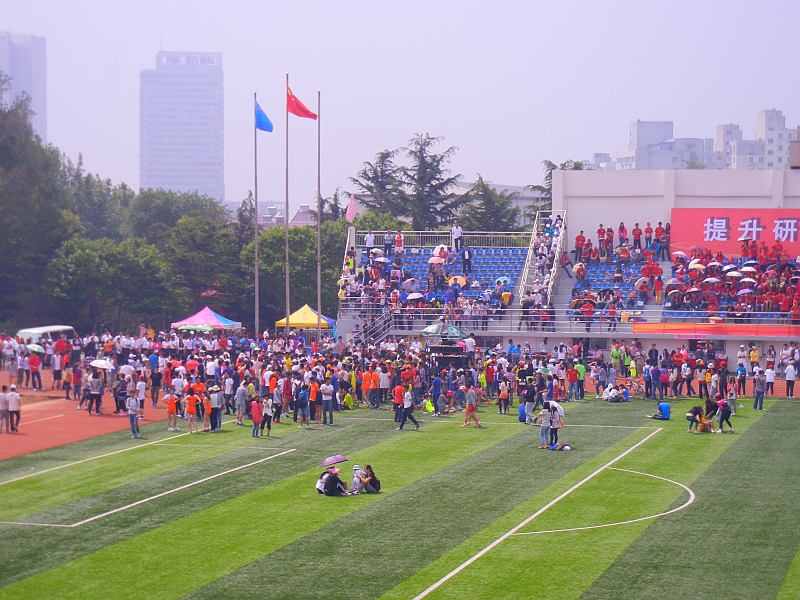
My feelings careened all over the emotional map during the women’s 3000-metre race. It was glorious, pathetic, dramatic, and a complete mess. (So was I, by the end.) Contrary to all the rules of track competition, many of the schools had conscripted a young man to run alongside their female entrant, while others had a relay team taking one or two hundred-metre turns urging the runners on and charging pell-mell across the infield. Some of the go-go girls carried water bottles, and would fling handfuls at the faces of their favourite athlete on this warm day. Some competitors plodded drearily, hands on exhausted hips. There were two heats of this spectacular struggle session, so as the lead runner was heading for the home stretch, she lengthened her stride trying to achieve a winning time. A dozen young men ran with her, just inside the infield, occasionally barrelling over a race marshal or spectator. Her desperate effort across the last hundred metres had me choked with admiring emotion. The glory of sport! Even here! What a noble effort! But as I moved closer to the finish line, I saw a growing collection of young women, dazed and prone, or in a couple of photogenic cases (but sorry, no photo!) a limp body being carried in the arms of a young Galahad towards a patch of shade. Anxious teams of friends and first-aid volunteers (with no training) fanned and flung water in a flurry of urgent and useless ministrations to fallen warriors. That’s when I started to get angry.

Continue Reading >>

Sports Day 1: Track & Field With Chinese Characteristics

JamesHowden.com is always concerned about the reading pleasure of its visitors. Because the report on my university’s June athletic competition is full of dudgeon and joy, it has been split into two parts. (Well, okay, my bride also said, “It’s too darned long!”) This is Part 1, while Part 2 is here.

I wrote earlier about the (nearly) annual Sports Day at my university (though that story only covered the day’s first 90 minutes). It is a mark of how deeply North America-centric I was (and likely still am) that I was mildly shocked, on arriving in China four years ago, to find that universities had no sports teams. The alliance between higher education and elevated levels of sporting competition is mainly an American thing, so I should’ve known; non-academic sports clubs and academies are the rule in Europe, Asia, and South America.1 There are glorified intramural basketball or volleyball games involving different faculties, which sometimes draw hundreds of drumming, shouting supporters. Yes, and there is (usually) a track and field meet, bumped off the schedule last year for the 60th anniversary commemorations of my university.2 In my earlier piece, I didn’t get past the pageantry, so here, by popular request3, is the sporting part of the story.

1 I may have been fooled by watching Kung Fu Dunk, starring Taiwanese singing sensation Jay Chou, known here as Zhou Jielun, on my first flight to China in 2009. A disgraced Shaolin monk (Chou, whom you might have seen as Kato in the movie version of The Green Hornet), is recruited by a semi-criminal sleazeball to transfer his other-worldly martial skills into stardom in the C.U.B.A. (Chinese University Basketball Association). It was spectacularly and delightfully bad. Anyway, only a few prestigious universities participate in the CUBA, which it turns out is mainly a place to enroll unqualified students – those who came up through State basketball academies, but have no future as pros – for the glory it will cast on school administrators. Hmm. Maybe it’s not completely different from American schools…

2 That day had pageantry and enforced student enthusiasm by the bucketful, so apparently there was no need for running and jumping that year. This reinforces my suspicions about what this “athletic meeting” is for, and for whom.

3 Well, my buddy JP has been bugging me about it. And my wife. That’s popularity!

A view of the finish line area from across the infield: officials, marshals, timers, medical volunteers, team spirit leaders, and a bunch of random people milling about. Photo: J.P. Mayer

Continue Reading >>

John Wooden (on failure)

“Success is never final; failure is never fatal. It’s courage that counts.”

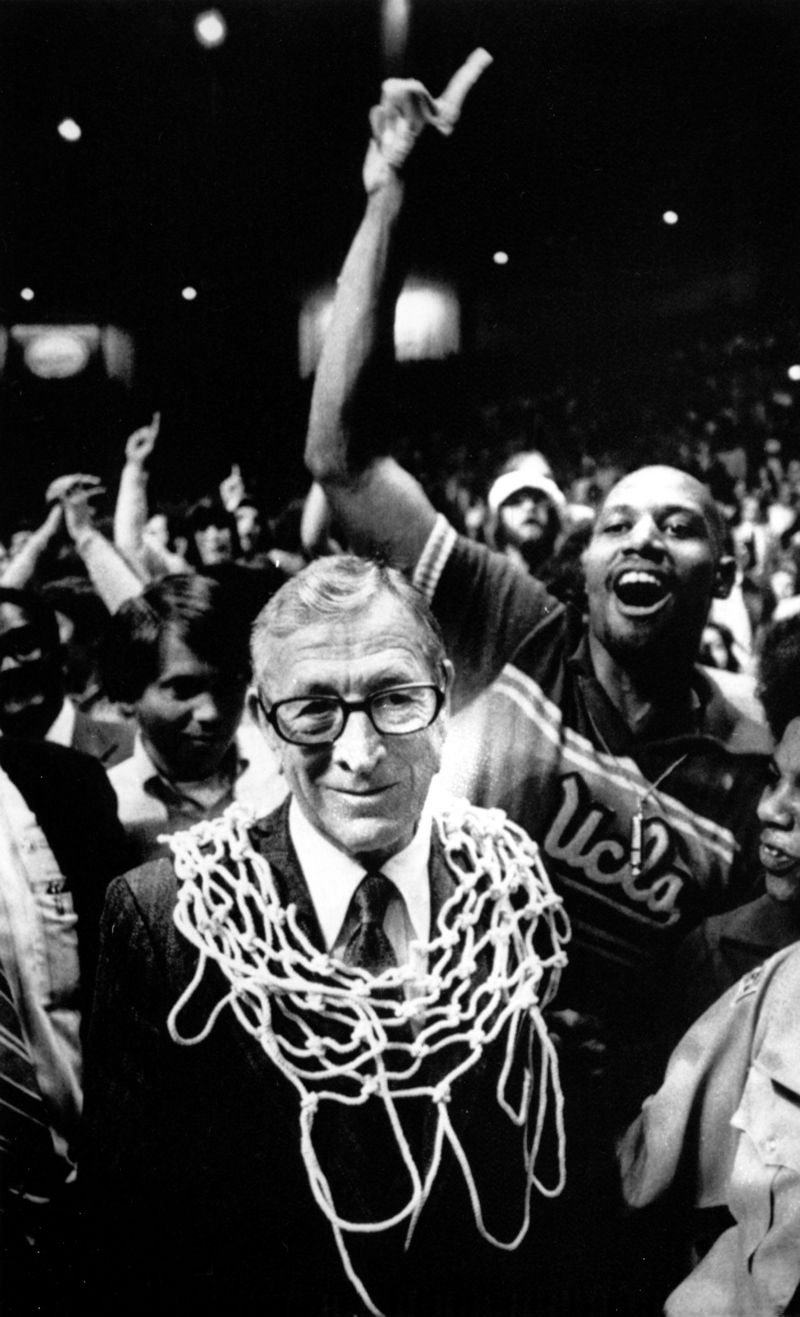
John Wooden (191o-2010) was not only the greatest basketball coach of all time, but a wise teacher for 20th and 21st century America. I quoted his wisdom in a recent article here. He was my hero, perhaps even Number 2 among the greatest men I can imagine, and I can’t believe he’s been gone three years already. He was a writer and an educator, though, and his words live on, as does his example. His advice runs through my mind nearly as often as that of ‘Abdu’l-Baha. In the immediate calm-down after an incredible NBA finals, where I loved the Spurs and admired the heck out of LeBron and the Heatles, I miss basketball and coaching. I miss John Wooden.

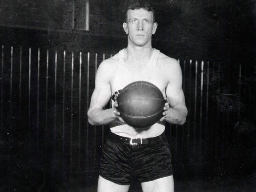
A Hall of Fame player, tough and fiery, with a degree in English literature and teaching as a day job.

Humble victor, though he won again and again and again and again. A great man with feet of granite.

Learning Danny Green

Although my teaching schedule has blissfully allowed me to watch every minute of the NBA Finals — the games are on at 9 am here in Dalian, and my classes are mainly in the afternoons — it’s also June: time to make up for past marking sins, time for administrivia and visas and social obligations, time to prepare for a Canadian summer. I haven’t written a thing about the Spurs versus the Heat, and Game 6 is already upon us. Xiaoqiang is here, and the TV is warming up. I’m thinking about Danny Green.

Continue Reading >>

John Ralston Saul (on corporatism and individualism)

In The Unconscious Civilization (1995), Saul traces the rise of individualism in the West, but complains that the term has been “hijacked” in modern times:

“Nowhere…was the individual seen as a single ambulatory centre of selfishness. That idea of individualism, dominant today, represents a narrow and superficial deformation of the Western idea….[We are] a society addicted to ideologies – a civilization tightly held at this moment in the embrace of a dominant ideology: corporatism…[It] causes us to deny and undermine the legitimacy of the individual as a citizen,…which leads to our adoration of self-interest and our denial of the public good….The overall effects on the individual are passivity and conformity in those areas which matter and non-conformism in those which don’t.”

John Ralston Saul is a Canadian thinker, writer and activist for the public good. I was lucky enough to watch from close range, in the mid-2000s, as he continued to develop the ideas he put forth in The Unconscious Civilization (1995) and to poke and provoke conversation about ideas that matter, from the neighbourhood to the globe. He’s an intellectual fireball. In the midst of watching too much basketball and reading too many student papers, I’m stealing the chance to re-read Saul.

Peter Khan (on idealism vs. lethargy)

“We, today, face…the test of overcoming apathy and lethargy, the test that those around us increasingly lack zeal and idealism and a passion for changing the world. Society around us has lost its vision….Heroes and heroines…have become discredited….They have been found to have feet of clay. There are no heroes. There are no heroines….It is a matter of making it through day by day, being concerned only for one’s self because no one else is interested in us. You survive or not. It is a hard, cruel world out there.

“That is not the Bahá’í way. We are people committed to the creation of a new society. We are summoned to heroism…to sacrifice…to idealism and to altruism….We are people who love and are concerned about generations yet unborn and we are prepared to dedicate our lives that those generations to come…may have a better life; may have a life of peace and unity and harmony and the possibility for the full development of their potential.

“This is the idealism to which we are summoned as Bahá’ís. We need to overcome the apathy and lethargy of society and stand apart as people dedicated to the creation of a new world.”

Peter Khan (1936-2011) was a professor of electrical engineering who became best known for his service to several sorts of Bahá’í community institutions in the U.S.A. and Australia, as well as membership on the worldwide community’s elected international council. This is an excerpt from a talk he gave in 1995 in Chicago. What a mind! His spoken delivery was very deliberate and dry, not dazzling at all unless you listened to what he was saying.

The Party, the Bread, the Track, and the Circus

God knows that I love bread. (Bread and I, however, are in the midst of a relatively amicable separation, and my waistline has noticed.) The student body at my university, and especially at the rich-kid college within it where I teach, is of a particularly well-fed demographic, and they see their grindstone bachelor’s degree exclusively as job training, nothing more. (The majority work in majors chosen for them, often with no real interest or aptitude in the subject but only faith in the promise of the “comfortable life” that most Chinese — understandably — seek.) Though privileged within Chinese society, they do endure acres of boredom and megatons of rote learning, so the circus does come to town. And though I am not above the occasional superior sneer at the circus entertainments chosen by others, I’m still a sucker for the Olympic march of the athletes, small-town parades, the communal experience of fireworks. Even loners like me love a good show, some high-wire performance, but I was recently put in mind of the ancient Roman poet Juvenal’s scorn of the use of “bread and circuses” to pacify a population.

It was Sports Day at my university in northeastern China, a day common to most schools here. It is a more of a show than a track and field meet, and actually two days of class are

The March of the One-Time Athletes. A beautiful day for a show. (Photo: JP Mayer)

sacrificed for it. Many students are required to miss class sessions in the days before in order to prepare, but not for their events. In a country where precious little importance is given to physical education – except, that is, for the tiny minority selected in their youth or childhood to attend State sports schools and bring sporting honour to their province or their Olympically-ambitious country – this once-yearly festival of geng kuai, geng gao, geng qiang (“faster, higher, stronger”) sees astonishingly little athletic preparation, or even the possibility of it. It drives my Canadian friend JP, a masters decathlete and long-time high-school coach, just slightly bonkers.

Continue Reading >>

Juvenal (on “bread and circuses”)

“… Already long ago, from when we sold our vote to no man, the People have abdicated our duties; for the People who once upon a time handed out military command, high civil office, legions — everything, now restrains itself and anxiously hopes for just two things: bread and circuses

(Juvenal, Satire 10.77–81. “Juvenal” is the English name of a Roman poet, who lived in the 1st and 2nd centuries of the Christian Era. This famous critique of the degraded mentality of the Roman masses has been widely and often used to disparage the ways in which governments try to keep their citizens tranquillized, and which the public often and willingly accepts. In Spain, they’ve called it “bread and bullfights”, for example.)

And, to increase the linguistic richness of JH.com, and thanks to dear young
Wikipedia, here is the original Latin of Juvenal’s statement:

[…] iam pridem, ex quo suffragia nulli / uendimus, effudit curas; nam qui dabat olim / imperium, fasces, legiones, omnia, nunc se / continet atque duas tantum res anxius optat, / panem et circenses. […]

E.L. Thayer (“Casey” Turns 125, Still no Joy in Mudville)

On June 3, 1888, the iconic American hymn to baseball, “Casey at the Bat”, was first published. Baseball is so old, and no sport has been written about so much or so well, at least not in North America. Basketball was still only a gleam in Mr. Naismith’s imagination when “Casey” came out, and obviously the game was already a major part of American consciousness, as this poem has also become. It’s a lovely thing to read (or to hear, if you follow the link above to one of its destinations), and is really well made and made to be memorized and recited — oh, for those seemingly long-gone days! Some of these phrases sing: “Oh, somewhere in this favoured land the sun is shining bright / The band is playing somewhere, and somewhere hearts are light…”

So here’s to the mighty Thayer, who apparently wrote little poetry besides this little piece of eternity, spun out when he was 25:

Casey at the Bat

by Ernest Lawrence Thayer

The outlook wasn't brilliant for the Mudville nine that day:
The score stood four to two, with but one inning more to play,
And then when Cooney died at first, and Barrows did the same,
A pall-like silence fell upon the patrons of the game.

A straggling few got up to go in deep despair. The rest
Clung to the hope which springs eternal in the human breast;
They thought, "If only Casey could but get a whack at that—
We'd put up even money now, with Casey at the bat."

But Flynn preceded Casey, as did also Jimmy Blake,
And the former was a hoodoo, while the latter was a cake;
So upon that stricken multitude grim melancholy sat,
For there seemed but little chance of Casey getting to the bat.

But Flynn let drive a single, to the wonderment of all,
And Blake, the much despisèd, tore the cover off the ball;
And when the dust had lifted, and men saw what had occurred,
There was Jimmy safe at second and Flynn a-hugging third.

Then from five thousand throats and more there rose a lusty yell;
It rumbled through the valley, it rattled in the dell;
It pounded on the mountain and recoiled upon the flat,
For Casey, mighty Casey, was advancing to the bat.

There was ease in Casey's manner as he stepped into his place;
There was pride in Casey's bearing and a smile lit Casey's face.
And when, responding to the cheers, he lightly doffed his hat,
No stranger in the crowd could doubt 'twas Casey at the bat.

Ten thousand eyes were on him as he rubbed his hands with dirt;
Five thousand tongues applauded when he wiped them on his shirt;
Then while the writhing pitcher ground the ball into his hip,
Defiance flashed in Casey's eye, a sneer curled Casey's lip.

And now the leather-covered sphere came hurtling through the air,
And Casey stood a-watching it in haughty grandeur there.
Close by the sturdy batsman the ball unheeded sped—
"That ain't my style," said Casey. "Strike one!" the umpire said.

From the benches, black with people, there went up a muffled roar,
Like the beating of the storm-waves on a stern and distant shore;
"Kill him! Kill the umpire!" shouted someone on the stand;
And it's likely they'd have killed him had not Casey raised his hand.

With a smile of Christian charity great Casey's visage shone;
He stilled the rising tumult; he bade the game go on;
He signaled to the pitcher, and once more the dun sphere flew;
But Casey still ignored it and the umpire said, "Strike two!"

"Fraud!" cried the maddened thousands, and echo answered "Fraud!"
But one scornful look from Casey and the audience was awed.
They saw his face grow stern and cold, they saw his muscles strain,
And they knew that Casey wouldn't let that ball go by again.

The sneer is gone from Casey's lip, his teeth are clenched in hate,
He pounds with cruel violence his bat upon the plate;
And now the pitcher holds the ball, and now he lets it go,
And now the air is shattered by the force of Casey's blow.

Oh, somewhere in this favoured land the sun is shining bright,
The band is playing somewhere, and somewhere hearts are light;
And somewhere men are laughing, and somewhere children shout,
But there is no joy in Mudville—mighty Casey has struck out.

– See more at: http://www.poets.org/viewmedia.php/prmMID/15500#sthash.EIvjHJNK.dpuf

Reason to Remember: A Short Story


Memory was a funny thing. David Jenkins could still name the starters on UCLA’s 1973 championship basketball team, and he could recite Marcy’s girlhood phone number, twenty-five years, four Bruins coaches, and two wedding days later. Yet it seemed to him that his days were dedicated to forgetfulness. So many gaps. There were entire years of his schooling with only the barest souvenir shreds attached to them. The childhoods of his own three kids had become one big soup, with only the occasional bit of meaty remembrance.

“Well, I do remember that Johnny loved to dance. Every time I played ‘Blind’, he went crazy, just boogeying around in his diaper. You know, that was the last vinyl album I ever bought, I think. That was the Talking Heads, right? And projectile poop, I told you about that, didn’t I? That was definitely Jordan, straight off the change table, splat against the wall! Who was trying to change him? Mary, maybe? How’s that for ‘good morning, auntie’! No picture of that one. Hey. I used to have a great picture of Joey, what happened to that? He’s maybe 18 months, standing beside a stop sign. Or a fire hydrant. Anyway, believe it or not, Joey was chubby when he was a little sprout! I think he was the one that fell off the back stoop, or was that…?” It was always Marcy Gingrich, though, at the center of his memories, the one who could always redraw the lines that had faded. He had met her when he was fourteen, and most things before that were hazy in his mind.

Elwood Henry had found a way – one of the usual ones – to deal with a name that can get a boy a bloody nose at recess. He had become the fun boy, the goofball, the lucky charmer, “crazy Henry”. On David’s high school football team, Elwood was a treasured cutup and the object of many gags, practical or just bloody foolish. The Blues were a pitiable team, with a history of doing more damage to each other than to any opponent. One practice, while the team’s only coach was still grabbing an after-school coffee, the captains tried to get things started. So did Potter, who really was crazy when he put on a helmet. He grabbed Elwood around the thigh pads from behind, turned him upside-down, and used him to demonstrate King Kong Bundy’s pro wrestling pile-driver move. A few guys cheered. This was better than stretching! No one was too surprised when Elwood started staggering around the calisthenics lines, eyes wide, arms pointing vaguely. This was Crazy Henry.

“What am I doing?  Where am I?” As a sophomore, David had nothing to say, but the veteran players were enjoying the show.

“Hey, not bad, Henry!”

“Better go down to guidance. Rabbit’ll tell you what to do!”

“Listen, how many times did Elwood watch Invasion of the Bodysnatchers, anyhow?”

“Nah, he’s just in a daze. He slept all the way through The Perv’s class.”

“Alright, shut-up, you guys. You wanna get stretching, dickhead? Coach is still pissed about your fumble Friday – hey, dipstick, you listening? Hey! Woody?”

David only knew Elwood from the team, and the occasional hallway elbow, but he knew something about this was weird. He was carrying the joke too far. He had even taken off his helmet, and he looked scared. Jason was stunned to see that Crazy Henry was crying.

“I don’t know who I am!” he wailed.

Nobody knew much about concussions back then, but the Blues were learning. The halls were still buzzing with wide-eyed details – I’m not shittin’ you, he didn’t even know his own name! – when David Jenkins added to the fogbound memories of that vague and losing season.

The Blues practiced Monday through Thursday, though on Fridays it often looked like they’d been press-ganged out of class just that afternoon. A few days after what was by then called The Henry Shuffle, David lined up at his usual slotback position. He knew his assignment on Power Pitch 37, and everyone else’s, too. He imagined himself bursting from his stance, getting a good angle on the outside linebacker, and sealing him to the inside as the running back went wide. Ecker wasn’t quick, but he outweighed David by at least 75 pounds. He knew there was no choice but to cut-block him, since he’d get buried if he tried to hit Ecker up high. On the snap, David sprinted to get wide of the pursuing linebacker, who was quicker than he looked. He threw his body across his path, and the last image he saw before blankness was Ecker’s left knee.

David remembered nothing else until he noticed that he was sitting in Doctor Linden’s office across town, and he never did recall how he’d gotten there. Marcy filled in most of the blanks later. She had stayed after school that day for cheerleading practice, and Guck, the football manager and “go-fer” extraordinaire, knew where to find her.

“Marcy, you gotta come ‘cause Dave got conked out and he can’t find his locker and he doesn’t know which clothes are his, come on!”

Despite the oddity and the overpowering odor of entering the jam-packed jumble of the boys’ tiny change room, Marcy had no trouble in picking out David’s usual jeans, green hockey sweater, and his white Chuck Taylor All-Stars with the wide blue laces. She then took him to his locker, and held up the lock, its dial marked from 0-60.

“Can you remember your combination, sweetie?”

“Yeah!  129, 63, 108.” (Hearing the tale recounted months later, for the fiftieth time, David suddenly laughed, realizing he must have given the combination for his father’s office safe.) With repeated reminders of what he needed to do, and with three red-faced entries into the boys’ washroom near the science labs, Marcy did manage to get David clothed and then driven to the doctor’s. She phoned the Jenkins’s to explain what had happened.

“Oh, my.  It’s an ill wind. We just found out that Wayne’s father has died. Heart attack,” David’s mother said. Wayne had married David’s oldest sister, Mary, five years before, and David idolized him – his stunning speed as a country fastball pitcher, the facts he spewed on the most arcane and undebatable subjects, and one unique bit of living room gymnastics. He would make an inverted arch by linking his fingers below his waist, then hop over his joined hands, frontwards and back.

“Oh, Dave,” Marcy said when she came back to the waiting room. “I’ve just talked to your mom. Wayne’s father died today!”  She held David’s hand, and watched him. His reaction was muted and very slow, but he seemed to understand. He looked at the carpet, shaking his head slowly. His voice was hollow and strained.

“Oh, no. That’s terrible.” He sat, unmoving, for several minutes. Marcy let him grieve quietly, a little surprised that David wanted no more details and had nothing else to say.

“Your mom says the funeral’s Friday.”

“What funeral? Who died?”

“Mr. Richardson! Wayne’s dad!”

“He died?  Oh, no. That’s terrible.” He looked down, and shook his head slowly.

In the hospital that night, Marcy made a little laughter grow through the solemnity, telling David’s visitors how she had broken the news repeatedly, getting a fresh flood of slow-moving grief each time. He could remember the last time she had told him, sitting in those hard chairs in a white room, waiting for the family doctor. It was the first memory that had stuck in his head since his closeup view of the grass-stained knees of Ecker’s football pants.


Years passed. By the end of high school, the Blues had better helmets and some wins, and Marcy and David had already envisioned their riverside wedding. Though they enrolled in different universities, there was no doubt they’d soon be together again. “Darcy and Mave”, their friends sometimes called them. Delighted at their merging, they sometimes called themselves that. Their respective dormitory staffs marveled at the volume of their loving mail. They were married at 21 in Marcy’s back yard, and threw flowers in the water. They were the golden couple, almost always the first among their various associates and friends to have married.

By age 25, there was Joseph and new-born careers. By 27, there was Jordan, a first house, and weekend trips to see Daddy play in various outposts of fast-pitch softball. By 32, there was Jonathan staggering about the backyard Olympics of his two big brothers. And by 34, David and Marcy had loved each other for more than half their lives, but were somehow forgetting how to do it. Too many questions were asked, and too much darkness was falling. There was impotent hope, and pleas for the impossible, bruised walls and broken words. As he traced the plotlines in his mind, David could see the shadows of separation, but no matter how many times he reread the story, he was always surprised at the end, and after all the slowly marching pain, how abrupt it seemed. He kept looking for a rose-colored epilogue.

He was living by then next to Mary and Wayne, in the small apartment they’d built for the last years of his mother’s life after Wayne’s father had died. Having given up playing ball years before to keep summers more clear for Marcy and the lads – she’d never been much for sports – David didn’t hesitate to resume playing when the Port Hope club gave him a call. He brooded dully on the irony that, though he wanted to live and play with hope, there wasn’t any left for him and Marcy. The Sailors weren’t the young, athletic powerhouse they had been before, either, though David was more player than he’d been in his twenties. The manager, Jerry Edwards, remembered too well.

“You know, Dave, you wore mediums when you played before,” he said, handing Jason a pair of large uniform pants. Still, he was able to shed the rust from his throwing arm, his batting stroke was still there, and though he needed a lot more stretching in between innings, he was still pretty quick going from first to third. David, at 35, was glad to have teammates, as well as a ball and some lukewarm dreams to chase. Joey and Jordan, even little Johnny, enjoyed seeing Daddy play, and loved even more roaring about among the trees and picnic tables beyond the rightfield fence.

David remembered where the weakest kid always got placed in tyke baseball, so it was a pin to his pride to have to play right field. It did make it easy to daydream and watch the boys on his custody weekends, and he’d had worse stings. Besides, the kid who’d been the batboy during his first tour of ball-playing duty was the new shortstop, and David had to admit that Skinny was pretty good. Pony was a fast little fixture in centerfield, David’s other favorite position, but he didn’t take charge of the outfield the way David thought he should. He would have reason to remember that thought, not far into his first season back in the blue and gold.

It was a warm Friday in June, and a few bugs lazily circled the floodlights. David was having a good night, and was starting to feel like a ballplayer again, not just “Dad” to his younger teammates. In the fifth inning, he got a good jump on a short fly ball, right off the bat.  As he raced in from right, his eyes bounced from the falling ball to Eddie, the second baseman, who was running into the outfield. When he knew Eddie wouldn’t get there, David yelled, “I got it got it got it!” The last thing he remembered this time was that he was going to have to dive to make that catch.

They probably shouldn’t have moved him after a blow to the head like that. He was unconscious for a couple of minutes, and the blood bubbled and spurted from his nose and mouth. After he seemed to know roughly where he was and what was happening, his mates helped him to his feet and, arms draped across the broadest shoulders, David began a deeply drunken march to the dugout. The ambulance was already driving in to the park by the time he crossed the first baseline, and David wanted to know one thing.

“Somebody hurt? Whosa ambulance for?”

The guys had some laughs telling that story, and David filled in the gaps. It had likely been Pony’s left knee – another one, smaller than Ecker’s but moving much faster – as he galloped wordlessly in from centerfield and made the catch, that had broken David’s nose and scrambled his brain. His first dim awareness, the next memory that remained after I got it!, was at least half an hour after leaving the suburban ballpark. He realized, wonderingly, as the back doors opened at the entrance to the hospital emergency room, that he was in an ambulance.

He was wearing his ball uniform. There was lots of blood across the Sailors logo. Memory of where he had been, and how he might have been hurt came only slowly, and David never did recall anything after the doomed race for that short pop fly. The next thing he knew was that Mary was by his hospital bedside. It seemed odd, somehow, that his sister was there, but he was glad to see her. She gently explained what she knew of the accident, its results, and how she’d been notified. Something bothered David, though. Something wasn’t right, but he couldn’t remember what it was. He was vaguely but increasingly anxious throughout their conversation, before a question bloomed in his mind like an instantaneous tumor.

“Where’s Marcy?”

He hadn’t even finished the third syllable before he groaned like a huge and badly wounded beast. He had flashed, in a thundering moment, from his disquiet to the cascading replay of the previous two years of marital drama and separation. Instantly. David hadn’t cried in front of his sister since he’d been five, but sobs shook him like a Doberman does a rag doll. Later, she told him that this blitzkrieg of sudden awareness had played itself out half a dozen times since she’d arrived at his bedside.

“I’m sorry, Mary,” he moaned as she hugged him. “I just remembered.”