Rss

T-Mac III: McGrady is Finished. HoF Speculation Begins.

Tracy McGrady has announced his retirement, and it’s a black-armband day

Despite years of mediocrity, it was still a story. He was exciting, and such a perfect foil for “what if”s and “if only”s.

for Chinese basketball fans. (Some NBA snobs would say it’s his second retirement, the first being when he came over to Qingdao to play for the Double Star Eagles in the short Chinese Basketball Association season. I would not say that, as I need all the Chinese friends I have.) I’m certain that tears were shed in more than one Middle-Kingdom man-cave, though T-Mac also had a surprisingly big fan-club of starry-eyed young women, too. For a North American, the scenes of his arrival in and departure from Chinese airports were astonishing to watch, even in small doses. “TracyMania”, it was.

While he doesn’t inspire that sort of devotion in America, and certainly not among most Canadian ball-watchers, there’s no time to wait. Like greedy relatives who want to know the contents of the will before the deceased is even cold, writers and fans in the West vault instantly past any of the routine thoughts we have when someone we care about retires. So, what are you looking forward to? Does it feel good to be done? (When it comes to thirty-something men who have been incredibly well-paid for playing games, this would seem like a silly question, though I’m not sure it is, always.) And maybe we’d be bold enough to ask, Are you well set-up financially? How will you fill your days? What gives you a sense of purpose now? None o’ that, in the case of athletes we allegedly love. We are patently uninterested in any of those things. We don’t care a lick about what life for the famous dude will be like. The writers and fanboys go straight at the only question, it seems, that matters to us: is T-Mac a Hall of Famer?  

Continue Reading >>

Leslie T. Chang (on migrant Chinese women)

“When you met a girl from another factory, you quickly took her measure. What year are you? you asked each other, as if speaking not of human beings but of the makes of cars. How much a month?…How much for overtime? Then you might ask what province she was from. You never asked her name….

“When you did make a friend, you did everything for her. If a friend quit her job and had nowhere to stay, you shared your [dormitory] bunk despite the risk of a ten-yuan fine, about $1.25, if you got caught. If she worked far away, you would get up early on a rare day off and ride hours on the bus, and at the other end your friend would take leave from work – this time, the fine one hundred yuan – to spend the day with you….

“Workers were required to stay six months, and even then permission to quit was not always granted. The factory held the first two months of every worker’s pay….Getting into a factory was easy. The hard part was getting out.

“The only way to find a better job was to quit the one you had [and lose two months’ salary and start over again]….The pressing need for a place to eat and sleep was incentive to find work fast. Girls often quit a factory in groups,…pledging to join a new factory together, although that usually turned out to be impossible. The easiest thing in the world was to lose touch with someone…” *

Leslie T. Chang was a reporter for The Wall Street Journal in Beijing when she began to interview and befriend young Chinese women in the factory cities of Guangdong province. Of Chinese descent herself, this American writer had her excellent Factory Girls: From Village to City in a Changing China published in 2008. The passage quoted is from the opening pages of the book. She is married to Peter Hessler, who has written three superb books on life in modern China.  

* If my long overdue brilliant and insightful review of this terrific book is not posted within a week, you should email me indignantly.

Take the Red Pill! Rainn Wilson & The Matrix II

This is the second part of my recollection of actor Rainn Wilson’s talk at the recent Association for Baha’i Studies conference in Irvine, California. Part One is here.

Rainn Wilson related, with wonder and amusement, how excited many people became in  connecting the “man was embryonic in the world of the matrix” quote of ‘Abdu’l-Baha to the  mind-blowing Matrix trilogy. He said that there were groups of people who embrace “Matrixism” as religion, and regard ‘Abdu’l-Baha as its early prophetic voice, and as its link to the entire history of revealed religion. This was news to me, but I found them in a most curious and bemusing on-line presence. One of their four basic tenets is the use of hallucinogenics as a sacrament; another is “adherence to the principles of one or more of the world’s religions until such time as the One [Neo doesn’t count] returns”. This tiny group does elaborate a few more funky laws, my favourite of which is that “all forms of professional athletic competition have now been abrogated”. (The revenge of the picked-on against the surly jocks!) That’s funny stuff, I guess, unless it’s pathetic. However, it points out again, if we needed more evidence, how hungry human beings are for a sense of meaning in life.

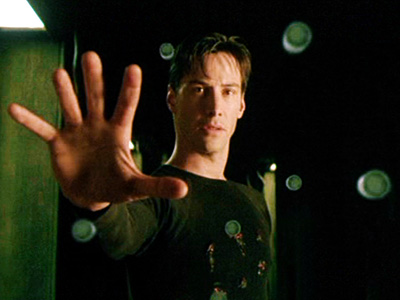
Wilson showed another clip from Matrix the first. Neo faces off with the baddies who are trying to prevent him from penetrating and exposing the mass hallucination that intelligent machines have created. Their programming illusion is intended to convince the humans that life is as it always was – meanwhile, their actual bodies are imprisoned in pods and used as robot fuel. This is where many of the oh cool! effects of the movie are featured. Neo bends

“Bullets, be still and know that I am Neo!” Who hasn’t done this?

space and time. A hail of bullets slows at his silent command and clatters to the floor. He leans at impossible angles, and leaps with impossible speed. He artfully decomposes a bad dude by flying right into his holographic gut and exploding him from the inside. (Nice!) Neo has wondrous powers in the supercomputer-generated matrix because he understands that it is only a projection, an unreal construction. (Well, and because he is The Chosen One, which obviously helps.) By knowing the reality of life in that world, he becomes the master of it. 

Continue Reading >>

One Morning

In the fourth quarter of the ebb and rush of sleep, he dreamed of hardwood and eager faces and stories of how it’s done. It was an outdoor court with crowds of people looking in and down and around. They were silent. He and they got to watch the man in the middle, who could train those eager faces to know how to get to their hopes. Mainly, it was by listening to him. They did. Too much talking, the dreamer observed, though he was entranced by the words. Before long, he was saying them himself, and loved how the eager faces were looking at him now.

Sometimes he got them into furious, coordinated motion, but they returned inexorably to waiting, to expectation, to muted urgency and frozen delight. He knew the possibilities were endless. He felt that this time, with these eager young men, the outcome would be different — lofty, victorious, filling, splendid, and true. It was all there in their faces.

When he awakened, his mind turned seamlessly to planning. How to convert that dreamy enthusiasm into skill and the making of Great? How does that talk translate into glistening skin, fiercely danced choreography, lunges beyond their best, into gauzy ambition made muscular? He wanted practice. He imagined it as blazingly competitive, yet the deepest of collaborations. Talk would become creative repetition. Routines would build comfort in extremity. Everyone would know exactly what he was doing and why, yet would be thrilled by undreamt-of, eye-widening results. This is how it feels. I can still help this happen.

Lying in bed, he was years removed from places and chances to channel that mighty and frantic motion. There were no eager faces anywhere but in his dreams, but for untellable moments, it didn’t matter. He was there, in a bright-eyed, ever-hopeful zone. Lists and diagrams and imploring words begot grassroots heroism and physical grace and the full spending of shared powers. He didn’t want to leave, and then it was gone.

He might be a fool. He must be a coach.

Rainn Wilson Explores The Matrix

The Association for Baha’i Studies is knocking the “stuffy” out of the notion that academia and intellectual pursuits are narrow, competitive, elitist and pretty darned dull. The concept of scholarship is being remade out of its old “ivory tower” paradigm into something more closely resembling a noble, shared adventure in learning. This, among many other things — the new friends I meet, the musicians I add to my playlist, the books I lust over, the writing ideas I hatch — has made the Association’s annual conference one of my greatest treats. So many smart and good-hearted people! Such outstanding, mind-altering presentations! So many confirmations of my careening efforts to “walk the spiritual path with practical feet”! 

Anyway. What follows is Part One of a report on one of the highlights of the recent conference of the ABS in Irvine, California, which is (kind of) on the way from Ottawa to Dalian…

***

“So I went to the fights the other night and a hockey game broke out!” Rodney Dangerfield

It’s an old gag, but it’s still a goodie. In the same spirit, I went to the 37th annual conference of the Association for Baha’i Studies and a pop-culture laugh riot ensued. Not only did I feel happy and a little smarter at the end of that comic lecture, but nobody tried to sell me anything except ideas. This is the second time, so far as I know, that actor Rainn Wilson has spoken at one of these spirited, brainy conclaves. He brings a healthy kind of irreverence and the humour one would expect from a certified Comedy Star, but also a serious commitment to his faith community, a sharp mind and a blazing conviction that soul matters. (And no, he doesn’t speak or behave like Dwight Schrute from The Office.)

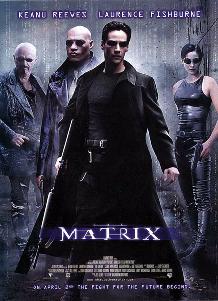
The iconic poster: trenchcoats and coolness and guns, oh my!

Mr. Schrute’s Wilson’s talk was designed to show that the 1999 blockbuster film The Matrix had more to it than awesome special effects and a cool visual style. He wasn’t joking, but he was hilarious.  Just in case we’d forgotten, or had missed Keanu Reeves (as Neo) and Laurence Fishburne (Morpheus) and the gang when The Matrix came out, Wilson went to the video screen for a reminder.

Continue Reading >>

Chad Harbach (on hopes for his baby)

Chad Harbach, author of the acclaimed 2011 novel The Art of Fielding, says he is most proud of a literary/social discourse magazine that he helped to found in 2004. n+1 is still rolling, no easy thing for a publication aimed at people’s higher selves rather than their wallets and knickers. Recently, an on-line interviewer asked Mr. Harbach this question: “Do you have an ultimate goal in mind for n+1, a moment…when your initial inspiration for the publication will have been fulfilled?” I adored this off-the-top-of-his-head reply.

“Hmm. I guess when wealth is equitably distributed; global warming is halted; and thoughtful, nourishing public discourse about literature and politics becomes normal and unremarkable, then n+1’s work is done. It might take a while…”

reORIENTation

(Or is that DISorientation?)

(Or maybe a simple case of disappointment? )

Downtown Dalian: Labour Park and Highrise Central. No view of the hills, or of the sea, that highlight this windswept little village of six million.

They’ve had a tropical summer in Dalian. My dry, windy Chinese city had wild thunderstorms last night and remains a humid mess of clingy air and greyness. Usually, the ocean winds blow away the smog, but not today. (Maybe it’s not all car exhaust this morning.) The gardens at the top of our hill are taller and more riotously green than I’ve seen them. The weeds make visions of compost dance in my fevered head. The last few weeks of our Canadian summer, plus a weekend near Los Angeles, were bright but surprisingly cool for August. Here, I go through several shirts a day, and I’m not even trying to move much.

Marching music plays on an endless loop from the college next door, where this year’s pseudo-scholarly inputs are being put through their paces, without a hint of a metaphor. Their introduction to higher education, these future hairdressers and kitchen hands of China as well as their more highly tested university counterparts, is to march and march. There are team-building, patriotic and letting-off-steam aspects to the drill, but as bystanders our experience is one of martial music on repeat, amplified exhortations and ceaseless counting: Yi! Er! San! Si! Yi, er, san! Si!

Continue Reading >>

Abdu’l-Baha (on the greatness of goodness)

“Is there any deed in the world that would be nobler than service to the common good? Is there any greater blessing conceivable for a man, than that he should become the cause of education, the development, the prosperity and honour of his fellow creatures?…The highest righteousness of all is for blessed souls to take hold of the hands of the helpless and deliver them out of their ignorance and abasement and poverty, and with pure motives, and only for the sake of God, to arise and energetically devote themselves to the service of the masses, forgetting their own worldly advantage and working only to serve the general good…”

‘Abdu’l-Baha (1844-1921), The Secret of Divine Civilization (1875), p. 103. This then-anonymous treatise, an open letter to the people of Iran (then Persia), is still an incredibly valuable perspective on human progress, true happiness, and the development of nations. The line “only for the sake of God” has had me thinking. Yet another re-read of this seminal book this summer has been contributing to the general good of this man’s mind.

Define Your Terms, For God’s Sake

What do we mean, fergawdsake, when we say that something must be done/undone/thought about/dismissed for this ultimate reason? 1 And who believes in God anymore? Well, lots do, and I suspect that more would want to, fashionable intellectualism aside, if only the idea of the Creator weren’t so polluted by fairy tale images, anti-scientific credos and rancid politics.

Here is one thing we might mean: when we do things at our most sincere, or our most urgent or beneficent or noble, we are helping God out, doing the (theoretical) Lord and Master of All Things a good turn. Well. This assumes that the Prime Mover needs a nudge in the right direction from one of the millions of species populating one little blue planet. That doesn’t make a lot of sense; it’s at least arrogant, if not delusional, to think that Something capable of fashioning a universe needs my advice or yours.

Continue Reading >>

William Easterly (on global inequity and Harry Potter)

“On July 16, 2005, the American and British economies delivered nine million copies of the sixth volume of the Harry Potter children’s book series to eager fans….There was no Marshall Plan for Harry Potter, no International Financing Facility for books about underage wizards. It is heartbreaking that global society has evolved a highly efficient way to get entertainment to rich adults and children, while it can’t get twelve-cent medicine [to cure malaria] to dying poor children.”

William Easterly (b. 1957) is an American economist concerned with development and global poverty. I recently stumbled across his 2006 book The White Man’s Burden: Why the West’s Efforts to Aid the Rest Have Done So Much Ill and So Little Good. (I only had time, though, to read the opening chapter.) In it, he elaborates his response to the likes of Jeffrey Sachs (The End of Poverty), whom Easterly admires but labels a “Planner”, someone whose big-picture ideas for the elimination of economic injustice are just another example of patriarchal, top-down approaches to the needs of the poorest of the poor. Easterly argues that what he calls “Searchers”, with a grassroots and learning-centred way of thinking, will be more effective in this essential work. They will working directly with (or be) the local people themselves, harnessing their intelligence, experience and resourcefulness.

Two more books to read.