
I had a few things to say, six months ago, on reading the story of a little-known Iranian woman named Mahvash Sabet. She was the focus, on May 14, for the international #7Bahais7Years campaign that tried to train a spotlight on her imprisonment, and those of six of her fellow Iranian Baha’is. Iran ought to be ashamed of itself.
The world was briefly more aware of the Quietly Magnificent Seven, prisoners of conscience in Iran for seven outrageous years, but as of right this minute it’s now seven and a HALF years. There is no sign of their imminent release from an incarceration that would be ridiculous if it weren’t such a serious injustice, such an outright loss to Iranian society. So if you missed it, here I was, trying to get to know Mahvash a little better.
Ms. Sabet was the first among the seven Baha’i leaders to be arrested, in March of 2008. These seven had taken on an ad hoc role of guiding and encouraging the oppressed Baha’i community of Iran, since its local and national institutions had been banned in the wake of the 1979 Iranian Revolution. Over a year after her arrest, Ms. Sabet was charged with “espionage” and “spreading propaganda against the [government]” in a kangaroo court proceeding, more of a political harangue than anything we’d recognize as judicial. There she is, and here am I, wondering about her life as I read a brief biography.
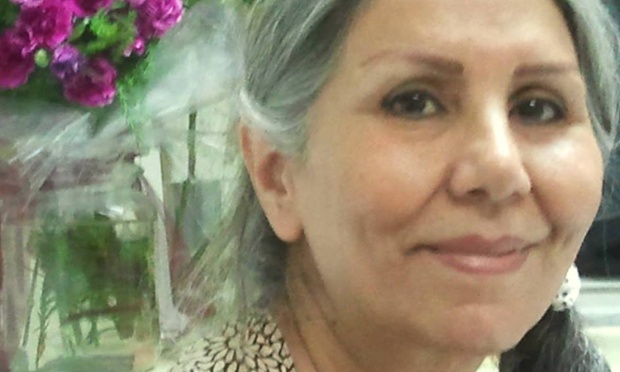
Greyer, but what a kind, calm face.
[Last night, the Ottawa Writers Festival took me on a road trip to Rwanda with Canadian humorist Will Ferguson. Wait. What? Rwanda? Humour? Yes, both, and it was superb. SPOILER ALERT: Rwanda has more to it than machetes and murder. (Gorillas. Mountains. Peace. Progress. More females in government than in your country.) Rwandans laugh. They remember. They change. It’s not still 1994 there, even if it is in most of our minds. But speaking of thought, I haven’t even told you about the previous WriteFest journey I went on, which stayed much closer to home.]
Speaking of public radio, and public spaces, and public service – as often happens around my little corner of the globe – I was in a sacred place last week where service to the common good was extolled with the help of a radio star that video couldn’t kill. (It probably helps that Alan Neal might be part hobbit.)
The SPACE: Centretown United Church is a lovely old stone building about 10 bus stops from Canada’s Parliament. Churches give some people the creeps, sometimes with good reason – desperately resisting the temptation here to mention what happened in Rwandan churches – but the UC is a benevolent and remarkably open-minded Canuck institution, and this place gets a different but complementary dose of the sacred whenever the Ottawa Writers Festival takes it over. Stained glass, hard benches, bright light at sundown, elevated and inspiring conversation. And BOOKS. (Another flavour of heaven, though as my father-in-law muttered afterward, “I don’t know what Pierre Berton was thinking when he called his book The Comfortable Pew. Had he ever sat on one of these things?” Irony can be fun.)
The RADIO: An interview with the evening’s author had already been done on CBC Radio 1’s local afternoon show, but the cherubic and funny Alan Neal was glad to recapitulate his conversation with Kevin Page for a live, though clearly greying, audience. It was like public radio in a really big studio, and was punctuated by the duo’s mock competitition to see who could insert more promos: the host at “All-in-a-Day-at-91.5-FM-in-Ottawa” or the writer “flogging my book Unaccountable”. I declared a tie. They made a good comedy team in the context of what could have been a very dry and earnest conversation. It gave bureaucrats (and public radio) a good name.

Kevin Page and a Parliamentary chandelier. (photo by Chris Wattie/Reuters)
The PUBLIC SERVICE and its SERVANT. Kevin Page became an unlikely centre to a surprising storm of Canadian attention. A self-professed “bean-counter”, this long-time economist within the Canadian federal public service became Canada’s first Parliamentary Budget Officer in 2008. “Nobody else wanted the job,” he claims. It would seem to be a rather grey and readily-ignorable position; certainly, the sitting government during his tenure would have preferred that it remain so.
Top o’ the evenin’, friends. (All slip and slope from here.)
Here were the many bits of sparkle and significance of an apparently random Tuesday in the life of a meaning-masher (me), trying to understand where one slightly eccentric but on the whole rather typical guy (also me) was coming from.
(NOTE: I am aware of autumnal equinoxes and Officially Falls, but summer was over and I heard the school bells ring. September First is a Time of Change.)
Once a teacher, always one, and always for me has the first of September been a wistful but galvanizing passage. The anxiety dreams were, and are still, in full swing. (Can I still do this? Even if I don’t actually do it anymore? Luckily, performance worries are easily transferrable.) It was, once again, time to get ready.
September 1 marked Cycle 39, Phase IV, Action Plan 13(b) of my eternal Get Organized! campaign. Those shelves? Downstairs. Clear that desk. These books go here and there. (Some may even be released into the wild.) Several priorities are in the shop for rearrangement. So much STUFF. And what do I do with cassette tapes of radio recordings and The Talking Heads? A coil-bound series of musty journals? My files from a teaching career that shows hopeful signs of being defunct? Major conundrums. Serious biz, no doubt, but I waded in and felt enlivened and resolute (with a hot ‘n’ sour side of rueful fatalism).
Speaking of fate and rue: 9-1 was mumblety-seven years and a few odd days past a coulda shoulda wouldabin wedding anniversary, would’ve been a quietly joyful reconnaissance of things past if the lights hadn’t gone out that dreadful year. Instead: “Yup. That happened. We started off so well, I thought.”
On the other hand,
It’s not an anniversary, but it’s close. About mid-July 2014 my wife and son and I made our summer trip back to Canada from China, but for the first time in five years we were coming to stay. So. <Cleansing breath.> Alrighty, then. We’ve been back nearly a year. <Another breath, deeper. Shakes the tension out of his hands, drama-class style.> We’re looking at each other and thinking, This is where we are. How’re we doing? What’s up with you/me/him? Are we who we thought we were? And so on.
I study. I teach, coach, plan. Dishes, floors and laundry loads get done. The garden is weeded and I’d better pick more lettuce and funkygreens. (Note to co-habitants: belly up to the salad bar, hombres!) I am reading about: boys and young men and what might be holding them back; James Baldwin; the NBA draft and free agency; a wonderfully eccentric view of the Bible; Reading Lolita in Tehran. I’m not reading much fiction, again, but Baldwin’s Go Tell It on the Mountain and Atwood’s Maddadam are shouting at me.
I don’t write much. I’m borrowing a concept from The Year of the Flood, the second in Margaret Atwood’s vivid futureDoom trilogy. There, in a “God’s Gardeners” community, people who are lethargic, dispirited, depressed or otherwise dysfunctional are said to be in a “fallow” state, as fields are left uncultivated by wise farmers so that the soil might not be depleted. June was a fallow field for my writing, and after about mid-month I accepted that. It gave my days-ends greater contentment, which is almost always a good thing. I wrote this, however tentative and diffident it is as a spasm of seed-planting, just so that you and I know where we are. (Hello!)
Before I abandoned my writing desk, I was writing feelingly and hard (not sure how well; haven’t gone back to look), striving to better know and appreciate seven prisoners of exquisite conscience. These “friends” of the oppressed Iranian Baha’i community, a group of leaders who tried to encourage their fellow believers once all their institutions and most of their rights had been removed, are now well into the eighth year of their incredible sentences. (Maybe I went fallow then because of futility — daily, tapping my uncalloused fingers against prison walls in a strange and distant country. Or I just got lazy; as a matter of principle, I don’t believe in futility, though I practise it with astonishing persistence.) Maybe you would like to read about the “Yaran”. My personal (possibly meandering) responses to their captivity helped them become more real to me.
It’s time for a quick update, reminders, and some sense of where you are, electronically speaking:
Vahid is Vahid Tizfahm, yet another widely known and cherished community servant taken from among the Iranian Baha’is. He and his partners in “crime” are the focus for the international #7Bahais7Years campaign, and here we go again. Danny and Pej asked their buddy, me, to contribute to the social media protests, and I’m hoping these personal essays are of some use in the necessary worldwide conversation. Vahid Tizfahm and his six colleagues are sacrificial lions, bravely enduring pariah status in a country that needs their kind more than it knows. Here is the last instalment of my series on the Quietly Magnificent Seven, prisoners of conscience in Iran for seven years, and counting…
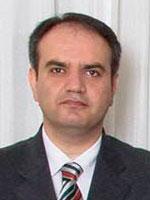
Ever had an optometrist for a hero? I have, now. Vahid Tizfahm is a lion.
At 42, Mr. Tizfahm is the same age as his father was when he was executed for being a Baha’i. Three bullets, no lawyer, no charge that we would recognize as remotely judicial. Vahid, the son who is now the similarly arrested father, is quite the youngest of the Yaran, the “friends”, the group of seven Baha’is that worked to guide and encourage the members of their persecuted community. As has become the disgusting norm in Iranian society, it goes without saying — so I’ll SAY it, again — that he did not go to university; as a member of “this detestable sect”, he wasn’t allowed to. He was able to train as an optometrist, and alongside this business he was a youth leader, taught children’s classes and was appointed to generally inspire, encourage, and promote learning among Baha’is. He studied under and supported the BIHE, the Baha’i Institute for Higher Education, an underground university that trains excluded Baha’i students in living rooms and by email. He did these things, of course, until he and the other Yaran were arrested, for “crimes” such as these, a little more than seven years ago.
***
Vahid is the Persian form of an Arabic word that means “unique”, “peerless”. Vahid. One of the greatest figures of the violently visionary and just plain violent early years of the Baha’i movement, in 19th-century Persia, was given this lofty title. And now we have another singular man, quietly, hardily, heartily bearing societal rejection and punishment in the name of principle, in the pursuit of justice.
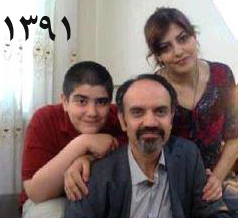
The Tizfahm family. Not sure whether this is a prison visit, or just prior to his arrest.
Vahid Tizfahm’s son was in grade 3 when they came for him, about the same age his daddy had been when his own father was taken. The family had just moved to Tehran, and my thinly educated guess is that they had done so in order for Mr. Tizfahm to more easily work together with his Baha’i leadership colleagues. (You know, relocation to pursue sacrificial voluntarism, that old story.) The lad is now a sophomore in high school. I have a son about that age, who probably gets more contact with his Dad than he’d like. But what about young Mr. Tizfahm?
It’s Day 4 of 7. I’m thinking of this man, previously unknown to me, who is among the seven innocent Baha’is now entering their eighth year of imprisonment in two Iranian jails. He — and his six partners in the most benevolent, world-minded sort of “crime” you could imagine — are the focus for the international #7Bahais7Years campaign, and this is my attempt to honour Mr. Naeimi. This probably isn’t what Danny and Pej had in mind; the bulk of the campaign they asked me to contribute to involves social media, an area where I have only narrow and entry-level eptitude. These friends, among others that I’m close to, have only 1 or 2 degrees of separation from these sacrificial lions. The Seven are enemies of an insecure state simply because of their membership in an often-ostracized community, which has been subject to nearly two centuries of bigoted slander from the entrenched shiah orthodoxy in what was once Persia, now Iran. I learn more of this tragic, heroic and underreported story of the Quietly Magnificent Seven, prisoners of conscience in Iran for a week of years. I call to remembrance people that I don’t know, because when I read their stories, they are no longer strangers.
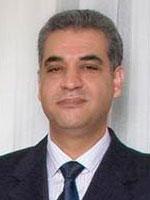
Mr. Naeimi, circa 2005 or so.
When I was young, I thought I wanted to be a doctor. So did Afif Naeimi. I was undone, for most medical schools, by my underwhelming performance in university chem and biology labs. At the progressive school I came the closest to being selected for, my clumsy interview performance likely roasted my goose. Mr. Naeimi? Now that’s a different story. He’s 53 now, which means that when he graduated from high school, a superb student, the Islamic Republic of Iran was in place, and a member of the “detestable Baha’i sect” was automatically disqualified from university. This is still the case in 2015.
How’s this for a life of crime? Dad’s a doctor who loses his job for practising medicine while Baha’i (that’s known as a ‘PMWB’ offence, which went from a misdemeanour to a felony after the Iranian Revolution in 1979). He was imprisoned and tortured, though it probably did nothing to straighten him out. (You know how these people are!) His daughter Fariba seemed to think that, just because she had outstanding high school marks, her brazen attempt to go to university was somehow her RIGHT. The ruling authorities of the Islamic Republic, fortunately, were able to nip that nefarious plan in the bud. Ms. Kamalabadi, however, was incorrigible, embarking in her 30s on an extended, clearly delusional attempt at higher education from an underground university, the notorious “Baha’i Institute for Higher Education” (BIHE). She had a lengthy criminal record with a wide range of what are euphemistically called “volunteer activities” and was imprisoned several times. Finally, when her propensity for repeated, remorseless involvement with a gang of six other reprobates continued – why, these people were helping that illegal Baha’i element to learn, marry and other of their supposed “human rights” – she was among the seven who were finally rounded up and removed, dangers as they clearly were to law-abiding Iranian citizens, from decent society…
*Coughs*. That’s enough of that. Irony is hard. Sarcasm kills…

Pre-incarceration photo, likely much changed now — except for that resolute chin.
[This is the second of my stubborn efforts to get to know more of the seven innocent Baha’is in Iran, who are the focus for the international #7Bahais7Years campaign, and so here’s a taste of the remarkable life of that “arch-criminal” Fariba Kamalabadi, 52. Again, thanks to intrepid Baha’i social networkers Danny and Pej, who have fed me with a steady diet of sad yet still ennobling information about this tragic, heroic and underreported story of the Quietly Magnificent Seven, prisoners of conscience in Iran for a week of years. This won’t take long; be sure not to miss her own description of her “crime” below.]
Yes, and you may have heard of Stubbornness Is Virtue (SIV) week, self-declared and self-extended, in which I have granted myself executive authority to Get Stuff Done, no matter how ‘last month’ it might be. This week, we have heard more from the investigation of the Germanwings air disaster, more on the sordid rehearsal that CopilotBoy did for his all-too-sadly-inclusive march into oblivion. I wrote, quite bitterly, about this unnameable coward earlier, but here was my first (pre-empted) reaction, now finally finished — rather like my lengthy high school career.
I was in high school for a LONG time.
It was five years, at first, back in the era of Ontario’s Grade Thirteen. Five years of education and some factory/retail time later, I did some teacher prep-time in a few southern Ontario elementary schools, and then resumed what seemed to be the endless walk down the halls of eternal high school. I was a full-time Creature in my 20s, and was still barking and grinning, cajoling and joking and explaining and teaming my ever-lovin’ head off ‘til I was deep into my forties.
Then, in China, I taught university students, but it didn’t feel much different. (The kids, so sheltered by the abrasive cocoon of high-pressure study – and so charming in their child-like forays into English – seemed younger than European and North American kids. Less experienced. Less jaded. The freshmen inevitably reminded me of ninth-graders, the girls beginning to dress for the male gaze, the boys pretending not to notice.) And even now, having retreated from that consuming, exhausting gig, I hang with high-schoolers all the time. Two of ‘em live with me, and I chase many more of them around gyms, with a whistle and incessant roundball counsel. (It’s no way to make a living, but I feel lively when I’m doing it.)
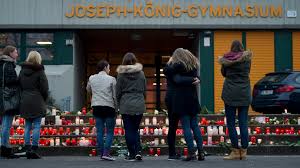
There weren’t enough candles in the world to brighten that day. (photo from rt.com)
High school is where I live, still, with much of my heart. No surprise, then, that when the Germanwings airliner went down, and my morning dose of Bad News at Home and Abroad muttered that “…eighteen of the dead are from one German high school”, my heart ached more than usual. The last time I felt this way – like a bombing near-miss, where I’m assaulted by the carnage but haven’t a scratch myself – was the bit-by-bit unfolding to me of the costs of the Sichuan earthquake in 2008, especially in the lives of children buried in shoddily built schools.