Rss

Better Read Than Never: SAUL’s The Unconscious Civilization 2

I began talking about John Ralston Saul’s book back here, though on that occasion I mainly focussed on the writer. Here is the first part of my precis of this short, bold, stimulating, even visionary book.

Kind of a cheesy cover, but don’t judge…

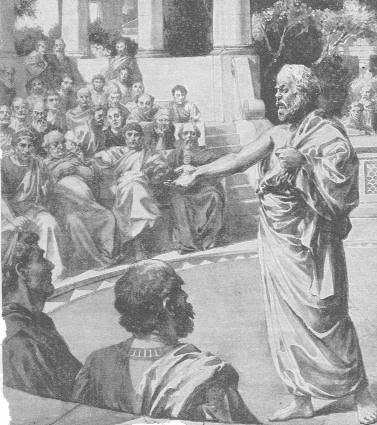
“Know thyself.” “The unexamined life is not worth living.” John Ralston Saul might have chosen these Socratic aphorisms to lead off The Unconscious Civilization, his 1995 lecture series and book. Instead, he chose a slightly more modern reference to self-knowledge, and his fundamental argument is that this same imperative of understanding applies to societies and even entire civilizations, hence his title.

Saul argues that mere propaganda has become a domineering substitute for the socially constructive use of language in public discourse. He warns that our practice of what we call ‘democracy’ is in fact warped and even thwarted by the steady march of corporatist thinking.

Continue Reading >>

John of Salisbury (on personal understanding)

“Who is more contemptible than he who scorns knowledge of himself?”

John of Salisbury (1120-1180 C.E.), born in England, was a churchman, diplomat and writer. He was secretary to the assassinated Thomas a Becket, the Archbishop of Canterbury; a prime source of the early history of the University of Paris; and, “little John” was the Bishop of Chartres in the last years of his life. John Ralston Saul’s 1995 The Unconscious Civilization leads off with this “true question” from the Middle Ages, and asks us to apply it to societies, to civilizations, as well.

Boston Strong. So is Baseball. Radio Works.

I know, I know. It’s Friday. The World Series ended Wednesday night. We should forget about it as quickly as possible and get on to the next entertainment fix, just as we trash the orange and black from the malls and get the reindeer prancing and Santa selling. I beg to differ. (I stomp my feet and holler to differ.) I had an odd and possibly interesting view of the high baseball holy days from China, and here’s what some of it looked like. This is the third in my World Series Series (the first was here). 


“They are three outs away from winning the World Series, ” Dan Shulman suavely said into my earphones in Room 501. He’s a microphone pro, one of the best narrators in the world of sports, and though smooth  as always, a younger man’s glee at looming victory was tangible in his voice. (He’s also Canadian, I may have pointed out before, as is Jonah Keri, the author of this excellent recap of Boston’s road to victory. Mine’s a narrower, more idiosyncratic take, while Keri gets inside baseball as well as anybody I’ve read.) I was with Shulman and fellow commentator Orel Hershiser, plus tens of thousands of screaming BoSoxian crazies, and who knows how many eavesdroppers via ESPN Radio, but I couldn’t have been much more alone in my hunger for baseball.

501 is the Chinese teachers’ workroom in the small economics college of a thoroughly average university in northeastern China. There were no tacos, no high fives and no between-innings arguments. (For most of the hour or so I was there, there wasn’t even another human.) I hadn’t been able to find another foreigner with any baseball interest to share the “October Classic” with.

Continue Reading >>

A Distant World Series: What About the *Radio*?

Note: This post has been updated to reflect that I heard bits and random pieces of the radio broadcast of game 5, but mostly ESPN program notices. 

This became my plan for doing more than just reading recaps on the World Series games on a Chinese afternoon, that is, after I caught the best bits of the Cardinals’ game two World Series win on ESPN Radio. This solution never occurred to me in my ridiculous struggles to catch Game One or the first six innings of the second, more compelling game. Ortiz’s two-run shot for the Sox, followed next inning by the Cardinals running and daring themselves back into the lead. Epiphany! A return to yesteryear! Nostalgia becomes the solution to a technical problem! Mum and Dad had followed the Cleveland Indians this way in the ‘40s and ‘50s, and why not now? (Well, my bride did have to wave her hands in front of my face during that stretch of Game 2 – she wasn’t even hearing what had me day-dreaming of Fenway Park – as she tried to engage in a curious exercise she calls “planning”. That was Friday morning.) My iffy Internet connection had no trouble pulling down some good old-fashioned audio.

The added bit of sentimental pleasantness was the rich voice and baseball clarity of Dan Shulman doing the play-by-play, and not only because he’s a Canadian.

Continue Reading >>

Jonathan Franzen (in Freedom, on rival wives)

After a small festival of reading Franzen non-fiction, and non-fiction about Franzen, and speculating idly about the famous Franzen Twitter-aversitude, I dived into his most recent novel, Freedom. I read and enjoyed his The Corrections six or seven years ago, and have been waiting for “the right time” to start his newest. ‘Nuff waitin. Ain’t no ‘right time’. (Unless it’s now.) I’m a quite delicious (thank you) 164 pages in, with no real effort. Here are just a few sentences — the last knocked me out — brief character description that somehow implies an entire generational critique. Merrie Paulsen is a neighbour of protagonist Patty Berglund’s, and not in her fan club:

“Another problem…was that Patty was no great progressive and certainly no feminist (staying home with her birthday calendar, baking those goddamned birthday cookies) and seemed altogether allergic to politics. If you mentioned an election or a candidate to her, you could see her struggling and failing to be her usual cheerful self — see her becoming agitated and doing too much nodding, too much yeah-yeahing. Merrie, who was ten years older than Patty and looked every year of it, had formerly been active with the SDS in Madison and was now very active in the craze for Beaujolais nouveau…”

Jonathan Franzen, pp. 8-9 of the paperbook version of Freedom, just getting rolling. The SDS, for you youngsters and un-Americans, was the radical organization Students for a Democratic Society, which had no interest in wine or gentrification at all.


MLB in China: You Can’t Be (World) Serious!

Well, it’s been another day in the life of the ex-pat athletic supporter…

I’ve been to one Chinese Basketball Association game up in Shenyang, my province’s capital, and that was a frosty Friday nearly three years ago. The word is that Dalian was once a national power in Chinese professional (soccer) football, and I really ought to get out to the stadium once before I’m back in Canada for good. I’m sure it would turn my athletic crank and shuffle my observation deck if I actually got out there, but I’m not a great expedition-planner and this would require some linguistic Sherpas. A guy with mornings free, which I sometimes am, can often pick up an NBA game on CCTV 5, the ESPN of China, but he can forget about hockey and baseball.

Tools of nostalgia, weapons of youth. I miss baseball.

Except that, try as I might, I can’t forget baseball. As a sports fan in China, I’m mainly a reader, and a big proportion of that textual wading is devoted to basketball, both splashy coverage of the American college and pro games, and homely black and white reports from the Canadian university scene. (And don’t forget NiuBball.com, for all the Chinese hoops news that’s fit to print in English!) I don’t often read about baseball, though, and when I do it’s an in-depth feature on an athlete or on some trend in the sport. Game results? Heck, 162 games times 30 teams (and by the way, the Jays stunk again this year) equals no friggin’ way. Gotta draw the line somewhere.

Continue Reading >>

Jonathan Franzen (on Alice Munro)

“Reading Munro puts me in that state of quiet reflection in which I think about my own life: about the decisions I’ve made, the things I’ve done and haven’t done, the kind of person I am, the prospect of death. She is one of the handful of writers, some living, most dead, whom I have in mind when I say that fiction is my religion. For as long as I’m immersed in a Munro story, I am according to an entirely make-believe character the kind of solemn respect and quiet rooting interest that I accord myself in my better moments as a human being.”

Jonathan Franzen is the great American novellist (The Corrections, Freedom, and a brilliant non-fiction collection called How To Be Alone, among others). He paid the most breathtakingly erudite tribute to Ms. Munro in a 2004 New York Times review of her collection Runaway. This remarkable piece lauds the greatness of Alice Munro, and criticizes literary fashion and our culture’s blindness, in one restless, contrarian, impassioned and unpredictable essay.

Hitting ‘Refresh’: One Dark Night, This Ol’ Dad

I just didn’t get it. (I never seem to, as he often reminds me.)

We’d had a pretty good time at the basketball courts, my 13 year-old son and me and a half dozen temporary teammates. I thought so, anyway; I was gassed, toast, bagged (as we used to say in the Grand valley), as usual, but fairly content. I’d had a good run. Some shots and passes found their targets. No ankles were harmed in the making of that afternoon which had turned into an early Dalian evening. We had a 20-minute walk home, but somehow we couldn’t pull it off.

Ours was not a Norman Rockwell moment.

I can’t rebuild that wrecked conversation now, and there’s no instant replay available – all I know is that I must have said a steaming pile of Wrong Things, and before I could say “that was fun” my lad was snorting and huffing, you just don’t get-ting and stomping his way as far from the Dysfunctional Father Unit as he could get. He’s a fiery critter, and a stubborn, and maybe-just-maybe a little too much like his old man for our collective good. Here we go again, I muttered. How did we get here from there?  

It was dark, and I was alone, and except for the relationship shrapnel, that was fine by me. Breathing room. A little peace and quiet. Yes. But not only that: I also remembered to turn to an old favourite consolation.

Continue Reading >>

Alice Munro (fiction and parental fears)

Don’t be fooled: her writing isn’t dainty, but perfectly dangerous.

Well, you all know that the Canadian short story writer Alice Munro, 82 years young, won the Nobel Prize for Literature this year after a career of writing nothing but short stories.

Or maybe you didn’t. Short story: she’s magnificent, and I blushed at how long it’s been since I have read her. When the Nobel news came there was only one thing at hand for me to read: “Miles City, Montana”, from a paperback Canadiana collection that I picked up somewhere, my Can-Lit homework for this fifth China year.

It’s typically homely, but danger lurks. A couple and their two small girls travel by car from British Columbia to southern Ontario, mostly via the United States. I won’t go on, but simple events and the hauntings of memory make us feel that we have known the narrator from the inside. Here’s the quote.

Continue Reading >>

Love My Shorts

The mighty Iron Shorts! See how proudly they stand! How scornful they are of Photoshop or rigidity-enhancing chemicals! Straight off the clothesline, in our living room…

They say, don’t they, that small things amuse small minds. Here’s proof!

I grin sometimes when I drop my shorts at the end of a warmish day and they stand where I stood. I decided that you, dear readers, should not be deprived of this odd bit of jollity. Clothing that “wears like iron” is a desirable quality in my world, though not in my bride’s. She grimaces at a garment that stands on its own two pant-legs, rather than softly swirling. I, on the other leg(s), will be proudly wearing these shorts in 2023. I bought ’em on a steep discount from my usual low-fashion outlet, and later bought a similarly reduced fall/winter jacket under the same label and made with the same heavy, durable canvas. (And with such numerous, handy and sturdy-zippered pockets! I’m not into backing companies with no need of my support, but it’s good stuff.)

The next load of laundry was ready for hanging in our south-facing balcony, but these bad boys don’t dry too quickly. I took them off the line, then stood them up on the ottoman to finish drying. No extra starch. No hidden supports. No photo magic. Just an upstanding pair of shorts, just the way Howdy likes ’em.