
*With Chinese Characteristics
(This is Part Two of my attempt to communicate the wonder of a “Christmas Show” in a Chinese college. Part ONE is here. There were pictures.)
When we last electronically met, I recounted my first-row scribbled impressions of an event the likes of which few Ontario basketball coaches get to experience. We made it to Act the Sixth, but there was much more to come. This is a late report, but the show had few connections to any particular season, let alone Christmas. Speaking of which, Happy New Year. (Again.)

It wasn’t all sweetness and light (and singing), but a lot of it was.
ACT 7: Gold-lamé pants, white flowing blouses and pink ribbons. A rather gentle, oriental opening to the dance. BUT. Here come the heaving breasts, the hip thrusts and, my gosh, the friggin’ bass. Well, that was fairly sexual. Unfairly? [And hey: maybe the overwhelming percentage of female students in our college, in our entire university – it’s a Finance & Economics uni, which means female, while the technology school up the road skews massively male – makes this kind of dancing a biological imperative. It pays to advertise, and all that. Come to think of it, maybe it’s not just that it’s a rich-kid college that makes the hallways so often look like a dance-club anteroom. Minis and heels and spangles. I’m beginning to detect a theme. The young men in our school are a pampered lot, in more ways than two, and yet Chinese reserve is such that most guys barely talk to their female classmates. Missed opportunities.]
ACT 8: This looks Japanese to me, which all will instantly deny. White-draped, angelic young women demurely wave feathery fans. They’re wearing what I’d call harem pants if they weren’t so clearly, well, East Asian. Expensive costumes, kids! [And from the Should’ve Known Better File: these, too, are all rentals. There must be some junior staffer whose entire job was costumes. Amazing. Money has been spent.] That was quite lovely, a sweet tonic.
ACT 9: Here they come! the sort-of-English-speaking MC warns. The tonic didn’t last – it’s back to black leather hotpants!
*With Chinese Characteristics
While this all happened, I was scribbling in the dark, periodically shielding my eyes when the gyrating stage lights tried to blind me in my privileged-foreigner (?) front-row seat. For reasons benevolent and charming, some still unclear, and others only a little nauseating, my college puts on its “Christmas Show” on the second weekend in December. When Western universities were completing exams, we had one last bash before the grim final few weeks of term. Exams started yesterday; I have papers to mark and journals to read, but remembering this is more fun. Besides, it’s (barely!) still 2013. I’d missed the show in 2012, on some pretext. Hmm, and also the year before that. This was Chance the Last, and if I hadn’t gone, you wouldn’t be able to read this breathless blurt of hyper-opinionated Western bemusement, befuddlement, wonder and dismay at the spectacle that is a Chinese celebration of we’re-not-sure-what-but-you-must-have-a-great-time…
This is Part One, and a second blast will soon follow. Happy New Year.
Oh, the sparkles, the spangles, the balloons! Oh, the frilly clothing and the 38-yuan red high heels that it was the honour of the young women honoured to be conscripted as the honoured hostesses to buy! Oh, that song, again and still – China takes all the weariness of the post-Hallowe’en deluge of Christmas songs and sharpens it all to a fine point, a stabbing red-hot poker called “Jingle Bells” that plays on repeat. Here is the same version that has impaled me for weeks at the mall where I tutor overpaying English learners on Thursday nights, at one of the many cash-cow private Business English academies. Worse, it’s a rendition that is a sonic cheese-grater to the soft parts of the ears, apparently called “Jingo Be-yo”:
Jingo be-yo, jingo be-yo, jingo ah de whee
Oh wha funny tease to righ / Inna one-hoss oben slee…
[Surely to punish me for my impertinence, the McD’s where I’m hiding away for freedom from distraction and high-grade Author Fuel is playing a diabetes-inducing version of “Here Comes Santa Claus”, which at least has the virtue of not being the George Michaels classic “All I Want for Christmas is You”.]
The glittering MCs come to the fore, to great applause.
OR: Don’t Shoot Brian Phillips, He’s Only the Typist
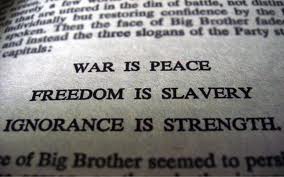
George Orwell first brought it to my conscious attention, this capacity of ours to accept violently opposite things at the same time, using the same set of brain cells. “Doublethink”, he called it. With adolescent loftiness, I had started in my early teens to notice how my reading and my family urged me to be reasonable all week, while Sunday morning church seemed to demand that I put sense in a headlock and believe a dozen dubious things before lunch. (After that, I could return to the eminent reasonableness of NFL double-headers or five hours of road hockey.) By the end of high school, I’d come to 1984, and
Language is power. The pen is mighty.
been punched by Orwell’s description of a totalitarian regime with its Thought Police and, of course, its doublethink, “the power of holding two contradictory beliefs in one’s mind simultaneously, and accepting both of them.”
Since at least those high school days, I’ve felt conflicted about my deep and dedicated love of sport. Most of the time, it just meant that I was the “flake” on the team, even when I was its best player, or that I always felt dislocated. As a “grown-up” athlete, I sometimes felt like my face in the team picture was out of focus; I didn’t share my teammates’ affection for beer or pickups (female or automotive), nor their enthusiastic ignorance of books and other flaky ponderables. “Don’t think too much, Howdy, you’ll hurt the ball-club” was at first the wise and kindly advice of an educated vet of the ball diamond, who occasionally caught me trying to understand hitting at the same time that I was doing it. (Yogi knew.) As time passed, though, in the locker room and finally in my own mind, it became a mocking sort of mantra which suggested that sport and introspection were, or maybe ought to be, mutually exclusive.
Sigh. I could blame the exams, the final projects, the nutbars that I live with or another knock to my already addled head, but I’m late, as usual.
Of course, we don’t actually know the precise date of the birth of Jesus, so I could also plead historical vagueness as a virtue, but that’s not why I missed, either. Let’s just say it’s the season. Let’s just say that it has taken me some time before I could really think much about The Reason for the Season, as Christian friends back home like to remind themselves and their fellow crazed consumizens. (In China these days, it is even more bluntly obvious than it is among comfort-craving North Americans: avid consumption is the best-understood expression of citizenship. “Consumizens.” Not bad.) In fact, it was the thoughtful questions about Christianity from a young Chinese friend that got me thinking more deeply about why this time of year still stirs my blood and brain.
Anyway, I ran across this statement
With apologies to the great Paul Simon, I present a thoroughly personal update of his jiggy 1975 song “50 Ways To Leave Your Lover”. A chronological milestone was recently reached by my bride, who had the dubious honour of hearing — LIVE! — Mr. Simon’s melodies and beats overwhelmed by a most eccentric chorus of all-too-willing back-up singers, with me trying to stay in one key during the verses. It was. It was… It was odd, funny and delightful. She loves to laugh, does my bride. Her name is Diana.
Fifty Ways We Love Diana
This business of aging’s no big deal, don’t you agree?
The woman’s always dancing, if a little recklessly
And when we think about the loveliness of ‘Dee’
There must be fifty ways we love Diana
Look down, yup, the post right down below, for text to go with the above title. (I messed up.) It would be fantastic for JH.com if you could somehow respond to my invitation. JH
A Backward Glance, A Second Thought. (Whadiddy Sayagin?)
‘Tis the season, friends and neighbours.

Evanescence is the new solidity.
No, not the season of rampant materialism, though crassness happens. And I don’t mean the time when thoughts of peace on earth, good will towards men quietly insist on being heard amid the din and the hurrying, though I’m all in favour. (Not of the noise and the haste, but of the good will part.) It’s Mirror Time! The Annum That Was! What the Heck Just Happened? The Year in Review!
Sports Illustrated has chosen the NFL quarterback Peyton Manning as its Sportsman of the Year, and the December flood of instant nostalgia is rising. No doubt Time (do we still have Time?) and People and Cool Gossip About Rich Folk I’ll Never Know are putting out their reflections on 2013; and good-for-them, I thought, might not be a bad thing for this humble gathering of electrons.
So, without further mumbling, an Invitation For You:
Faithful readers, occasional lurkers, subscribers loyal and visitors frequent, I would like to know what you’ve liked here at JH.com in 2013. Over the past year, this site has featured 39 “At First Glance” pieces on everything from fireworks to novels; 34 short essays that were “All About Sports”; five longer meditations that are found in the “On Second Thought” section; and, 45 quotations under the heading “He Said/She Said”. (I got a bit nutty, maybe, about HS/SS the past few months, but increasingly I use them as thought exercises, and append my responses to the notable words of others and my reasons for posting them.) So, lots to choose from!
Ideal scenario: you’ve read lots, remember some well, and don’t mind traipsing through the archives to remind yourself of what you’ve read here. You’ll fire me a Top 10 list (or Super 7, or…), and I’ll compile it with those of others to produce a JH.com Year in Review.
Another scenario: you haven’t been around here for long, or don’t come often, or just don’t have time to mess around with rankings, but you have read a thing (or three) that you like. Let me know the titles, and I’ll feed your choices into the blender, too.
In any case, please send me the list of your favourite titles by December 31, and I’ll try to get the 2013 results up before 2014 gets too old. Thanks! Send your list — and any other feedback, commentary, suggestions — to INFO@JAMESHOWDEN.COM .
YES, and JH.com is now followable on Twitter @JamesHowdenIII. Thanks for looking in. If you’re new here, read on to find out more of what JH.com is all about, including how to SUBSCRIBE…
“Every gun that is made, every warship launched, every rocket fired signifies, in the final sense, a theft from those who hunger and are not fed, those who are cold and are not clothed. This world in arms is not spending money alone. It is spending the sweat of its laborers, the genius of its scientists, the hopes of its children. . . . This is not a way of life at all, in any true sense. Under the cloud of threatening war, it is humanity hanging from a cross of iron.”
Was it politics-as-usual, war-by-other-means, or were his words the earnest thought of a man who really knew the price of war?
Dwight David Eisenhower (1890-1969) was the Supreme Allied Commander by the end of World War II, first military head of N.A.T.O., and then a landslide Republican winner of the 1952 U.S. Presidential election. He served two terms as President, during which the Cold War deepened and America prospered mightily. This quotation comes from his widely broadcast and historically notable 1953 “Chance for Peace” address, sometimes known as the “Cross of Iron” speech. Even Wikipedia notes the “debatable” sincerity of his words, and yet they are urgent and fine and no less true today.
He elaborated the purely economic price of the arms race like this:
* With Chinese Characteristics.
What follows is the bemused, inconclusive, but delightful tale of an “innocent abroad”, yours truly, trying hard to enjoy whatever taste of locally grown hoops he could find, and understand how it worked. Coach Howden was in the building. Several times! He was, though, a long way from his own hometown hardwood, and no one offered him a whistle or a clipboard.
I stole moments in my school’s gym over several November weekends, after I accidentally found out that there was an ongoing tournament for Dalian universities and colleges, 16 of ’em. College hoops! 15 minutes walk from Apartment 902! Who knew?
It’s pretty bad basketball, actually, which wasn’t news to me. I’ve known for years that Chinese universities, if they have teams, field poorly trained squads — never mind their Q scores, they are barely known (beyond their girlfriends) on their own campuses — that play a tournament or two and then disappear completely. Because, though, of a cinematic cheese-fest called Kung Fu Dunk (starring pop idol Zhou Jielun, “Jay Chou”) that I
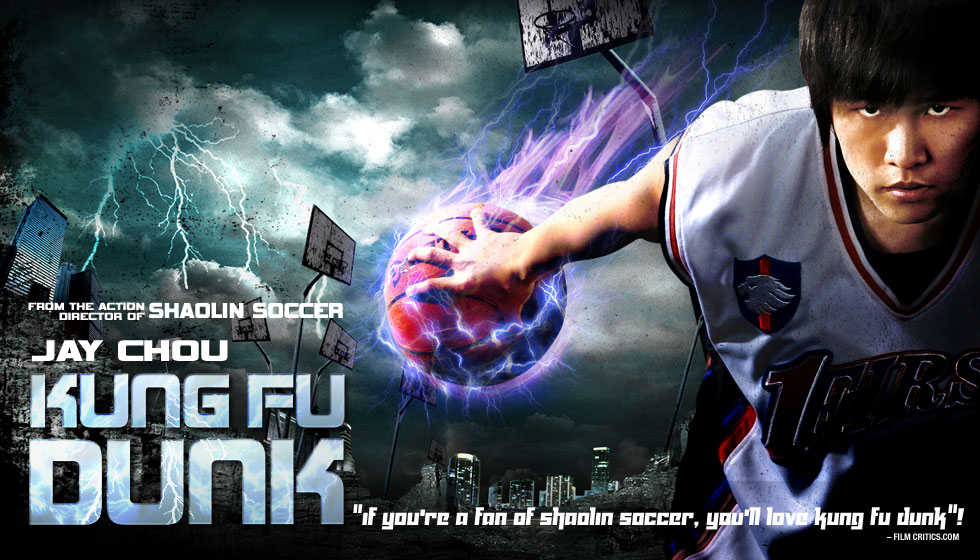
Surely one of the silliest movies ever. The key fight-scenes were backed by Mr. Chou singing how his “kung fu” would turn hapless opponents into “tofu”. (It rhymes even better in Chinese.) Priceless.
watched during my first flight into Beijing, I knew there was something called the Chinese University Basketball Association. The university I taught at my first two years, Dalian Ligong Daxue, our nearby University of Technology, has had a women’s CUBA team for years; periodically, I’d see tall women trudging toward the outdoor stadium for wind sprints, or hang around after an indoor 4-on-4 game to watch them practice. No men’s team, though, at least not then, and why did Ligong have a women’s CUBA team, anyway? Apparently, some connections, and a willingness to admit under-achieving graduates of specialized sports schools and shepherd them through something approximating a degree,