Rss

William Easterly (on global inequity and Harry Potter)

“On July 16, 2005, the American and British economies delivered nine million copies of the sixth volume of the Harry Potter children’s book series to eager fans….There was no Marshall Plan for Harry Potter, no International Financing Facility for books about underage wizards. It is heartbreaking that global society has evolved a highly efficient way to get entertainment to rich adults and children, while it can’t get twelve-cent medicine [to cure malaria] to dying poor children.”

William Easterly (b. 1957) is an American economist concerned with development and global poverty. I recently stumbled across his 2006 book The White Man’s Burden: Why the West’s Efforts to Aid the Rest Have Done So Much Ill and So Little Good. (I only had time, though, to read the opening chapter.) In it, he elaborates his response to the likes of Jeffrey Sachs (The End of Poverty), whom Easterly admires but labels a “Planner”, someone whose big-picture ideas for the elimination of economic injustice are just another example of patriarchal, top-down approaches to the needs of the poorest of the poor. Easterly argues that what he calls “Searchers”, with a grassroots and learning-centred way of thinking, will be more effective in this essential work. They will working directly with (or be) the local people themselves, harnessing their intelligence, experience and resourcefulness.

Two more books to read.

Ken Loach (on Margaret Thatcher)

Kenneth Loach is a British film director, best known in North America for a stunning film on the Irish struggle for independence, the Palme d’Or winner at Cannes in 2006 called The Wind That Shakes the Barley. (It is a blunt and rather bleak film that fans of superheroes and explosions might not enjoy.) Loach has most definitely lived and worked in opposition to the right-wing, market-driven policies that found their clearest expression and results during the controversial and frighteningly decisive tenure of British Prime Minister Margaret Thatcher. When she died this year, there were the usual voices of obituary praise, and there was Ken Loach. He called her “the most divisive and destructive Prime Minister of modern times,” and wrote that “her enemy was the British working class…[and] it is because of policies begun by her that we are in this mess today…” Well, now. Partisan politics is a mess and a dead end, in this writer’s view, but that doesn’t stop me from finding social justice — community-building that favours the many over the few, and damn the ‘trickle-down’ — a good basic premise. So I couldn’t help grinning at the audacity and the satiric truth-telling that had Mr. Loach making this argument:

“How should we honour her? Let’s privatise her funeral. Put it out to competitive tender and accept the cheapest bid. It’s what she’d have wanted.”

Margaret Thatcher (on power (and women))

“Being powerful is like being a lady. If you have to tell people you are, you aren’t.”

Margaret Thatcher (1925-2013), long before being brought (back) to life and attention in an Oscar-winning 2011 Meryl Streep performance, was a tough-minded politician who became a polarizing figure as Prime Minister of the United Kingdom. To her short definition I quickly think of others: being honest, or good in some way at at some thing, being blind to race or not chiefly motivated by money…

(And where do these quotes come from, you probably don’t wonder? In this case, Ms. Thatcher’s witticism — perhaps not words to live by, but awfully clever and yes, powerful — come from the March 11 edition of Sports Illustrated, its so-called “power issue”. I look for inspiration and good words everywhere.)

Abdu’l-Baha (on greatness and wealth)

At age 31, the exiled Abdu’l-Baha — son of the Founder of the Baha’i Faith and one of its central figures — wrote an anonymous plea to his homeland. He wanted Persia (Iran) to rise from its lethargy and backwardness; this sternly affectionate letter to a nation that had persecuted his community and rejected its call to progress was later called The Secret of Divine Civilization. The following describes the characteristics of the truly great, those who better their own countries or the whole world:

“The happiness and greatness, the rank and station, the pleasure and peace of an individual have never consisted in his personal wealth, but rather in his excellent character, his high resolve, the breadth of his learning, and his ability to solve difficult problems….

It should not be imagined that the writer’s earlier remarks constitute a denunciation of wealth or a commendation of poverty. Wealth is praiseworthy in the highest degree, if it is acquired by an individual’s own efforts…and if it be expended for philanthropic purposes….If, however, a few have inordinate riches while the rest are impoverished, and no fruit or benefit accrues from that wealth, then it is only a liability to its possessor…”

Chad Harbach (on art and beauty and sport)

I just finished The Art of Fielding, a 2011 novel by Chad Harbach that centres on baseball but ranges widely (sometimes wildly) from Herman Melville to environmental activism to collegiate sexual mores to the nature of the life well-lived. I liked best its many meditations on the meaning of sport, and the pursuit of greatness in it. Here is one passage:

“The making of a ballplayer: the production of brute efficiency out of natural genius.

“For Schwartz, this formed the paradox at the heart of baseball, or football, or any other sport. You loved it because you considered it an art: an apparently pointless affair, undertaken by people with a special aptitude, which sidestepped attempts to paraphrase its value yet somehow seemed to communicate something true or even crucial about The Human Condition…, that we’re alive and have access to beauty, can even erratically create it, but will someday be dead and will not.

“Baseball was an art, but to excel at it you had to become a machine. It didn’t matter how beautifully you performed sometimes, what you did on your best day,how many spectacular plays you made. You weren’t a painter or a writer — you didn’t work in private and discard your mistakes, and it wasn’t just your masterpieces that counted. What mattered, as for any machine, was repeatability…”

Chad Harbach is a new writer to me. He is the co-founder a literary and cultural magazine called n+1, also new to me. He writes about baseball like Henry the Shortstop, his protagonist, fields ground balls: with grace, the occasional wow, and deep understanding.

He came into my line of sight rather pathetically: a student in my writing class in a Chinese university, hectored by me to find something fun/interesting/pleasurable to read in English rather than the stiff, classical and too damnedly difficult texts they typically have chosen for them, showed up with The Art of Fielding. She’d paid 77 yuan for the paperback, about 13 bucks, which was in a Chinese bookstore solely because it was a New York Times notable book. Her choice was a sad, bitter and completely unintentional joke on me and my sometimes absurd hopes for students, and nobody got the joke but me: not only is it a fine and rather literary novel, it’s about baseball. Ms. An hadn’t the faintest clue what the book was about, and hadn’t even bothered trying to begin it. I released her from this painful (or patently fake) fantasy of fiction reading, then borrowed the book, and have so far been unsuccessful in convincing her to allow me to pay her for it. (It’s great. It’s so laughably/pitiably far beyond the grasp of nearly any Chinese student, though not apparently a financial stretch for this one.)


Jacob Riis (on perseverance and “pounding the rock”)

“When nothing seems to help, I go and look at a stonecutter hammering away at his rock perhaps a hundred times without as much as a crack showing in it. Yet at the hundred and first blow it will split in two, and I know it was not that blow that did it, but all that had gone before.”

I had never heard of Jacob Riis (1849-1914) before my attention to all things San Antonio Spurs reached new heights during their NBA Finals series with the Miami Heat. (Spurs coach Gregg Popovich, tired of the “typical, trite silly crap you see in locker rooms at all levels”, has long had Riis’s stonecutter quote displayed in the Spurs’ dressing room. I was puzzled when a microphone picked up “Coach Pop” imploring his team during a timeout to “keep pounding the rock!” This could have been basketball jargon for “keep dribbling the ball”, which was a strange thing for such a team-oriented coach to say. Now, suddenly millions of NBA fans know of Jacob Riis and his love for basketball  tireless dedication to social justice.)

Riis was a journalist, a muck-raker, an activist and a noted practitioner of the brand-new art of photography. Born in Denmark, he was a relentless advocate for immigrant rights and decent living conditions in New York. It was in the context of his activism on behalf of the “poor, huddled masses” that he made the above statement. The Spurs use it because they believe in the process of team-building, slowly and steadily. I think of it when trying to teach English, build community, educate for justice, find my mislaid abdominals and write and write. (What’s your rock?)

John Wooden (on failure)

“Success is never final; failure is never fatal. It’s courage that counts.”

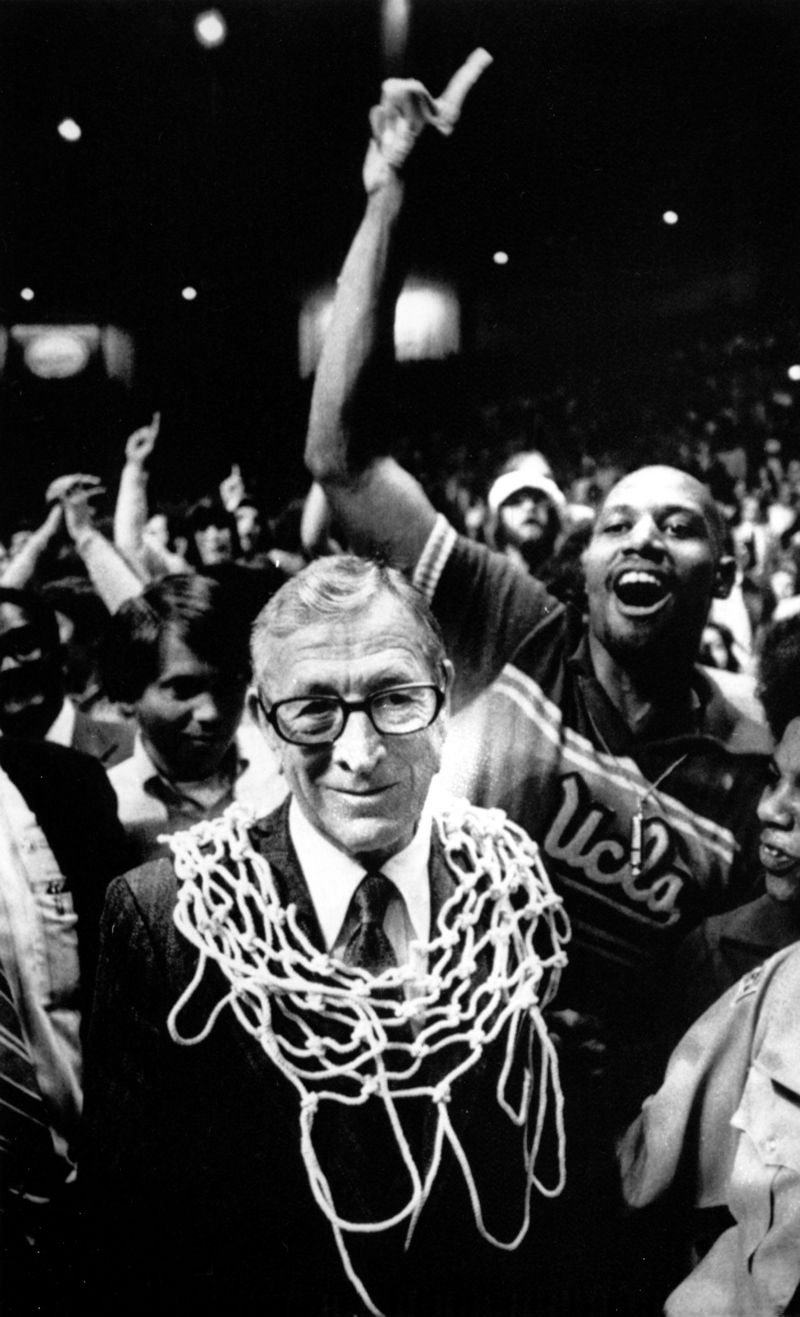
John Wooden (191o-2010) was not only the greatest basketball coach of all time, but a wise teacher for 20th and 21st century America. I quoted his wisdom in a recent article here. He was my hero, perhaps even Number 2 among the greatest men I can imagine, and I can’t believe he’s been gone three years already. He was a writer and an educator, though, and his words live on, as does his example. His advice runs through my mind nearly as often as that of ‘Abdu’l-Baha. In the immediate calm-down after an incredible NBA finals, where I loved the Spurs and admired the heck out of LeBron and the Heatles, I miss basketball and coaching. I miss John Wooden.

A Hall of Fame player, tough and fiery, with a degree in English literature and teaching as a day job.

Humble victor, though he won again and again and again and again. A great man with feet of granite.

John Ralston Saul (on corporatism and individualism)

In The Unconscious Civilization (1995), Saul traces the rise of individualism in the West, but complains that the term has been “hijacked” in modern times:

“Nowhere…was the individual seen as a single ambulatory centre of selfishness. That idea of individualism, dominant today, represents a narrow and superficial deformation of the Western idea….[We are] a society addicted to ideologies – a civilization tightly held at this moment in the embrace of a dominant ideology: corporatism…[It] causes us to deny and undermine the legitimacy of the individual as a citizen,…which leads to our adoration of self-interest and our denial of the public good….The overall effects on the individual are passivity and conformity in those areas which matter and non-conformism in those which don’t.”

John Ralston Saul is a Canadian thinker, writer and activist for the public good. I was lucky enough to watch from close range, in the mid-2000s, as he continued to develop the ideas he put forth in The Unconscious Civilization (1995) and to poke and provoke conversation about ideas that matter, from the neighbourhood to the globe. He’s an intellectual fireball. In the midst of watching too much basketball and reading too many student papers, I’m stealing the chance to re-read Saul.

Peter Khan (on idealism vs. lethargy)

“We, today, face…the test of overcoming apathy and lethargy, the test that those around us increasingly lack zeal and idealism and a passion for changing the world. Society around us has lost its vision….Heroes and heroines…have become discredited….They have been found to have feet of clay. There are no heroes. There are no heroines….It is a matter of making it through day by day, being concerned only for one’s self because no one else is interested in us. You survive or not. It is a hard, cruel world out there.

“That is not the Bahá’í way. We are people committed to the creation of a new society. We are summoned to heroism…to sacrifice…to idealism and to altruism….We are people who love and are concerned about generations yet unborn and we are prepared to dedicate our lives that those generations to come…may have a better life; may have a life of peace and unity and harmony and the possibility for the full development of their potential.

“This is the idealism to which we are summoned as Bahá’ís. We need to overcome the apathy and lethargy of society and stand apart as people dedicated to the creation of a new world.”

Peter Khan (1936-2011) was a professor of electrical engineering who became best known for his service to several sorts of Bahá’í community institutions in the U.S.A. and Australia, as well as membership on the worldwide community’s elected international council. This is an excerpt from a talk he gave in 1995 in Chicago. What a mind! His spoken delivery was very deliberate and dry, not dazzling at all unless you listened to what he was saying.

Juvenal (on “bread and circuses”)

“… Already long ago, from when we sold our vote to no man, the People have abdicated our duties; for the People who once upon a time handed out military command, high civil office, legions — everything, now restrains itself and anxiously hopes for just two things: bread and circuses

(Juvenal, Satire 10.77–81. “Juvenal” is the English name of a Roman poet, who lived in the 1st and 2nd centuries of the Christian Era. This famous critique of the degraded mentality of the Roman masses has been widely and often used to disparage the ways in which governments try to keep their citizens tranquillized, and which the public often and willingly accepts. In Spain, they’ve called it “bread and bullfights”, for example.)

And, to increase the linguistic richness of JH.com, and thanks to dear young
Wikipedia, here is the original Latin of Juvenal’s statement:

[…] iam pridem, ex quo suffragia nulli / uendimus, effudit curas; nam qui dabat olim / imperium, fasces, legiones, omnia, nunc se / continet atque duas tantum res anxius optat, / panem et circenses. […]