Rss

H.M. Tory, U of A (on the mission of higher education)

The PEOPLE, the PEOPLE, the PEOPLE, the WHOLE PEOPLE!

“The modern state university has sprung from a demand on the part of the people themselves for intellectual recognition, a recognition which only a century ago was denied them. The result is that such institutions must be conducted in such a way as to relate them as closely as possible to the life of the people. The people demand that knowledge shall not alone be the concern of scholars. The uplifting of the whole people shall be its final goal.”

Dr. Henry Marshall Tory was the founding President of the University of Alberta, and this was part of his address at the infant school’s first Convocation on October 6, 1908. Alberta had been a province for three years at this point. I’ve had a soft spot for the U of A for decades, as my big sister Leanna graduated from there and taught there for many years. It was only last summer, though, thanks to a T-shirt gift from our professor friend Kyle, that we knew of this quote from Dr. Tory. 

This quote helped me conclude a recent piece on environmentalism and the front lines of sustainable community living. How many modern universities (including the U of A) act as if they subscribe to this grassroots view of higher education?

Reaping the Whirlwind and Looking for Hope

I quoted Theodore Roosevelt  back in the dim reaches of my “He Said/She Said” collection, but anybody can do that. Recently on Grantland, I read a piece on Don King, the once-dominant promoter in
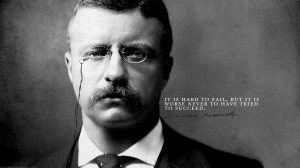
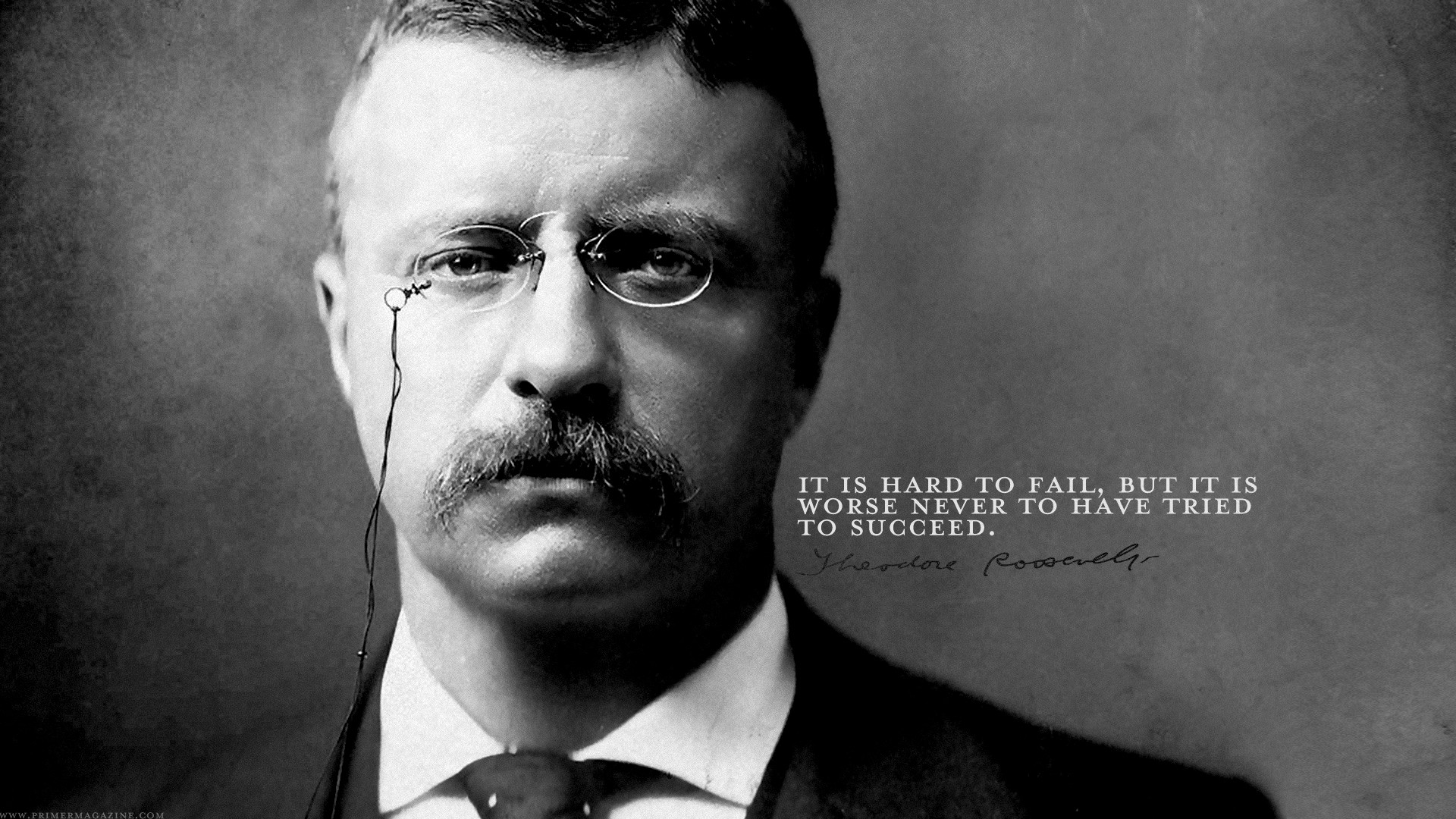
Teddy was no saint, but I like his attitude.

professional boxing, in which he pulled the Man in the Arena passage that I love so well out of his well-worn pouch of salesmanship. (Heck, maybe he loves it like I do, but after all his flim-flams and showmanship and indictments, it’s hard to tell.) This isn’t about Don King, though he did get me thinking back to a November 2010 piece I wrote about wanting to be on the front lines of life, wanting to have that “face marred with dust and sweat and blood”, as Roosevelt put it in a 1910 speech, to be an embattled veteran of causes worthy and noble. At moments, sports have given me that taste. So have wild-eyed efforts as an educator. So has Shakespeare, and a growing mid-life consciousness of ecology.

Being in China helps, too, and not only when I’m bombarded by cultural noise that I still can’t get my head around, not to mention fireworks or the adrenaline rush of getting across a busy street. The Baha’i teachings I battle to live by find many responsive ears here, and its community-building processes are of blatantly obvious value. The response to both is routinely gratifying, yet given the frantic movement and

Can a threatened planet become a cliche? (This is OURS, btw.)

incredible size of this population, it’s all pretty darned humbling, too. I am surely not patient enough; for four years, China has done its best to teach me, but I am a slow learner. There’s a lot of that going around, as you may have noticed, particularly if you’re a climate watcher.

Recently, we’ve been thinking of the front lines of the climate wars. EnviroBride has taught me much about the crisis we’ve created in the global ecology, and the search for sustainable ways to live with and within it. We have avoided, it seems, a third World War, though Native American prophecies of the three “great shakings” that the world must undergo before the age of peace are an eerie warning.

Continue Reading >>

Eric Hoffer (on fearsome & fearful enemies)

“You can discover what your enemy fears most by observing the means he uses to frighten you.”

I don’t know an awful lot about Eric Hoffer, or about where and when I came across this quote. Perhaps it was the one memorable line in another’s book, one that I’ve forgotten, but this citation has stayed in my mind. And now that, shamed by the ignorance I’ve confessed here, I know a little more about this mainly self-taught American intellectual (and migrant worker) and philosopher (who worked for decades as a longshoreman), I’m hungry to know more. His most famous book, published in 1951, was called The True Believer.

In my immediate surroundings, I can’t help but think of another quote, from my buddy Joe Pearce, that “China is a fear-based society”. Observing the alternating fear and boredom that oppress my Chinese students and friends, I try to determine what is their “enemy” — “fear itself”, the Roosevelts might have argued — and what that enemy, be it philosophical, historical, or institutional, most fears.

I fear that this is about to turn into an excuse not to write what I was going to write, so here I end.

Not One Shining Moment

It’s a quarter to three on a sunny Tuesday afternoon on the third floor of my university’s School of International Business. (Note to longtime readers: yes, I teach in a business school. Rich kids, mostly. But I’m just here for the language. (English is my personal favourite.) I teach them literacy and love and great songs and joyful reading, yes, and comma faults and five-paragraph essays and there/their/they’re. Some learn.) That means that Monday night’s NCAA final between the Louisville Cardinals and the Michigan Wolverines ended about three hours ago, as we’re a half-day ahead of Eastern Standard Time where I live.

I like this ’13 team better than Chris Webber’s “Fab 5” team, but he was a superb player.

I know that former UM great Chris Webber came to the game, which was a burning question on American sports wires for a day or so. I know that Louisville’s coach, Rick Pitino, had a horse he owns win something big in the equestrian universe. I know that Cardinals star Russ Smith’s high-school coach died recently, and that emerging Wolverine freshman Mitch McGary has a learning disability and, for a while, weight problems that kept him bench-bound.

What I don’t know is who won.

Continue Reading >>

Forward to the Final Four

When last your confused hoops correspondent waxed prophetic in It’s All About Sports! after the first weekend of American collegiate March Madness, when his bracket was significantly hobbled, he predicted an NCAA Elite 8 as follows.

Some of them really are students, I swear. But this image is disgracefully disingenuous, not that this post really wades into that swamp of “Student Athlete” dismay.

Louisville was to play Duke. Bingo! (Okay, a number one seed against a 2; it hardly ranked with Nostradamus, but I’ll take my successes where I find them.) I picked Duke to win through to tomorrow’s Final Four, because I always do, because: A) they often do, and B) I’m a Blue Devils loyalist. Coach K is great, even if he does do too much commercial shilling, and I always argue that there is a large percentage of available high school recruits that Duke can’t even consider because they genuinely need to be students in Durham. (I hope this is still true.) Louisville was just too relentless, and too quick in the backcourt, for Duke.

Continue Reading >>

Bumper Sticker of the Week

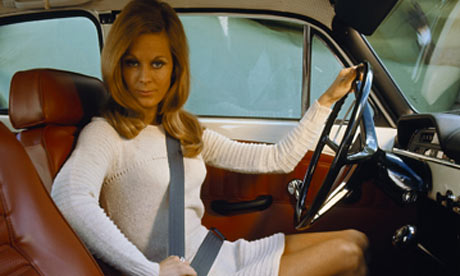
Not my mother. A generation and several hemline inches removed, but remember those steering wheels? Sex tries to sell seatbelts, but stats and hefty fines finally do the trick.

Even long after she had no more little ones in the car, far past the time when buckling up became law – and then suddenly the absolute minimum expectation of parental responsibility – my mother had a reflexive connection between her right foot and hand. When her foot lunged from accelerator to brake pedal, her right hand made a karate-worthy swipe to restrain front-seated kiddies who were no longer there. Through the 1950s and most of the 1960s, this was her automotive child-protection toolkit, that and her lip-chewing, white-knucklingly slow driving. I didn’t get the habit of seatbelt use until I was driving myself. Can you imagine?

You’d have no trouble imagining if you were in China. Here, safety consciousness in cars is about at the mid-1960s level (so, by the way, are popular music, workplace equity, and pollution control). It’s becoming part of the conversation, I think, but most people don’t buckle up, and it is routine to see grandparents and well-coiffed young mummies holding babies on their laps in the front seat. There must be trendy, upper-middle-class parents who have infant and child car-seats, but I haven’t noticed one yet.

Continue Reading >>

Time Goes Fast, Learning Goes Slow *

Love this album.

* This is a line from from Bruce Cockburn‘s song “When You Give It Away”,  from his 1999 album Breakfast in New Orleans, Dinner in Timbuktu. Bruce is mighty, but this post isn’t about him. It’s all about me, folks. (Well, and maybe them, and her, and all of us, and maybe even you.)

I should know by now.

(I do know, as through an angry glass, darkly.)

I should know by now that vehicles on Dalian streets do not yield for pedestrians, but may accelerate around corners or slalom from one lane of traffic to another to get past them. I should know better than to get revved up, but I still do. It happened again yesterday, though I didn’t shout and flail. (Progress!?)

I should know by now that my freshman class’s leader wouldn’t really understand my directions, though he said, “Got it!” I should have known that he would go upstairs to ask the school administrators for an empty classroom, rather than just doing the quick walkabout I’d recommended to find a spot for a writing class that we’d had to re-schedule. (I knew they wouldn’t help him, since he was a mere student, and they likely wouldn’t have had any better answer for me. Such requests are, no matter how banal, always “very difficult”.) By the time I arrived, just barely at the time we’d agreed on, some of the group had dispersed because there were “no rooms available”. Yes, well, except for the one on the first floor, the one on the second, and the one on the third. I didn’t go any higher.

I shouldn’t have been surprised to learn, later that day, that our Canada-bound sophomore students are required to pay a 6500-yuan “service/counselling fee” to get their visas. That’s about a thousand bucks. That’s about two months’ rent for our well-above-average apartment. My surge of head-shaking disgust was surely redundant. I shouldn’t have been surprised, either, that the kids seemed entirely resigned about it.

I should know better than to have let my temper rise at dinner last night, too. He was only 20-something, and yes, he had too much to say, and he talked right over the friend to his right and was sublimely uninterested in hearing from the two women at our table. Four bottles of beer in an hour didn’t help him much, come to think of it, and I do have a son-of-an-alcholic’s distaste for those who find loud courage in a bottle. It’s true, also, that most of our students and young Chinese friends assume that Canada is paradise and that our lives are far more fortunate than theirs – which, in most ways, is nothing but true.

But he got so aggressive in bemoaning how hard it was to find a wife, how little he had learned in seven years of university, his not knowing how to do his job, how difficult it was, how long it would take him to save for a house so long as he turned down his well-off daddy’s standing offer to buy him one or two (which would, according to Chinese custom, make his wife-hunt much easier, sad to say). By the time he launched into you don’t know, you’re from Canada, everything is easy for you, I should have known it was time to bid a polite good night, but this spoiled prince-ling had hit a whole bunch of a cheek-chewing Canadian’s buttons. He probably doesn’t think a lot differently than many young men I know here, but he was rude and insistent enough that he got both barrels. I don’t like to be so salty and direct, and I wish I’d been able to do it without so much heat, but enough was enough and maybe I was burnt by a long day of learning what I ought to already know. We had spoken earlier of the value of directness, and maybe he learned something, too. We parted civilly, all of us, with mutual congratulations for frank discussion and the importance of seeing for ourselves, but I was still muttering to myself as I got ready for bed. I slept long.

I knew this wouldn’t be easy. There is so much education to be had! (Trouble with nations, trouble with relations / Where you gonna go for some illumination? / Too much to carry, too much to let go / Time goes fast, learning goes slow…*) As we approach the end of four years living and teaching in China, I know who the real student is. (Imagine: I complained a little in our first year that our living conditions in China were too comfy, that we weren’t really experiencing sufficient hardship to genuinely grow, to contribute usefully to this society. I hope I’m growing. I hope I’m giving something that China can use. But I should’ve known better than to tempt the fates as brazenly as that!) I wasn’t used to thinking of myself as a slow learner1, but I should’ve known that a stubborn idealist and a fiery perfectionist (those would be me) would take some bumps.


1 And, if more evidence were needed, I’m headed for another adventure in old-boy basketball Sunday night, playing students again in the same gym from which I took an unscheduled hospital trip in January. Some guys never learn, and sometimes that ain’t so bad.

Madness, Seen and Read

I didn’t watch a single regular-season NCAA basketball game this year. Some college hoops purists would snort that this puts me in the same category as (Sir) Charles Barkley, the NBA opinionator who parachutes down to see what higher (basketball) education has to offer to the pros, when national tournament frenzy grips the upper Americas. It puts me in the same boat as lots of people, actually, who join me in filling out a bracket — after ignoring the game all year — for all the unpredictable agony and ecstasy that reduce 64 hopeful squads to four, in two four-day weekends.

Sometimes, I can get some good video from here in Dalian. Often, though, madness takes its toll…

Unlike most late-March bandwagon-jumpers, though, I care about the college game, though I can’t watch any of it here in China. (I suppose I could try to stream games on my computer, but that’s not a hassle I volunteer for easily. It reminds me of my youth, when college games were hard to find on Canadian TVs, when even The Tournament was only partly available in the early rounds. That was before March Madness became a Brand.) I did see the UNLV Runnin’ Rebels live, minus their likely one-and-done Canadian star, Anthony Bennett, when they edged the Carleton Ravens in Ottawa last summer on a northern exhibition tour.

Continue Reading >>

Slowed by Fasting

For a while there, I just gave up on eating and drinking. I’m telling you, I was done with it.

Fasting.

What a weird and counter-cultural thing to do in a world of Whoppers and I’m Lovin’ It and Have it Your Way, to say nothing of obesity epidemics and 140-character limits on attention. (Yeah, I guess I might as well say it. Harrumph.)

Fasting. Muslims do it. Christians used to, though even by my faithful mother’s heyday, she would merely give up one of her oral pleasures – usually chocolate, never cigarettes – for the Lenten leadup to Easter. (Jesus fasted and prayed for 40 famous days in the

Not the view from downtown Dalian, but sunrise is lovely anywhere.

wilderness, getting ready to bear a mighty Ministry; however, this exemplary practice seems to have been largely abandoned  by followers of the Son.) Baha’u’llah also prescribed it for a 19-day period leading up to the first day of spring (the Baha’i new year), from sunup to sundown.

Continue Reading >>

Fighting Off the “Irish”

I’m on a heckuva roll: it was another St. Patrick’s Day without green beer for this might’ve been an Irishman. Most Howdens appear to come from the north of England – not far from York, there is a village called Howden, which has a miniature, half-ruined, poor Gothic cousin to the magnificent York Minster Cathedral. My Howden forebear, though, came to Canada from County Fermanagh in Northern Ireland.

Fermanagh: my home and (pre) native land?

My preferred fantasy is that this Howden man was a poor, dashing poet like the central character in Thomas Flanagan’s novel The Year of the French, an adventurous soul who set out for Canada spurred not only by famine but by his lusty curiosity and spirit of adventure. In my dim family memory bank, he was also a James, and I’m reluctant to puncture this thought with actual research. I rather suspect, too, that he was a comfortable man who saw a chance for cheap land in Upper Canada, now the narrow wedge of Americanized soil called Southern Ontario. Still, for reasons mainly mysterious, I have a special affection for things Irish, though I’ve never been there. Two of my sons have it, too, even more strongly than me: one of them is a real scholar of Irish history, and couch-surfed there for several months.

Continue Reading >>