Rss

T-Mac and Tang

Ill-fated ‘80s music duo? Fast-food lunch combo? Bachelor grocery list?

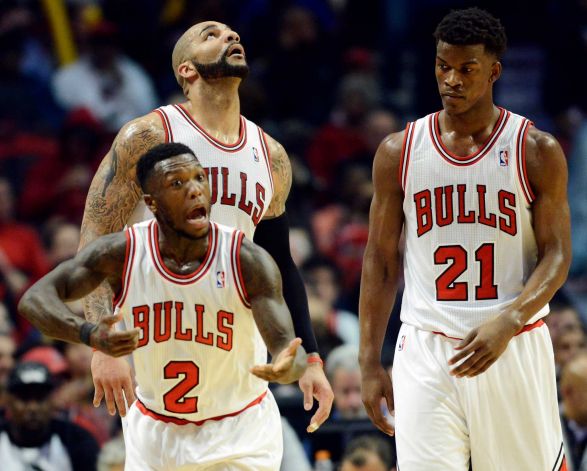
The answer is D) None of the above. Here are some notes about two bits of news that might be meaningful to you if you have both a mildly unhealthy appetite for basketball and a streak of Chi-curiosity. They are about two ballplayers whose careers will likely never come in direct contact, yet which are bizarre mirror images of each other.

T-Mac, of course, is Tracy McGrady, the former NBA scoring wizard who spent last season in what was, to some, a startingly unimpressive late-career stroll through a season with the Qingdao Eagles of the Chinese Basketball Association. Tang is T-Mac’s basketball opposite, a teenaged hoops prodigy from Jiangsu province who went to the United States for high school so that he could be a student and an athlete. Tang Zihao is called Chris Tang in the States, Chris for the point guard’s sporting hero, Chris Paul, and Tang as in the powdered sugary-orange drink, not as it’s pronounced back home in southeastern China.

“Surprisingly athletic” will be the phrase.

I’d read about young Mr. Tang in an excellent December feature by Jay Caspian Kang of Grantland. The 6’3” guard was mid-way through his junior year of high school at Oak Hill Academy in Virginia, after having dominated at another school in his first two high school seasons.

Continue Reading >>

About Boston.

I woke to a small explosion this morning, a mother-son dispute about laptop use. We worry about how compelling is our young teen’s attachment to headphones, computers and his PDA. Our little sense of post-dawn peace was – well, I can’t say shattered, just can’t, because my own little electronic window just told me about Boston.

Victory and crisis, crisis and victory.

When you love sport as I do, there is something especially horrible when evil visits the home court of dreams and persistence and the desire to surpass oneself, one of the places we go to believe in human goodness and greatness. This year’s Boston Marathon, 26.2 miles of tradition, where Tom Longboat brought honour to his Grand River people and thousands have found deeply personal victory, was dedicated to the 26 who died at the Sandy Hook elementary school. Now there is disbelief and pain where there should be only exhaustion, exhilaration and the giving of one’s all.

Continue Reading >>

Katherine Switzer (on running and hope)

“If you are losing faith in human nature, go out and watch a marathon.”

Katherine Switzer (1947-), the first woman to run in the Boston Marathon. Today, a bitter cast to this gorgeous quote, as the 2013 marathon saw several die, many more injured, who had done exactly what the indomitable Ms. Switzer had recommended.

FYI

Hello, kind visitor. This is just a quick note about categories. This main section of JH.com is called “At First Glance”, and there is all kinds of stuff here. Over yonder to the right (or on the button above) is access to sports-related writing, and today I want to point out that the piece “On Boston.”, like many of the things in “It’s All About Sports!“, is not really about box scores, winners and losers. Today it’s about tragedy marring aspiration, disfiguring some of the best in life.

Also, today’s quote in the “He Said/She Said” collection is by a brave and pioneering young woman, Katherine Switzer, whose love of running yielded the painful-but-still-true comment that I can’t get out of my mind. Thanks for visiting.

(calling out golf players)

BLURT 24: Those who play football are called “football players”. Hardwood bouncers of orange spheres are called basketball players. Heck, if you bet on horse racing, you’re a horse player. Yet when I asked my bride if she remembered who Tiger Woods is, and she indignantly answered, “Of course, he’s a golf player!” she was right and she was, in sporting syntax, so very wrong. And why is that? Is golf the only game like this, and should this make me dislike golf even more?

And what’s a blurt?

H.M. Tory, U of A (on the mission of higher education)

The PEOPLE, the PEOPLE, the PEOPLE, the WHOLE PEOPLE!

“The modern state university has sprung from a demand on the part of the people themselves for intellectual recognition, a recognition which only a century ago was denied them. The result is that such institutions must be conducted in such a way as to relate them as closely as possible to the life of the people. The people demand that knowledge shall not alone be the concern of scholars. The uplifting of the whole people shall be its final goal.”

Dr. Henry Marshall Tory was the founding President of the University of Alberta, and this was part of his address at the infant school’s first Convocation on October 6, 1908. Alberta had been a province for three years at this point. I’ve had a soft spot for the U of A for decades, as my big sister Leanna graduated from there and taught there for many years. It was only last summer, though, thanks to a T-shirt gift from our professor friend Kyle, that we knew of this quote from Dr. Tory. 

This quote helped me conclude a recent piece on environmentalism and the front lines of sustainable community living. How many modern universities (including the U of A) act as if they subscribe to this grassroots view of higher education?

Reaping the Whirlwind and Looking for Hope

I quoted Theodore Roosevelt  back in the dim reaches of my “He Said/She Said” collection, but anybody can do that. Recently on Grantland, I read a piece on Don King, the once-dominant promoter in

Teddy was no saint, but I like his attitude.

professional boxing, in which he pulled the Man in the Arena passage that I love so well out of his well-worn pouch of salesmanship. (Heck, maybe he loves it like I do, but after all his flim-flams and showmanship and indictments, it’s hard to tell.) This isn’t about Don King, though he did get me thinking back to a November 2010 piece I wrote about wanting to be on the front lines of life, wanting to have that “face marred with dust and sweat and blood”, as Roosevelt put it in a 1910 speech, to be an embattled veteran of causes worthy and noble. At moments, sports have given me that taste. So have wild-eyed efforts as an educator. So has Shakespeare, and a growing mid-life consciousness of ecology.

Being in China helps, too, and not only when I’m bombarded by cultural noise that I still can’t get my head around, not to mention fireworks or the adrenaline rush of getting across a busy street. The Baha’i teachings I battle to live by find many responsive ears here, and its community-building processes are of blatantly obvious value. The response to both is routinely gratifying, yet given the frantic movement and

Can a threatened planet become a cliche? (This is OURS, btw.)

incredible size of this population, it’s all pretty darned humbling, too. I am surely not patient enough; for four years, China has done its best to teach me, but I am a slow learner. There’s a lot of that going around, as you may have noticed, particularly if you’re a climate watcher.

Recently, we’ve been thinking of the front lines of the climate wars. EnviroBride has taught me much about the crisis we’ve created in the global ecology, and the search for sustainable ways to live with and within it. We have avoided, it seems, a third World War, though Native American prophecies of the three “great shakings” that the world must undergo before the age of peace are an eerie warning.

Continue Reading >>

Eric Hoffer (on fearsome & fearful enemies)

“You can discover what your enemy fears most by observing the means he uses to frighten you.”

I don’t know an awful lot about Eric Hoffer, or about where and when I came across this quote. Perhaps it was the one memorable line in another’s book, one that I’ve forgotten, but this citation has stayed in my mind. And now that, shamed by the ignorance I’ve confessed here, I know a little more about this mainly self-taught American intellectual (and migrant worker) and philosopher (who worked for decades as a longshoreman), I’m hungry to know more. His most famous book, published in 1951, was called The True Believer.

In my immediate surroundings, I can’t help but think of another quote, from my buddy Joe Pearce, that “China is a fear-based society”. Observing the alternating fear and boredom that oppress my Chinese students and friends, I try to determine what is their “enemy” — “fear itself”, the Roosevelts might have argued — and what that enemy, be it philosophical, historical, or institutional, most fears.

I fear that this is about to turn into an excuse not to write what I was going to write, so here I end.

Not One Shining Moment

It’s a quarter to three on a sunny Tuesday afternoon on the third floor of my university’s School of International Business. (Note to longtime readers: yes, I teach in a business school. Rich kids, mostly. But I’m just here for the language. (English is my personal favourite.) I teach them literacy and love and great songs and joyful reading, yes, and comma faults and five-paragraph essays and there/their/they’re. Some learn.) That means that Monday night’s NCAA final between the Louisville Cardinals and the Michigan Wolverines ended about three hours ago, as we’re a half-day ahead of Eastern Standard Time where I live.

I like this ’13 team better than Chris Webber’s “Fab 5” team, but he was a superb player.

I know that former UM great Chris Webber came to the game, which was a burning question on American sports wires for a day or so. I know that Louisville’s coach, Rick Pitino, had a horse he owns win something big in the equestrian universe. I know that Cardinals star Russ Smith’s high-school coach died recently, and that emerging Wolverine freshman Mitch McGary has a learning disability and, for a while, weight problems that kept him bench-bound.

What I don’t know is who won.

Continue Reading >>

Forward to the Final Four

When last your confused hoops correspondent waxed prophetic in It’s All About Sports! after the first weekend of American collegiate March Madness, when his bracket was significantly hobbled, he predicted an NCAA Elite 8 as follows.

Some of them really are students, I swear. But this image is disgracefully disingenuous, not that this post really wades into that swamp of “Student Athlete” dismay.

Louisville was to play Duke. Bingo! (Okay, a number one seed against a 2; it hardly ranked with Nostradamus, but I’ll take my successes where I find them.) I picked Duke to win through to tomorrow’s Final Four, because I always do, because: A) they often do, and B) I’m a Blue Devils loyalist. Coach K is great, even if he does do too much commercial shilling, and I always argue that there is a large percentage of available high school recruits that Duke can’t even consider because they genuinely need to be students in Durham. (I hope this is still true.) Louisville was just too relentless, and too quick in the backcourt, for Duke.

Continue Reading >>