Rss

Kurt Vonnegut (on what to pitch, and some things to keep)

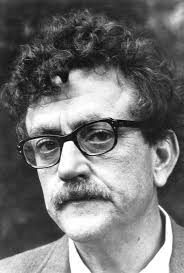
I’m still listening, Kurt. Still moved. (Photo from Wikipedia.)

When I write about something I’ve learned from the Baha’i system of knowledge and practice – or rather, in trying to understand it better – it sometimes appears at the Baha’i Teachings website. I also go there for small doses of perspective, wisdom and hope, and find them. David Langness is one of my favourite writers at BT, not least because on what Canucks call Remembrance Day, he posted a piece called “Veterans’ Day: Let’s Call It Armistice Day Again”. Although short, it was weighty, since Langness is himself a veteran of what the Vietnamese people don’t call the Vietnam War. Yes, and he also led off with a passage from Kurt Vonnegut’s 1973 Breakfast of Champions. Vonnegut is a hero to me.

I just re-read KV’s preface to that famous American novel. My vision blurred and I commenced breathing like a beat-up old machine. (This often happens when I read Vonnegut. He murders me, when I’m apparently supposed to laughing like a loon at his satire. ) He calls Breakfast a 50th-birthday present to himself, a mid-life attempt “to clear my head of all the junk in there….I think I am trying to make my head as empty as it was when I was born onto this damaged planet….I suspect that this is something most white Americans, and non-white Americans who imitate white Americans, should do…” (Sheesh. 1973!)

David Langness, in his argument for re-naming Veterans’ Day, goes on to cite his reasons: the growth of jingoism, hero-worship and militarism associated with November 11 in his country. “Perversely, we’ve turned the day into a recruiting tool for further war instead of a celebration of peace.” It’s well worth a read. But thanks to Mr. Langness, I’m pleasantly obsessing today over the incredible Kurt Vonnegut (how I miss him!) and these closing words of his preface to Breakfast of Champions. He explains why Armistice Day – from the Latin for “a cessation of arms” – is a holy concept that he will hang on to:
 

“So this book is a sidewalk strewn with junk, trash which I throw over my shoulders as I travel in time back to November eleventh, nineteen hundred and twenty-two.

“I will come to a time in my backwards trip when November eleventh, accidentally my birthday, was a sacred day called Armistice Day. When I was a boy … all the people of all the nations which had fought in the First World War were silent during the eleventh minute of the eleventh hour of Armistice Day, which was the eleventh day of the eleventh month. It was during that minute in nineteen hundred and eighteen, that millions upon millions of human beings stopped butchering one another. I have talked to old men who were on battlefields during that minute. They have told me in one way or another that the sudden silence was the Voice of God. So we still have among us some men who can remember when God spoke clearly to mankind.

“Armistice Day has become Veterans’ Day. Armistice Day was sacred. Veterans’ Day is not.

“So I will throw Veterans’ Day over my shoulder. Armistice Day I will keep. I don’t want to throw away any sacred things.

“What else is sacred? Oh, Romeo and Juliet, for instance.

“And all music is.”

20-20 Remembrance

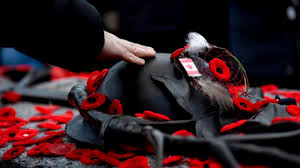
Touching the past. Poppies are sacred here. (Image from TV Ontario.)

[November 11 is Remembrance Day in Canada, and it’s not so far behind me that I’ve forgotten it already. Hurray for me!  This being Covid Year and all, it was a slightly oddball experience but I cherished it all the same. Here’s a quick look-back.]     [4-minute read]
[Oh, and over THERE in the “He Said/She Said” section is a short piece setting up a related quotation from the mighty Kurt Vonnegut, on why Armistice Day is just a better name for what his countrymen call “Veterans’ Day”. It’s a companion to this piece.]


She dragged me outside again on the 11th. (Let’s be dramatic – Bruce Cockburn sang it this way: You tore me out of myself, alive!) It was, to be precise, about ten minutes to the eleventh hour of the eleventh day of the eleventh month of this old year.¹ In Canada we call it Remembrance Day. Once upon a time, it was Armistice Day, honouring the moment when the guns of the Great War (when ‘great’ meant ‘ginormously large’ rather than ‘famously supercool’) stopped blasting in November of 1918. I was going to stay home, listen to CBC Radio’s Remembrance broadcast, but instead I went Outside. And, of course, my lovely Accompanist was right again.

                         ¹  Yes, ‘Oct-‘ refers to ‘8’ and ‘Dec-‘ to ‘10’ and November was the ninth month of the ancient Roman calendar. And in 2020, it is the ninth month (at least in my part  of the world) of what seems several years of Covid-19.

It doesn’t take me long to remember, Ah, right, moving. That’s a good thing. I like this body-working hypothesis. We walked, my bride and I, who tends to think that sacred acts are better done with other humans. It was only a few blocks to a little patch of green, a corner lot that developers didn’t get; it’s been preserved not only for kids to swing and play, or for elders and others to perch on a maple-leafy bench and watch the world go by for awhile (or to monitor their likes). No, the Riverside Memorial Park, though tiny, is a local monument to the neighbourhood fallen and to all the veterans from our corner of the capital.

We were around 20 souls, two city councillors and a greying crew of neighbourhoodies. It turned out that for the ceremony, we listened, around a memorial stone be-wreathed and poppified, to a Bluetooth speaker that transmitted the CBC Radio broadcast. Public radio, indeed! It felt odd and tinny at first but then suddenly was Actually Just Fine, Thank You! And I remembered these things, all in a serried line:

  • How grateful I am for a solo bugle and the Last Post. I loved hearing it live, some years, during my high school’s 11 am Remembrance Day program. It was often some old fella in an ill-fitting uniform that probably brought bemusement to some students, eye-rolls for a few, until he started blowing that horn. Chokes me up without fail, even via Bluetooth at the corner of Queen Mary and North River as the bus goes by.
  • That repeated short last line of a poetic verse that most of us – the older ones, anyway – have more or less to heart in Canada; it’s so powerful. There’s not much militarism here on November 11, but rather a widespread attitude of “never again!” and “consider what we’ve lost” and “let’s pray for peace”. I fiercely muttered, along with my handful of fellow Rememberers, the fervent echo, “We will remember them.” They shall grow not old, as we that are left grow old: / Age shall not weary them, nor the years condemn. / At the going down of the sun and in the morning / We will remember them.

(Every Remembrance Day ceremony in “America’s attic” now includes this fourth verse of seven in Laurence Binyon’s “For the Fallen”, written in 1914. It’s called “the act of Remembrance”, and is a reminder that there are also some fine things about the post-colonial British heritage in this here Canada. We will remember them. Nous nous souviendrons d’eux.” And I remembered other things, too, as the prayers and tributes went on:)

Continue Reading >>